Business A level paper 2 2017: -maizie hall
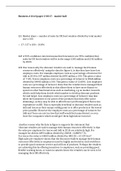
1.1 Market share = number of sales by UK food retailers divided by total market
size x 100
= 17/ 157 x 100 = 10.8%
1.2 A 95% confidence interval means that forecasters are 95% confident that
sales for UK food retailers will be in the range £185 million and £142 million
by 2020.
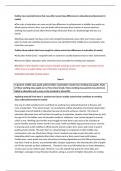
1.3 One reason why the discount retailers are said to ‘manage their human
resources effectively’ using the data fro figure 6, is that they have have low
employee costs. For example employee costs as a percentage of turnover for
Aldi in 2014 is 507 million divided by 6893 million x 100. This gives a value
of 7.4%. Tescos employee costs as a percentage of turnover is 6968 million
divided by 54443 million x 100. This gives a value of 12.80%. Low employee
costs as a percentage of turnover show that the retailers have managed their
human resources effectively as this allows them to have more finance to
spend on other functional areas such as marketing, e.g on market research
which could help them decide which market to develop discount products
for and target. Low employee costs as a percentage of turnover may also
allow the businesses to cut prices of the products that they offer (price
skimming), as they may be able to afford lower profit margins if theres less
expenditure on HR. This is especially beneficial to discount retailers such as
aldi and tescos as their unique selling point is to offer products at the lowest
price possible. However the employee costs as a percentage of turnover for
Aldi and Tesco are not too low that staff would feel unmotivated, or even
leave the companies which would give them high labour turnover.
Another reason why the data in figure 6 supports the statement that
‘discount retailers are said to manage their human resources effectively’ is that
the sales per employee for tescos and Aldi in 2014 are relatively high. For
example for Aldi its 6893 million divided by 23858 = £288917.76.
For tescos the value is 54443 million divided by 482152 = £112916.67.
High sales per employee shows that the discount retailers manage their human
resources effectively as employees must be highly motivated in each workforce
to provide good customer service and sell lots of products. Perhaps the retailers
are achieving this by offering incentives to employees, such as providing good,
flexible working hours, or raises in salaries hence the retailers can be seen to be
managing their HR effectively.
1.1 Market share = number of sales by UK food retailers divided by total market
size x 100
= 17/ 157 x 100 = 10.8%
1.2 A 95% confidence interval means that forecasters are 95% confident that
sales for UK food retailers will be in the range £185 million and £142 million
by 2020.
1.3 One reason why the discount retailers are said to ‘manage their human
resources effectively’ using the data fro figure 6, is that they have have low
employee costs. For example employee costs as a percentage of turnover for
Aldi in 2014 is 507 million divided by 6893 million x 100. This gives a value
of 7.4%. Tescos employee costs as a percentage of turnover is 6968 million
divided by 54443 million x 100. This gives a value of 12.80%. Low employee
costs as a percentage of turnover show that the retailers have managed their
human resources effectively as this allows them to have more finance to
spend on other functional areas such as marketing, e.g on market research
which could help them decide which market to develop discount products
for and target. Low employee costs as a percentage of turnover may also
allow the businesses to cut prices of the products that they offer (price
skimming), as they may be able to afford lower profit margins if theres less
expenditure on HR. This is especially beneficial to discount retailers such as
aldi and tescos as their unique selling point is to offer products at the lowest
price possible. However the employee costs as a percentage of turnover for
Aldi and Tesco are not too low that staff would feel unmotivated, or even
leave the companies which would give them high labour turnover.
Another reason why the data in figure 6 supports the statement that
‘discount retailers are said to manage their human resources effectively’ is that
the sales per employee for tescos and Aldi in 2014 are relatively high. For
example for Aldi its 6893 million divided by 23858 = £288917.76.
For tescos the value is 54443 million divided by 482152 = £112916.67.
High sales per employee shows that the discount retailers manage their human
resources effectively as employees must be highly motivated in each workforce
to provide good customer service and sell lots of products. Perhaps the retailers
are achieving this by offering incentives to employees, such as providing good,
flexible working hours, or raises in salaries hence the retailers can be seen to be
managing their HR effectively.