

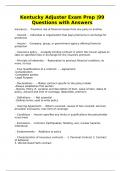
Kentucky Adjuster Exam Prep |99
Questions with Answers
Insurance - -Transfers risk of financial losses from one party to another
- Insured - -Individual or organization that pays premiums in exchange for
protection
- Insurer - -Company, group, or government agency offering financial
protection
- Insurance policy - -A legally binding contract in which the insurer agrees to
take on specified risks in exchange for the insured's premium.
- Principle of indemnity - -Restoration to previous financial condition; no
more, no less
- Four Qualifications of a contract: - --Agreement
-Consideration
-Competent parties
-Legal Purpose
- Declarations - -- Makes contract specific to the policy holder
-Always establishes first section
- Names, Policy #, Location and description of item, value of item, dates of
policy, amount and limit of coverage, deductible, premium
- Definitions - -- Not essential
- Defines terms used to write policy
- Insuring Agreement - -What is covered, causes of loss covered, services
provided, exclusions, max limit of coverage
- Conditions - -Insurer specifies any limits or qualifications the policyholder
must meet
- Exclusions - -common: Earthquakes, flooding, war, nuclear hazards,
intentional
- Endorsements - -Additions to policy
- Characteristics of Insurance contracts - -1. Personal Contract 2. Contract
of Adhesion
3. Utmost Good Faith contract
, 4. Aleatory Contract
5 Unilateral Contract 6. Conditional Contract
- Meanings of Risk - -- Potential for loss
-The insured item
- Categories of Risk - -- Speculative= any risk in which gain is possible. Not
insurable
- Pure Risk= any risk which no gain is possible
- Risk Management Techniques - -Risk Avoidance- Eliminates Risks
Risk Reduction- Reduces or mitigates risk
Risk Transference- Paying someone to take on risk
Risk Retention- Assumes or accepts risk
- Binder - -Temp. coverage until policy is issued
- Estoppel - -Principle holding that if insurer accepts a practice for a time, it
cannot later refuse coverage because of that practice.
- Occurence - -Event or circumstance that causes a loss
- Proximate cause - -original occurrence in an unbroken chain of events that
results in a loss
- Subrogation - -Transfer of rights that allows the insurer to recover its
losses after it has indemnified the policyholder
- Vicarious Liability - -When negligence is transferred from one party to
another
- Express Authority - -Given in writing within the agent's contract
- Implied Authority - -Reasonable for public to believe, not expressly
granted in writing
- Apparent Authority - -Granted when the insurer does not stop the agent
from acting in a certain way, even when those actions do not adhere to the
authority granted in the contract
- Adjuster Responsibilities - -1. Fiduciary Agent
2. Power to Bind
3. Report to the Principal
- Apportionment - -Defines how policy will respond when more than one
policy covers the same risk
Questions with Answers
Insurance - -Transfers risk of financial losses from one party to another
- Insured - -Individual or organization that pays premiums in exchange for
protection
- Insurer - -Company, group, or government agency offering financial
protection
- Insurance policy - -A legally binding contract in which the insurer agrees to
take on specified risks in exchange for the insured's premium.
- Principle of indemnity - -Restoration to previous financial condition; no
more, no less
- Four Qualifications of a contract: - --Agreement
-Consideration
-Competent parties
-Legal Purpose
- Declarations - -- Makes contract specific to the policy holder
-Always establishes first section
- Names, Policy #, Location and description of item, value of item, dates of
policy, amount and limit of coverage, deductible, premium
- Definitions - -- Not essential
- Defines terms used to write policy
- Insuring Agreement - -What is covered, causes of loss covered, services
provided, exclusions, max limit of coverage
- Conditions - -Insurer specifies any limits or qualifications the policyholder
must meet
- Exclusions - -common: Earthquakes, flooding, war, nuclear hazards,
intentional
- Endorsements - -Additions to policy
- Characteristics of Insurance contracts - -1. Personal Contract 2. Contract
of Adhesion
3. Utmost Good Faith contract
, 4. Aleatory Contract
5 Unilateral Contract 6. Conditional Contract
- Meanings of Risk - -- Potential for loss
-The insured item
- Categories of Risk - -- Speculative= any risk in which gain is possible. Not
insurable
- Pure Risk= any risk which no gain is possible
- Risk Management Techniques - -Risk Avoidance- Eliminates Risks
Risk Reduction- Reduces or mitigates risk
Risk Transference- Paying someone to take on risk
Risk Retention- Assumes or accepts risk
- Binder - -Temp. coverage until policy is issued
- Estoppel - -Principle holding that if insurer accepts a practice for a time, it
cannot later refuse coverage because of that practice.
- Occurence - -Event or circumstance that causes a loss
- Proximate cause - -original occurrence in an unbroken chain of events that
results in a loss
- Subrogation - -Transfer of rights that allows the insurer to recover its
losses after it has indemnified the policyholder
- Vicarious Liability - -When negligence is transferred from one party to
another
- Express Authority - -Given in writing within the agent's contract
- Implied Authority - -Reasonable for public to believe, not expressly
granted in writing
- Apparent Authority - -Granted when the insurer does not stop the agent
from acting in a certain way, even when those actions do not adhere to the
authority granted in the contract
- Adjuster Responsibilities - -1. Fiduciary Agent
2. Power to Bind
3. Report to the Principal
- Apportionment - -Defines how policy will respond when more than one
policy covers the same risk


