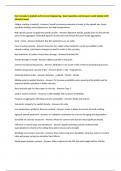
Key Concepts in Asphalt and Concrete Engineering - Exam Questions and Answers Latest Update 2025
Already Passed
Fatigue cracking in asphalt - Answers Caused by excessive amounts of water in the asphalt mix, heavy
repetitive loading, low temperatures, and high temperatures.
Bulk specific gravity vs Apparent specific gravity - Answers Apparent specific gravity does not include the
pores in the aggregate, while Bulk Specific Gravity does not include the pores in the aggregates.
Gmb = Gmm - Answers Indicates that the material has no air voids.
Cons of using concrete - Answers Concrete has a high carbon footprint, can be susceptible to ASR-
related cracking, and volume changes can lead to cracks in the concrete.
Best admixture to reduce freeze thaw damage - Answers Entrained Air.
Tensile Strength in wood - Answers Highest parallel to the grain.
Cement manufacturing process - Answers Hydration is not a part of the cement manufacturing process.
Asphalt components viscosity order - Answers Resins < Oils < Asphaltenes.
Materials defects order - Answers Polymers < Asphalt < Wood < Metals.
Adding water to asphalt mixture - Answers To increase workability when pouring at the jobsite and for
improved binder activation in hotter climates.
Best concrete type for skyscraper in cold city - Answers Type 3.
Sand in mortar mixtures - Answers It adds stability and increases workability.
Property of aggregates affecting concrete workability - Answers Shape and texture.
Volumetric property for asphalt density - Answers Air voids.
Low temperature grade for thermal cracking - Answers Lower is better to prevent thermal cracking.
Aging of asphalt pavement - Answers UV radiation contributes the most to the aging and degradation.
Durability of concrete structures - Answers Water-to-cement ratio has the most significant impact.
Influence of cement type and admixtures - Answers Rapid hardening cement combined with
superplasticizers shortens the setting time and increases early strength.
Shrinkage and creep in concrete - Answers They reduce long-term durability; using low water-to-cement
ratio and proper curing can minimize their effects.
Wood beam moisture content - Answers When reduced to the FSP, the total weight will be 4.00 lbs.
, Wood strength in tension and compression - Answers Stronger in tension parallel to the grain and
stronger in compression parallel to the grain.
Improving durability of wood composites - Answers Using chemical preservatives.
Construction tasks on humid day - Answers Assemble wooden framing for new houses and pour
concrete foundations.
Response to chewing test for asphalt - Answers Do not purchase the asphalt because your specifications
were not properly tested.
Minimum value of G*/sinδ for asphalt binders - Answers Required to ensure sufficient stiffness to resist
rutting.
Dimensional changes in wooden beam - Answers The tangential shrinkage will dominate, resulting in a
width reduction of about 3.3%.
Preventing plastic shrinkage cracking - Answers Apply curing methods such as covering with wet burlap
to maintain surface moisture during the critical setting stage.
Modeling creep and recovery behavior of asphalt - Answers Burger Model, combining viscous and elastic
components for accurate creep and recovery.
Kelvin Model - Answers Models only time-dependent deformation in materials.
Burger Model - Answers Combines viscous and elastic components for creep recovery.
Hirsch Model - Answers Integrates viscous and elastic components for accurate modeling.
Solid Masonry Units - Answers Includes stone, concrete brick, clay tile, and clay brick.
Hydroplaning Causes - Answers Moisture damage, rutting, flushing, bleeding, polished aggregate.
Cement Hydration Degree - Answers Highest cement ratio at 0% hydration degree.
Concrete Properties - Answers Economical, high compressive strength, tensile strength, aesthetics.
Sieve Analysis - Answers Percentage passing sieve No. 200 is likely 73%.
Concrete Strength Test Failures - Answers Temperature, vibrations, location, water-cement ratio affect
results.
Desired Aggregate Properties - Answers Toughness, soundness, no deleterious materials, proper
gradation.
ITZ in Concrete - Answers Interfacial transition zone, weakest part of concrete.
ASR Requirements - Answers Sufficient alkali, moisture, and reactive silica needed.
Already Passed
Fatigue cracking in asphalt - Answers Caused by excessive amounts of water in the asphalt mix, heavy
repetitive loading, low temperatures, and high temperatures.
Bulk specific gravity vs Apparent specific gravity - Answers Apparent specific gravity does not include the
pores in the aggregate, while Bulk Specific Gravity does not include the pores in the aggregates.
Gmb = Gmm - Answers Indicates that the material has no air voids.
Cons of using concrete - Answers Concrete has a high carbon footprint, can be susceptible to ASR-
related cracking, and volume changes can lead to cracks in the concrete.
Best admixture to reduce freeze thaw damage - Answers Entrained Air.
Tensile Strength in wood - Answers Highest parallel to the grain.
Cement manufacturing process - Answers Hydration is not a part of the cement manufacturing process.
Asphalt components viscosity order - Answers Resins < Oils < Asphaltenes.
Materials defects order - Answers Polymers < Asphalt < Wood < Metals.
Adding water to asphalt mixture - Answers To increase workability when pouring at the jobsite and for
improved binder activation in hotter climates.
Best concrete type for skyscraper in cold city - Answers Type 3.
Sand in mortar mixtures - Answers It adds stability and increases workability.
Property of aggregates affecting concrete workability - Answers Shape and texture.
Volumetric property for asphalt density - Answers Air voids.
Low temperature grade for thermal cracking - Answers Lower is better to prevent thermal cracking.
Aging of asphalt pavement - Answers UV radiation contributes the most to the aging and degradation.
Durability of concrete structures - Answers Water-to-cement ratio has the most significant impact.
Influence of cement type and admixtures - Answers Rapid hardening cement combined with
superplasticizers shortens the setting time and increases early strength.
Shrinkage and creep in concrete - Answers They reduce long-term durability; using low water-to-cement
ratio and proper curing can minimize their effects.
Wood beam moisture content - Answers When reduced to the FSP, the total weight will be 4.00 lbs.
, Wood strength in tension and compression - Answers Stronger in tension parallel to the grain and
stronger in compression parallel to the grain.
Improving durability of wood composites - Answers Using chemical preservatives.
Construction tasks on humid day - Answers Assemble wooden framing for new houses and pour
concrete foundations.
Response to chewing test for asphalt - Answers Do not purchase the asphalt because your specifications
were not properly tested.
Minimum value of G*/sinδ for asphalt binders - Answers Required to ensure sufficient stiffness to resist
rutting.
Dimensional changes in wooden beam - Answers The tangential shrinkage will dominate, resulting in a
width reduction of about 3.3%.
Preventing plastic shrinkage cracking - Answers Apply curing methods such as covering with wet burlap
to maintain surface moisture during the critical setting stage.
Modeling creep and recovery behavior of asphalt - Answers Burger Model, combining viscous and elastic
components for accurate creep and recovery.
Kelvin Model - Answers Models only time-dependent deformation in materials.
Burger Model - Answers Combines viscous and elastic components for creep recovery.
Hirsch Model - Answers Integrates viscous and elastic components for accurate modeling.
Solid Masonry Units - Answers Includes stone, concrete brick, clay tile, and clay brick.
Hydroplaning Causes - Answers Moisture damage, rutting, flushing, bleeding, polished aggregate.
Cement Hydration Degree - Answers Highest cement ratio at 0% hydration degree.
Concrete Properties - Answers Economical, high compressive strength, tensile strength, aesthetics.
Sieve Analysis - Answers Percentage passing sieve No. 200 is likely 73%.
Concrete Strength Test Failures - Answers Temperature, vibrations, location, water-cement ratio affect
results.
Desired Aggregate Properties - Answers Toughness, soundness, no deleterious materials, proper
gradation.
ITZ in Concrete - Answers Interfacial transition zone, weakest part of concrete.
ASR Requirements - Answers Sufficient alkali, moisture, and reactive silica needed.