1|Page
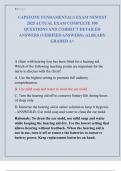
CAPSTONE FUNDAMENTALS EXAM NEWEST
2025 ACTUAL EXAM COMPLETE 100
QUESTIONS AND CORRECT DETAILED
ANSWERS (VERIFIED ANSWERS) |ALREADY
GRADED A+
A client with hearing loss has been fitted for a hearing aid.
Which of the following teaching points are important for the
nurse to discuss with the client?
A. Use the highest setting to promote full auditory
comprehension.
B. Use mild soap and water to clean the ear mold.
C. Turn the hearing aid off to conserve battery life during hours
of sleep only.
D. Immerse the hearing aid in saline solution to keep it hygienic.
- ANSWER-B. Use mild soap and water to clean the ear mold.
Rationale: To clean the ear mold, use mild soap and water
while keeping the hearing aid dry. Use the lowest setting that
allows hearing without feedback. When the hearing aid is
not in use, turn it off or remove the batteries to conserve
battery power. Keep replacement batteries on hand.
,2|Page
A nurse is admitting a client who has tuberculosis and a
productive cough. Which of the following types of isolation
precautions should the nurse initiate for the client?
A. Contact
B. Droplet
C. Protective
D. Airborne - ANSWER-D. Airborne
Rationale: The nurse should initiate airborne precautions
when a client has an infection that spreads through small
droplets that remain airborne for longer periods, such as
tuberculosis and measles. The client requires a negative-
pressure airflow room, and staff should wear an N95
respirator when in contact with the client. The nurse should
initiate contact precautions when a client has an infection
that spreads through indirect contact, such as major wound
infections or infection with multi-drug resistant organisms
such as MRSA. The nurse should initiate droplet precautions
when a client has an infection that spreads through droplets
larger than 5 microns, such as pneumonia or streptococcal
pharyngitis. The nurse should initiate a protective
environment when clients require a room with positive-
pressure airflow, such as those who have undergone stem-
cell transplants.
,3|Page
A nurse is assessing a client who has Parkinson's disease. Which
of the following manifestations should the nurse expect?
A. Pruritus
B. Hypertension
C. Bradykinesia
D. Xerostomia - ANSWER-C. Bradykinesia
Rationale: The nurse should expect to find bradykinesia or
difficulty moving in a client who has Parkinson's disease.
The nurse should expect to find oily skin, which results from
autonomic dysfunction, rather than pruritus, which results
from dry skin. The nurse should expect to find orthostatic
hypotension, which results from autonomic dysfunction. Te
nurse should expect to find uncontrolled drooling, especially
at night, instead of xerostomia or dry mouth in a client who
has Parkinson's disease.
A nurse is caring for a client with celiac disease. Which food
should be removed from the meal tray?
A. Corn bread
B. Mashed potato
C. Lentils
D. Tortillas - ANSWER-D. Tortillas
, 4|Page
Rationale: Tortillas contain gluten. Corn bread, mashed
potatoes and lentils do not contain gluten.
A nurse is assessing four clients for fluid balance. The nurse
should identify that which of the following clients is exhibiting
manifestations of dehydration?
A. A client who has a urine specific gravity of 1.010.
B. A client who has a weight gain of 2.2 kg (2 lb) in 24 hr.
C. A client who has a hematocrit of 45%.
D. A client who has a temperature of 39 degrees Celsius (102
degrees Fahrenheit). - ANSWER-D. A client who has a
temperature of 39 degrees Celsius (102 degrees Fahrenheit).
Rationale: An elevated temperature is a manifestation of
dehydration. The urine specific gravity is within the
expected reference range of 1.010 to 1.025. Concentrated
urine and a specific gravity of grater than 1.030 are
manifestations of dehydration. Weight gain is a
manifestation of fluid volume excess. The hematocrit is
within expected reference range of 37% to 64%. An elevated
hematocrit is a manifestation of hemoconcentration and
dehydration.
***A nurse is caring for a client receiving radiation treatments
for cancer. The client states he is experiencing dryness, redness
CAPSTONE FUNDAMENTALS EXAM NEWEST
2025 ACTUAL EXAM COMPLETE 100
QUESTIONS AND CORRECT DETAILED
ANSWERS (VERIFIED ANSWERS) |ALREADY
GRADED A+
A client with hearing loss has been fitted for a hearing aid.
Which of the following teaching points are important for the
nurse to discuss with the client?
A. Use the highest setting to promote full auditory
comprehension.
B. Use mild soap and water to clean the ear mold.
C. Turn the hearing aid off to conserve battery life during hours
of sleep only.
D. Immerse the hearing aid in saline solution to keep it hygienic.
- ANSWER-B. Use mild soap and water to clean the ear mold.
Rationale: To clean the ear mold, use mild soap and water
while keeping the hearing aid dry. Use the lowest setting that
allows hearing without feedback. When the hearing aid is
not in use, turn it off or remove the batteries to conserve
battery power. Keep replacement batteries on hand.
,2|Page
A nurse is admitting a client who has tuberculosis and a
productive cough. Which of the following types of isolation
precautions should the nurse initiate for the client?
A. Contact
B. Droplet
C. Protective
D. Airborne - ANSWER-D. Airborne
Rationale: The nurse should initiate airborne precautions
when a client has an infection that spreads through small
droplets that remain airborne for longer periods, such as
tuberculosis and measles. The client requires a negative-
pressure airflow room, and staff should wear an N95
respirator when in contact with the client. The nurse should
initiate contact precautions when a client has an infection
that spreads through indirect contact, such as major wound
infections or infection with multi-drug resistant organisms
such as MRSA. The nurse should initiate droplet precautions
when a client has an infection that spreads through droplets
larger than 5 microns, such as pneumonia or streptococcal
pharyngitis. The nurse should initiate a protective
environment when clients require a room with positive-
pressure airflow, such as those who have undergone stem-
cell transplants.
,3|Page
A nurse is assessing a client who has Parkinson's disease. Which
of the following manifestations should the nurse expect?
A. Pruritus
B. Hypertension
C. Bradykinesia
D. Xerostomia - ANSWER-C. Bradykinesia
Rationale: The nurse should expect to find bradykinesia or
difficulty moving in a client who has Parkinson's disease.
The nurse should expect to find oily skin, which results from
autonomic dysfunction, rather than pruritus, which results
from dry skin. The nurse should expect to find orthostatic
hypotension, which results from autonomic dysfunction. Te
nurse should expect to find uncontrolled drooling, especially
at night, instead of xerostomia or dry mouth in a client who
has Parkinson's disease.
A nurse is caring for a client with celiac disease. Which food
should be removed from the meal tray?
A. Corn bread
B. Mashed potato
C. Lentils
D. Tortillas - ANSWER-D. Tortillas
, 4|Page
Rationale: Tortillas contain gluten. Corn bread, mashed
potatoes and lentils do not contain gluten.
A nurse is assessing four clients for fluid balance. The nurse
should identify that which of the following clients is exhibiting
manifestations of dehydration?
A. A client who has a urine specific gravity of 1.010.
B. A client who has a weight gain of 2.2 kg (2 lb) in 24 hr.
C. A client who has a hematocrit of 45%.
D. A client who has a temperature of 39 degrees Celsius (102
degrees Fahrenheit). - ANSWER-D. A client who has a
temperature of 39 degrees Celsius (102 degrees Fahrenheit).
Rationale: An elevated temperature is a manifestation of
dehydration. The urine specific gravity is within the
expected reference range of 1.010 to 1.025. Concentrated
urine and a specific gravity of grater than 1.030 are
manifestations of dehydration. Weight gain is a
manifestation of fluid volume excess. The hematocrit is
within expected reference range of 37% to 64%. An elevated
hematocrit is a manifestation of hemoconcentration and
dehydration.
***A nurse is caring for a client receiving radiation treatments
for cancer. The client states he is experiencing dryness, redness