MOD 3 & 4-Exam 2- UTMB Pharmacology
Questions And Answers Latest 2025
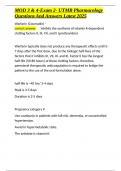
Warfarin (Coumadin) -
correct answer ✅Inhibits the synthesis of vitamin K-dependent
clotting factors X, IX, VII, and II (prothrombin)
Warfarin typically does not produce any therapeutic effects until 5-
7 days after the first dose, due to the biologic half-lives of the
factors that it inhibits (II, VII, IX, and X). Factor II has the longest
half-life (50-80 hours) of these clotting factors; therefore,
parenteral therapeutic anticoagulation is required to bridge the
patient to the use of the oral formulation alone.
half-life is ~40 hrs/ 3-4 days
Peak is 3-5 days
Duration is 2-5 days
Pregnancy category X
Use cautiously in patients with fall risk, dementia, or uncontrolled
hypertension.
Avoid in hypermetabolic state.
The antidote is vitamin K.
,MOD 3 & 4-Exam 2- UTMB Pharmacology
Questions And Answers Latest 2025
Clinical use and dosing:
Drug of choice for deep vein thrombosis (DVT) and pulmonary
embolism (PE)
Start at 5 mg per day (7.5 mg/d if weight greater than 80 kg).
Consider a lower dose if:
-Older than 75 years
-Multiple comorbid conditions
-Elevated liver enzymes
-Changing thyroid status
Dose to maintain an international normalized ratio (INR) between 2
and 3.
Monitoring :
INR daily until in therapeutic range for 2 consecutive days
Then two or three times weekly for 1 to 2 weeks
Then less frequently but at least every 6 weeks
Warfarin (Coumadin) therapeutic effect -
correct answer ✅Thus, the ultimate anticoagulant effect of vitamin
,MOD 3 & 4-Exam 2- UTMB Pharmacology
Questions And Answers Latest 2025
K antagonists (VKA) is delayed until the previously synthesized,
functional clotting factors are cleared from the circulation.
Depletion of both factor X and factor II (prothrombin) is important
for clinical efficacy, and factor II has the longest half-life of the
vitamin K-dependent factors (approximately three days-72hrs)
[3,4]. Thus, the desired anticoagulant effect of a VKA does not
occur for at least 3-4 days after drug initiation despite prolongation
of the prothrombin time (PT) at earlier time points. The initial
prolongation of the PT is due primarily to depletion of factor VII,
which has a short half-life (four to six hours)
Metabolized by CYP 1A2 and 2C9.
High bound to Plasma protein.
Well absorbed when taken orally.
What is plasmin? -
correct answer ✅Plasminogen, the precursor molecule to plasmin,
binds fibrin and tissue plasminogen activator (tPA). This ternary
complex leads to conversion of the proenzyme plasminogen to
active, proteolytic plasmin.
an enzyme that dissolves the fibrin of blood clots
, MOD 3 & 4-Exam 2- UTMB Pharmacology
Questions And Answers Latest 2025
Fibrinolysis
What does plasmin do? -
correct answer ✅Plasmin — Plasminogen, the precursor molecule
to plasmin, binds fibrin and tissue plasminogen activator (tPA). This
ternary complex leads to conversion of the proenzyme plasminogen
to active, proteolytic plasmin.
Plasmin has broad substrate specificity and, in addition to fibrin,
cleaves fibrinogen and a variety of plasma proteins and clotting
factors. Plasmin cleaves the polymerized fibrin strand at multiple
sites and releases fibrin degradation products (FDPs). One of the
major FDPs is D-dimer, which consists of two D domains from
adjacent fibrin monomers that have been crosslinked by activated
factor XIII. Plasmin also cleaves factor XIIIa, but not factor XIII,
leading to reduced fibrin crosslinking.
The plasminogen/plasminogen-activator system is complex,
paralleling the coagulation cascade. Plasmin activity is regulated by
vascular endothelial cells that secrete both serine protease
plasminogen activators (tissue-type plasminogen activator and
urokinase-type plasminogen activator) and plasminogen activator
inhibitors (PAI-1 and PAI-2).
Questions And Answers Latest 2025
Warfarin (Coumadin) -
correct answer ✅Inhibits the synthesis of vitamin K-dependent
clotting factors X, IX, VII, and II (prothrombin)
Warfarin typically does not produce any therapeutic effects until 5-
7 days after the first dose, due to the biologic half-lives of the
factors that it inhibits (II, VII, IX, and X). Factor II has the longest
half-life (50-80 hours) of these clotting factors; therefore,
parenteral therapeutic anticoagulation is required to bridge the
patient to the use of the oral formulation alone.
half-life is ~40 hrs/ 3-4 days
Peak is 3-5 days
Duration is 2-5 days
Pregnancy category X
Use cautiously in patients with fall risk, dementia, or uncontrolled
hypertension.
Avoid in hypermetabolic state.
The antidote is vitamin K.
,MOD 3 & 4-Exam 2- UTMB Pharmacology
Questions And Answers Latest 2025
Clinical use and dosing:
Drug of choice for deep vein thrombosis (DVT) and pulmonary
embolism (PE)
Start at 5 mg per day (7.5 mg/d if weight greater than 80 kg).
Consider a lower dose if:
-Older than 75 years
-Multiple comorbid conditions
-Elevated liver enzymes
-Changing thyroid status
Dose to maintain an international normalized ratio (INR) between 2
and 3.
Monitoring :
INR daily until in therapeutic range for 2 consecutive days
Then two or three times weekly for 1 to 2 weeks
Then less frequently but at least every 6 weeks
Warfarin (Coumadin) therapeutic effect -
correct answer ✅Thus, the ultimate anticoagulant effect of vitamin
,MOD 3 & 4-Exam 2- UTMB Pharmacology
Questions And Answers Latest 2025
K antagonists (VKA) is delayed until the previously synthesized,
functional clotting factors are cleared from the circulation.
Depletion of both factor X and factor II (prothrombin) is important
for clinical efficacy, and factor II has the longest half-life of the
vitamin K-dependent factors (approximately three days-72hrs)
[3,4]. Thus, the desired anticoagulant effect of a VKA does not
occur for at least 3-4 days after drug initiation despite prolongation
of the prothrombin time (PT) at earlier time points. The initial
prolongation of the PT is due primarily to depletion of factor VII,
which has a short half-life (four to six hours)
Metabolized by CYP 1A2 and 2C9.
High bound to Plasma protein.
Well absorbed when taken orally.
What is plasmin? -
correct answer ✅Plasminogen, the precursor molecule to plasmin,
binds fibrin and tissue plasminogen activator (tPA). This ternary
complex leads to conversion of the proenzyme plasminogen to
active, proteolytic plasmin.
an enzyme that dissolves the fibrin of blood clots
, MOD 3 & 4-Exam 2- UTMB Pharmacology
Questions And Answers Latest 2025
Fibrinolysis
What does plasmin do? -
correct answer ✅Plasmin — Plasminogen, the precursor molecule
to plasmin, binds fibrin and tissue plasminogen activator (tPA). This
ternary complex leads to conversion of the proenzyme plasminogen
to active, proteolytic plasmin.
Plasmin has broad substrate specificity and, in addition to fibrin,
cleaves fibrinogen and a variety of plasma proteins and clotting
factors. Plasmin cleaves the polymerized fibrin strand at multiple
sites and releases fibrin degradation products (FDPs). One of the
major FDPs is D-dimer, which consists of two D domains from
adjacent fibrin monomers that have been crosslinked by activated
factor XIII. Plasmin also cleaves factor XIIIa, but not factor XIII,
leading to reduced fibrin crosslinking.
The plasminogen/plasminogen-activator system is complex,
paralleling the coagulation cascade. Plasmin activity is regulated by
vascular endothelial cells that secrete both serine protease
plasminogen activators (tissue-type plasminogen activator and
urokinase-type plasminogen activator) and plasminogen activator
inhibitors (PAI-1 and PAI-2).