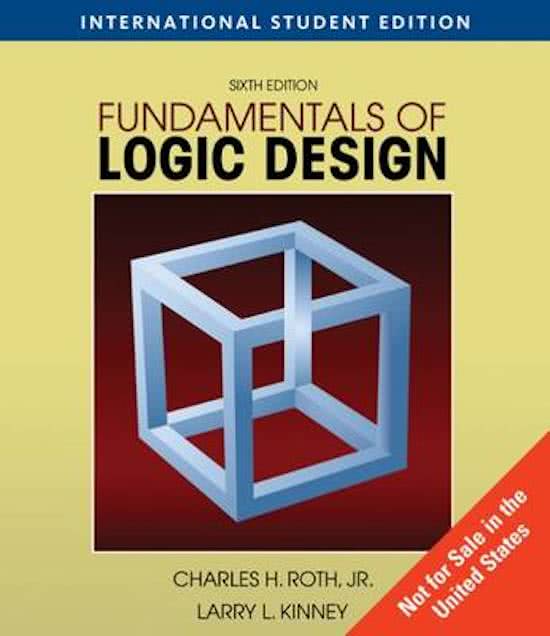
An Instructor’s Solutions Manual to Accompany
FUNDAMENTALS OF LOGIC DESIGN,
7TH EDITION
CHARLES H. ROTH, JR.
LARRY L. KINNEY
Complete All Chapters Updated.
, TABLE OF CONTENTS
I. INTRODUCTION 1
1.1 Using the Text in a Lecture Course 1
1.2 Some Remarks About the Text 2
1.3 Using the Text in a Self-Paced Course 2
1.4 Use of Computer Software 4
1.5 Suggested Equipment for Laboratory Exercises 5
II. SOLUTIONS TO HOMEWORK PROBLEMS 7
Unit 1 Problem Solutions 7
Unit 2 Problem Solutions 17
Unit 3 Problem Solutions 23
Unit 4 Problem Solutions 31
Unit 5 Problem Solutions 41
Unit 6 Problem Solutions 57
Unit 7 Problem Solutions 71
Unit 8 Problem Solutions 91
Unit 9 Problem Solutions 97
Unit 10 Problem Solutions 113
Unit 11 Problem Solutions 119
Unit 12 Problem Solutions 125
Unit 13 Problem Solutions 145
Unit 14 Problem Solutions 157
Unit 15 Problem Solutions 177
Unit 16 Problem Solutions 201
Unit 17 Problem Solutions 215
Unit 18 Problem Solutions 229
Unit 19 Problem Solutions 245
Unit 20 Problem Solutions 257
III. SOLUTIONS TO DESIGN, SIMULATION,
AND LAB EXERCISES 263
Unit 8 Design Problems 263
Unit 10 Design and Simulation Problems 283
Unit 12 Design and Simulation Problems 297
Unit 16 Design and Simulation Problems 303
Unit 17 Simulation and Lab Problems 313
Unit 20 Lab Design Problems 321
IV. SAMPLE UNIT TESTS 351
iii
© 2014 Cengage Learning. All Rights Reserved. May not be scanned, copied or duplicated, or posted to a publicly accessible website, in whole or in part.
Complete All Chapters Updated.
, iv
© 2014 Cengage Learning. All Rights Reserved. May not be scanned, copied or duplicated, or posted to a publicly accessible website, in whole or in part.
Complete All Chapters Updated.
, I: INTRODUCTION
The text, Fundamentals of Logic Design,7th edition, has been designed so that it
can be used either for a standard lecture course or for a self-paced course. The text is divided
into 20 study units in such a way that the average study time for each unit is about the same.
The units have undergone extensive class testing in a self-paced environment and have been
revised based on student feedback. The study guides and text material are sufficient to allow
almost all students to achieve mastery of all of the objectives. For example, the material on
Boolean algebra and algebraic simplification is 2½ units because students found this topic
difficult. There is a separate unit on going from problem statements to state graphs because
this topic is difficult for many students.
The textbook contains answers for all of the problems that are assigned in the study
guides. This Instructor’s Manual contains complete solutions to these problems. Solutions
to the remaining homework problems as well as all design and simulation exercises are also
included in this manual. In the solutions section of this manual, the abbreviation FLD stands
for Fundamentals of Logic Design (7th ed.).
Information on the self-paced course as previously taught at the University of Texas
using an earlier edition of the textbook is available from Prof. Charles H. Roth, croth@
austin.rr.com. In addition to the textbook and study guides, teaching a self-paced course
requires that a set of tests be prepared for each study unit. This manual contains a sample
test for each unit.
1.1 Using the Text in a Lecture Course
Even though the text was developed in a self-paced environment, the text is well
suited for use in a standard lecture course. Since the format of the text differs somewhat
from a conventional text, a few suggestions for using the text in a lecture course may be
appropriate. Except for the inclusion of objectives and study guides, the units in the text
differ very little from chapters in a standard textbook. The study guides contain very basic
questions, while the problems at the end of each unit are of a more comprehensive nature.
For this reason, we suggest that specific study guide questions be assigned for students to
work through on their own before working out homework problems selected from those
at the end of the unit. The unit tests given in Part IV of this manual provide a convenient
source of additional homework assignments or a source of quiz problems. The text contains
many examples that are completely worked out with detailed step-by-step explanations.
Discussion of these detailed examples in lecture may not be necessary if the students study
them on their own. The lecture time is probably better spent discussing general principles
and applications as well as providing help with some of the more difficult topics. Since all
of the units have study guides, it would be possible to assign some of the easier topics for
self-study and devote the lectures to the more difficult topics.
At the University of Texas a class composed largely of Electrical Engineering and
Computer Science sophomores and juniors covers 18 units (all units except 6 and 19) of
the text in one semester. Units 8, 10, 12, 16, 17, and 20 contain design problems that are
suitable for simulation and lab exercises. The design problems help tie together and review
the material from a number of preceding units. Units 10, 17, and 20 introduce the VHDL
1
© 2014 Cengage Learning. All Rights Reserved. May not be scanned, copied or duplicated, or posted to a publicly accessible website, in whole or in part.
Complete All Chapters Updated.
FUNDAMENTALS OF LOGIC DESIGN,
7TH EDITION
CHARLES H. ROTH, JR.
LARRY L. KINNEY
Complete All Chapters Updated.
, TABLE OF CONTENTS
I. INTRODUCTION 1
1.1 Using the Text in a Lecture Course 1
1.2 Some Remarks About the Text 2
1.3 Using the Text in a Self-Paced Course 2
1.4 Use of Computer Software 4
1.5 Suggested Equipment for Laboratory Exercises 5
II. SOLUTIONS TO HOMEWORK PROBLEMS 7
Unit 1 Problem Solutions 7
Unit 2 Problem Solutions 17
Unit 3 Problem Solutions 23
Unit 4 Problem Solutions 31
Unit 5 Problem Solutions 41
Unit 6 Problem Solutions 57
Unit 7 Problem Solutions 71
Unit 8 Problem Solutions 91
Unit 9 Problem Solutions 97
Unit 10 Problem Solutions 113
Unit 11 Problem Solutions 119
Unit 12 Problem Solutions 125
Unit 13 Problem Solutions 145
Unit 14 Problem Solutions 157
Unit 15 Problem Solutions 177
Unit 16 Problem Solutions 201
Unit 17 Problem Solutions 215
Unit 18 Problem Solutions 229
Unit 19 Problem Solutions 245
Unit 20 Problem Solutions 257
III. SOLUTIONS TO DESIGN, SIMULATION,
AND LAB EXERCISES 263
Unit 8 Design Problems 263
Unit 10 Design and Simulation Problems 283
Unit 12 Design and Simulation Problems 297
Unit 16 Design and Simulation Problems 303
Unit 17 Simulation and Lab Problems 313
Unit 20 Lab Design Problems 321
IV. SAMPLE UNIT TESTS 351
iii
© 2014 Cengage Learning. All Rights Reserved. May not be scanned, copied or duplicated, or posted to a publicly accessible website, in whole or in part.
Complete All Chapters Updated.
, iv
© 2014 Cengage Learning. All Rights Reserved. May not be scanned, copied or duplicated, or posted to a publicly accessible website, in whole or in part.
Complete All Chapters Updated.
, I: INTRODUCTION
The text, Fundamentals of Logic Design,7th edition, has been designed so that it
can be used either for a standard lecture course or for a self-paced course. The text is divided
into 20 study units in such a way that the average study time for each unit is about the same.
The units have undergone extensive class testing in a self-paced environment and have been
revised based on student feedback. The study guides and text material are sufficient to allow
almost all students to achieve mastery of all of the objectives. For example, the material on
Boolean algebra and algebraic simplification is 2½ units because students found this topic
difficult. There is a separate unit on going from problem statements to state graphs because
this topic is difficult for many students.
The textbook contains answers for all of the problems that are assigned in the study
guides. This Instructor’s Manual contains complete solutions to these problems. Solutions
to the remaining homework problems as well as all design and simulation exercises are also
included in this manual. In the solutions section of this manual, the abbreviation FLD stands
for Fundamentals of Logic Design (7th ed.).
Information on the self-paced course as previously taught at the University of Texas
using an earlier edition of the textbook is available from Prof. Charles H. Roth, croth@
austin.rr.com. In addition to the textbook and study guides, teaching a self-paced course
requires that a set of tests be prepared for each study unit. This manual contains a sample
test for each unit.
1.1 Using the Text in a Lecture Course
Even though the text was developed in a self-paced environment, the text is well
suited for use in a standard lecture course. Since the format of the text differs somewhat
from a conventional text, a few suggestions for using the text in a lecture course may be
appropriate. Except for the inclusion of objectives and study guides, the units in the text
differ very little from chapters in a standard textbook. The study guides contain very basic
questions, while the problems at the end of each unit are of a more comprehensive nature.
For this reason, we suggest that specific study guide questions be assigned for students to
work through on their own before working out homework problems selected from those
at the end of the unit. The unit tests given in Part IV of this manual provide a convenient
source of additional homework assignments or a source of quiz problems. The text contains
many examples that are completely worked out with detailed step-by-step explanations.
Discussion of these detailed examples in lecture may not be necessary if the students study
them on their own. The lecture time is probably better spent discussing general principles
and applications as well as providing help with some of the more difficult topics. Since all
of the units have study guides, it would be possible to assign some of the easier topics for
self-study and devote the lectures to the more difficult topics.
At the University of Texas a class composed largely of Electrical Engineering and
Computer Science sophomores and juniors covers 18 units (all units except 6 and 19) of
the text in one semester. Units 8, 10, 12, 16, 17, and 20 contain design problems that are
suitable for simulation and lab exercises. The design problems help tie together and review
the material from a number of preceding units. Units 10, 17, and 20 introduce the VHDL
1
© 2014 Cengage Learning. All Rights Reserved. May not be scanned, copied or duplicated, or posted to a publicly accessible website, in whole or in part.
Complete All Chapters Updated.