1
MDC 1 – Exam 1
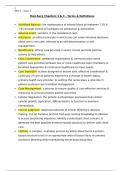
Med-Surg Chapters 1 & 3 – Terms & Definitions
Acid-Base Balance: the maintenance of arterial blood pH between 7.35 &
7.45 through control of hydrogen ion production & elimination.
Adverse event: variation in the standard of care.
Autonomy: an ethical principle in which one can make informed decisions
about one’s own care; referred to as self-determination or self-
management.
Beneficence: ethical care principle in which nurses promote positive
actions to help others.
Care Coordination: deliberate organization & communication about
patient care activities between two or more healthcare team members to
facilitate appropriate & continuous healthcare to meet needs.
Care Transition: actions designed to ensure safe, effective coordination &
continuity of care as patients experience a change in health status,
primary health care provider, or setting; the nurse plays a vital role in
patient-centered care transition management.
Case Management: a process to ensure quality & cost-effective services &
resources to achieve positive patient outcomes.
Cellular Regulation: the genetic & physiologic processes that control
cellular growth, replication, differentiation, & function to maintain
homeostasis.
Clinical Judgment: observed outcome of critical thinking & decision
making. It is an iterative process that uses nursing knowledge to observe
& access presenting situations, identify a prioritized client concern, &
generate the best possible evidence-based solutions to deliver safe client
care.
Clotting: a complex, multistep process by which blood forms a protein-
based structure (clot) in an appropriate area of tissue injury to prevent
excessive bleeding while maintaining whole-body blood flow.
, 2
MDC 1 – Exam 1
Cognition: the complex integration of mental processes & intellectual
function for the purposes of reasoning, learning, memory, & personality.
Comfort: a state of physical well-being, pleasure, & absence of pain or
stress. This definition implies that comfort has physical & emotional
dimensions.
Communication Techniques: Active listening, written communication,
observation, empathy, compassion…
Communication: dynamic, two-way sending and receiving messages using
words, sounds, expressions, body movements, written symbols, and
behaviors. Forms the basis for sharing meaning, expressing needs, and
building effective working relationships among individuals, families, and
the healthcare team.
Constipation: hard, dry stool that is difficult to pass through the rectum.
Cultural Competence: attained on a continuum ranging from incompetent
to competent. It cannot be achieved overnight because it is a
developmental process.
Culture of Safety: an environment that provides a blame-free approach to
improving care using interprofessional collaboration in high-risk, error-
prone healthcare settings.
Culture: what people in a group have in common, but it changes over
time. The totality of socially transmitted behavior patterns, arts, beliefs,
values, customs, lifeways, and all other products of human work and
thought characteristics of a population of people that human work and
thought characteristics of a population of people that guide their
worldview and decision-making.
Delegated Responsibility: nursing activity, skill, or procedure that is
transferred from a licensed nurse to a delegate, usually an LPN/VN or
assistive personnel in a selected patient care situation.
Delirium: acute fluctuating mental confusion.
Dementia: chronic mental confusion.
Diarrhea: watery stool without solid form.
MDC 1 – Exam 1
Med-Surg Chapters 1 & 3 – Terms & Definitions
Acid-Base Balance: the maintenance of arterial blood pH between 7.35 &
7.45 through control of hydrogen ion production & elimination.
Adverse event: variation in the standard of care.
Autonomy: an ethical principle in which one can make informed decisions
about one’s own care; referred to as self-determination or self-
management.
Beneficence: ethical care principle in which nurses promote positive
actions to help others.
Care Coordination: deliberate organization & communication about
patient care activities between two or more healthcare team members to
facilitate appropriate & continuous healthcare to meet needs.
Care Transition: actions designed to ensure safe, effective coordination &
continuity of care as patients experience a change in health status,
primary health care provider, or setting; the nurse plays a vital role in
patient-centered care transition management.
Case Management: a process to ensure quality & cost-effective services &
resources to achieve positive patient outcomes.
Cellular Regulation: the genetic & physiologic processes that control
cellular growth, replication, differentiation, & function to maintain
homeostasis.
Clinical Judgment: observed outcome of critical thinking & decision
making. It is an iterative process that uses nursing knowledge to observe
& access presenting situations, identify a prioritized client concern, &
generate the best possible evidence-based solutions to deliver safe client
care.
Clotting: a complex, multistep process by which blood forms a protein-
based structure (clot) in an appropriate area of tissue injury to prevent
excessive bleeding while maintaining whole-body blood flow.
, 2
MDC 1 – Exam 1
Cognition: the complex integration of mental processes & intellectual
function for the purposes of reasoning, learning, memory, & personality.
Comfort: a state of physical well-being, pleasure, & absence of pain or
stress. This definition implies that comfort has physical & emotional
dimensions.
Communication Techniques: Active listening, written communication,
observation, empathy, compassion…
Communication: dynamic, two-way sending and receiving messages using
words, sounds, expressions, body movements, written symbols, and
behaviors. Forms the basis for sharing meaning, expressing needs, and
building effective working relationships among individuals, families, and
the healthcare team.
Constipation: hard, dry stool that is difficult to pass through the rectum.
Cultural Competence: attained on a continuum ranging from incompetent
to competent. It cannot be achieved overnight because it is a
developmental process.
Culture of Safety: an environment that provides a blame-free approach to
improving care using interprofessional collaboration in high-risk, error-
prone healthcare settings.
Culture: what people in a group have in common, but it changes over
time. The totality of socially transmitted behavior patterns, arts, beliefs,
values, customs, lifeways, and all other products of human work and
thought characteristics of a population of people that human work and
thought characteristics of a population of people that guide their
worldview and decision-making.
Delegated Responsibility: nursing activity, skill, or procedure that is
transferred from a licensed nurse to a delegate, usually an LPN/VN or
assistive personnel in a selected patient care situation.
Delirium: acute fluctuating mental confusion.
Dementia: chronic mental confusion.
Diarrhea: watery stool without solid form.