Biological Catalysis
Some reaction rates have no dependence on concentration for example reactions which depend
on surface area of metals (Pt) which allows the reaction to occur.
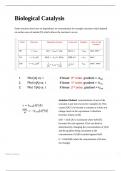
Isolation Method: concentrations of one of the
reactants is put into excess for example [A]. This
causes k[A]^2 to become a constant as it does not
change much in the experiment. k therefore
becomes reliant on [B]
keff = k3rd [A]^2 (constant) where keff [B]
becomes the rate equation. K3rd can then be
determined by changing the concentrations of [A]0
and the gradient being calculated as the
concentration of [A]0 is plotted against Keff.
k = k3rd [B]0 (when the concentration of B does
not change)
Biological Catalysis 1
, Differential Method: the rate at a series of concentrations of [A] can be measured producing
rate concentration data. ln(rate) = ln(k) + n ln[A]. gradient = n (order), [A] = m, rate = y, and k =
y-intercept (c).
Half Lives: time taken for the concentration of a specific reagent to fall to half its original value.
For a 0 order reaction; t= t1/2 [A] = [A]0/2. The half life is shorter each time for a 0 order
reaction. For a 1st order the reaction is independent of the starting concentration and remains
constant; t 1/2 = 1/k ln (2). For a 2nd order 1/2 = 1𝑘𝑘2𝑛𝑛𝑑𝑑1[𝐴𝐴]0
Molecular Orbital Theory - MO theory can be
used to calculate the energy of the system and
The reaction rate is often lower than the how it changed with different arrangements
collision rate. This is due to activate energy. of nuclei. When A and B are far apart the
The molecules do not only need to collide and energy of the system is the sum of the
react but they need to collide with enough energies of A and B. As the molecules
energy to overcome the activate energy. approach, the energy changes and this is
dependent on the arrangement of all the
The fraction of molecules having enough
atoms in the system. As the complexity of the
energy to overcome the energy barrier and
system increases there are more ways in
which the molecules can be arranged.
Biological Catalysis 2
Some reaction rates have no dependence on concentration for example reactions which depend
on surface area of metals (Pt) which allows the reaction to occur.
Isolation Method: concentrations of one of the
reactants is put into excess for example [A]. This
causes k[A]^2 to become a constant as it does not
change much in the experiment. k therefore
becomes reliant on [B]
keff = k3rd [A]^2 (constant) where keff [B]
becomes the rate equation. K3rd can then be
determined by changing the concentrations of [A]0
and the gradient being calculated as the
concentration of [A]0 is plotted against Keff.
k = k3rd [B]0 (when the concentration of B does
not change)
Biological Catalysis 1
, Differential Method: the rate at a series of concentrations of [A] can be measured producing
rate concentration data. ln(rate) = ln(k) + n ln[A]. gradient = n (order), [A] = m, rate = y, and k =
y-intercept (c).
Half Lives: time taken for the concentration of a specific reagent to fall to half its original value.
For a 0 order reaction; t= t1/2 [A] = [A]0/2. The half life is shorter each time for a 0 order
reaction. For a 1st order the reaction is independent of the starting concentration and remains
constant; t 1/2 = 1/k ln (2). For a 2nd order 1/2 = 1𝑘𝑘2𝑛𝑛𝑑𝑑1[𝐴𝐴]0
Molecular Orbital Theory - MO theory can be
used to calculate the energy of the system and
The reaction rate is often lower than the how it changed with different arrangements
collision rate. This is due to activate energy. of nuclei. When A and B are far apart the
The molecules do not only need to collide and energy of the system is the sum of the
react but they need to collide with enough energies of A and B. As the molecules
energy to overcome the activate energy. approach, the energy changes and this is
dependent on the arrangement of all the
The fraction of molecules having enough
atoms in the system. As the complexity of the
energy to overcome the energy barrier and
system increases there are more ways in
which the molecules can be arranged.
Biological Catalysis 2