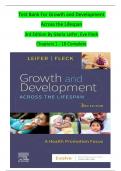
Test Bank For Growth and Development
Across the Lifespan
3rd Edition By Gloria Leifer; Eve Fleck
Chapters 1 - 16 Complete
,Table of Content
Chapter 1 Healthy People 2020
Chapter 2 Government Influences on Health Care
Chapter 3 Cultural Considerations in Health Care
Chapter 4 The Influence of Family on Developing a Lifestyle
Chapter 5 Theories of Development
Chapter 6 Prenatal Influences on Healthy Development
Chapter 7 The Infant
Chapter 8 Early Childhood
Chapter 9 Middle Childhood
Chapter 10 Adolescence
Chapter 11 Young Adulthood
Chapter 12 Middle Adulthood
Chapter 13 Late Adulthood
Chapter 14 Advanced Old-Age and Geriatrics
Chapter 15 Planning for the End of Life
Chapter 16 Loss, Grief, and Bereavement
,Chapter 1: Healthy People 2020
Test Bank
MULTIPLE CHOICE
1. The purpose of Healthy People 2020 is to:
a. examine world health needs.
b. evaluate accomplishments for years 2010–2020.
c. focus primarily on infant health and mortality.
d. examine funding issues for health care.
ANSWER: B
Healthy People 2020 is an evidence-based 10-year report card describing health-care
accomplishments in the United States between the years of 2010 and 2020.
DIF: Cognitive Level: Comprehension REF: p. 1 OBJ: 1
TOP: Healthy People 2020 KEY: Nursing Process Step: Intervention
MSC: NCLEX: Health Promotion and Maintenance: prevention and early detection of disease
2. A health-care worker planning a research project related to teenage pregnancy in his
community would include in the initial assessment the health status of the target population.
Health status could be best evaluated by the examination of the: a. birth rate, disease
morbidity, and life expectancy.
b. birth rate, access to health care, and death rate.
c. disease morbidity, life expectancy, and health insurance coverage.
d. health insurance coverage, death rate, and access to health care.
ANSWER: B
Birth rate statistics identify age of mother; death rates include infant mortality and age of
mother; access to health care may affect a teenager’s ability to obtain adequate prenatal
care.
DIF: Cognitive Level: Application REF: p. 6 OBJ: 3
TOP: Health status KEY: Nursing Process Step: Planning
MSC: NCLEX: Health Promotion and Maintenance: prevention and early detection of disease
3. The health-care worker teaches a group of new parents about the “back to sleep” program,
which is directed toward the reduction of sudden infant death syndrome (SIDS) by: a.
positioning the baby on a small flat pillow.
b. placing the baby on its back in the crib.
c. gently rocking the baby before returning it to bed.
d. tucking infant snuggly in the crib with a light blanket.
ANSWER: B
The back to sleep program helps reduce the incidence of SIDS by placing the infant on its
back rather than on its stomach.
DIF: Cognitive Level: Application REF: p. 8 OBJ: 5
, TOP: Back to sleep program KEY: Nursing Process Step: Intervention
MSC: NCLEX: Health Promotion and Maintenance: prevention and early detection of disease
4. Healthy sPeople s2020 sendorses sthe scompletion sof sa shigh sschool seducation sprimarily sto
senable sa sperson sto:
a. secure sa sbetter sjob.
b. increase sthe squality sof slife.
c. make shealthy slifestyle schoices.
d. maintain sthe sfamily sunit.
ANSWER: sC
One sof sthe sgoals sof sHealthy sPeople s2020 sis sto sincrease sthe snumber sof spersons
sgraduating sfrom shigh sschool sso sthat sthey shave sa sbetter seducation sbasis son swhich sto
smake shealthy slifestyle schoices.
DIF: Cognitive sLevel: sApplication REF: sp. s8 OBJ: s4
sTOP: sHealth sindicators s KEY: sNursing sProcess sStep: sNA sMSC:
sNCLEX: sNA
5. Healthy sPeople s2020 sis spublished sby sthe:
a. Centers sfor sDisease sControl sand sPrevention.
b. Department sof sthe sInterior.
c. World sHealth sOrganization.
d. Department sof sHealth sand sHuman sServices.
ANSWER: sD
Healthy sPeople s2020 sis spublished sby sthe sU.S. sDepartment sof sHealth sand sHuman
sServices.
DIF: Cognitive sLevel: sKnowledge REF: sp. s1 OBJ: s1
TOP: sHealthy sPeople s2020 s KEY: sNursing sProcess sStep: sNA sMSC: sNCLEX: sNA
6. Infant smortality srates sare sbased son sinfant sdeaths sthat soccur:
a. at sbirth, sper s1000 sdeliveries.
b. before s1 syear sof sage, sper s1000 slive sbirths.
c. from sinfection sand scongenital sdisorders, sper s1000 slive sbirths.
d. from sunexplained scauses, sper s1000 slive sbirths.
ANSWER: sB
Infant smortality sis sreported son sdeaths soccurring sbefore sthe sage sof s1 syear sper s1000
slive sbirths.
DIF: Cognitive sLevel: sKnowledge REF: sp. s6 OBJ: s4
TOP: sInfant smortality KEY: sNursing sProcess sStep:
sPlanning sMSC: sNCLEX: sHealth sPromotion sand sMaintenance: sgrowth sand
sdevelopment
7. Although sthe slife sexpectancy shas sincreased, sHealthy sPeople s2020 swill sfocus son sthe
solder sadult’s sneed sfor:
a. better spharmacy sinsurance scoverage.
b. improved sextended scare sfacilities.
c. increased scompliance sto smedical sprotocols.
d. maintenance sof sindependent slifestyles.
ANSWER: sD
Across the Lifespan
3rd Edition By Gloria Leifer; Eve Fleck
Chapters 1 - 16 Complete
,Table of Content
Chapter 1 Healthy People 2020
Chapter 2 Government Influences on Health Care
Chapter 3 Cultural Considerations in Health Care
Chapter 4 The Influence of Family on Developing a Lifestyle
Chapter 5 Theories of Development
Chapter 6 Prenatal Influences on Healthy Development
Chapter 7 The Infant
Chapter 8 Early Childhood
Chapter 9 Middle Childhood
Chapter 10 Adolescence
Chapter 11 Young Adulthood
Chapter 12 Middle Adulthood
Chapter 13 Late Adulthood
Chapter 14 Advanced Old-Age and Geriatrics
Chapter 15 Planning for the End of Life
Chapter 16 Loss, Grief, and Bereavement
,Chapter 1: Healthy People 2020
Test Bank
MULTIPLE CHOICE
1. The purpose of Healthy People 2020 is to:
a. examine world health needs.
b. evaluate accomplishments for years 2010–2020.
c. focus primarily on infant health and mortality.
d. examine funding issues for health care.
ANSWER: B
Healthy People 2020 is an evidence-based 10-year report card describing health-care
accomplishments in the United States between the years of 2010 and 2020.
DIF: Cognitive Level: Comprehension REF: p. 1 OBJ: 1
TOP: Healthy People 2020 KEY: Nursing Process Step: Intervention
MSC: NCLEX: Health Promotion and Maintenance: prevention and early detection of disease
2. A health-care worker planning a research project related to teenage pregnancy in his
community would include in the initial assessment the health status of the target population.
Health status could be best evaluated by the examination of the: a. birth rate, disease
morbidity, and life expectancy.
b. birth rate, access to health care, and death rate.
c. disease morbidity, life expectancy, and health insurance coverage.
d. health insurance coverage, death rate, and access to health care.
ANSWER: B
Birth rate statistics identify age of mother; death rates include infant mortality and age of
mother; access to health care may affect a teenager’s ability to obtain adequate prenatal
care.
DIF: Cognitive Level: Application REF: p. 6 OBJ: 3
TOP: Health status KEY: Nursing Process Step: Planning
MSC: NCLEX: Health Promotion and Maintenance: prevention and early detection of disease
3. The health-care worker teaches a group of new parents about the “back to sleep” program,
which is directed toward the reduction of sudden infant death syndrome (SIDS) by: a.
positioning the baby on a small flat pillow.
b. placing the baby on its back in the crib.
c. gently rocking the baby before returning it to bed.
d. tucking infant snuggly in the crib with a light blanket.
ANSWER: B
The back to sleep program helps reduce the incidence of SIDS by placing the infant on its
back rather than on its stomach.
DIF: Cognitive Level: Application REF: p. 8 OBJ: 5
, TOP: Back to sleep program KEY: Nursing Process Step: Intervention
MSC: NCLEX: Health Promotion and Maintenance: prevention and early detection of disease
4. Healthy sPeople s2020 sendorses sthe scompletion sof sa shigh sschool seducation sprimarily sto
senable sa sperson sto:
a. secure sa sbetter sjob.
b. increase sthe squality sof slife.
c. make shealthy slifestyle schoices.
d. maintain sthe sfamily sunit.
ANSWER: sC
One sof sthe sgoals sof sHealthy sPeople s2020 sis sto sincrease sthe snumber sof spersons
sgraduating sfrom shigh sschool sso sthat sthey shave sa sbetter seducation sbasis son swhich sto
smake shealthy slifestyle schoices.
DIF: Cognitive sLevel: sApplication REF: sp. s8 OBJ: s4
sTOP: sHealth sindicators s KEY: sNursing sProcess sStep: sNA sMSC:
sNCLEX: sNA
5. Healthy sPeople s2020 sis spublished sby sthe:
a. Centers sfor sDisease sControl sand sPrevention.
b. Department sof sthe sInterior.
c. World sHealth sOrganization.
d. Department sof sHealth sand sHuman sServices.
ANSWER: sD
Healthy sPeople s2020 sis spublished sby sthe sU.S. sDepartment sof sHealth sand sHuman
sServices.
DIF: Cognitive sLevel: sKnowledge REF: sp. s1 OBJ: s1
TOP: sHealthy sPeople s2020 s KEY: sNursing sProcess sStep: sNA sMSC: sNCLEX: sNA
6. Infant smortality srates sare sbased son sinfant sdeaths sthat soccur:
a. at sbirth, sper s1000 sdeliveries.
b. before s1 syear sof sage, sper s1000 slive sbirths.
c. from sinfection sand scongenital sdisorders, sper s1000 slive sbirths.
d. from sunexplained scauses, sper s1000 slive sbirths.
ANSWER: sB
Infant smortality sis sreported son sdeaths soccurring sbefore sthe sage sof s1 syear sper s1000
slive sbirths.
DIF: Cognitive sLevel: sKnowledge REF: sp. s6 OBJ: s4
TOP: sInfant smortality KEY: sNursing sProcess sStep:
sPlanning sMSC: sNCLEX: sHealth sPromotion sand sMaintenance: sgrowth sand
sdevelopment
7. Although sthe slife sexpectancy shas sincreased, sHealthy sPeople s2020 swill sfocus son sthe
solder sadult’s sneed sfor:
a. better spharmacy sinsurance scoverage.
b. improved sextended scare sfacilities.
c. increased scompliance sto smedical sprotocols.
d. maintenance sof sindependent slifestyles.
ANSWER: sD