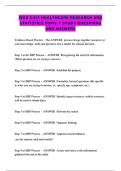
Evidence-Based Practice - The ANSWER process brings together resources w/
your knowledge, skills and practices into a model for clinical decision
Step 1 in the EBP Process - ANSWER Recognizing the need for information
(What question are we trying to answer)
Step 2 in EBP Process - ANSWER Establish the purpose
Step 3 in EBP Process - ANSWER Formulate focused questions (Be specific
in what you are trying to answer, ex. specify age, symptoms, etc.)
Step 4 in EBP Process - ANSWER Identify target resources (which resources
will be used to obtain data)
Step 5 in EBP Process - ANSWER Perform the search
Step 6 in EBP Process - ANSWER Organize findings
Step 7 in EBP Process - ANSWER Appraise trustworthiness
.are the sources used trustworthy?
Step 8 in EBP Process - ANSWER Assess relevance is the information
gathered relevant to the study
, Step 9 in EBP Process - ANSWER Select action based on the information
gathered, what are you going to decide?
Step 10 in EBP Process - ANSWER Implement and evaluate
EBP Pyramid - ANSWER
Case study- ANSWER an in-depth study regarding the subject being studied, be
it a person, group, place, event, organization, or phenomenon.
Case study- ANSWER tends to rely on qualitative data with methods including
interviews, observations, and analysis of primary and secondary sources.
Case study - ANSWER will also collect quantitative data and have been
considered a research strategy or design, an evaluation method, and a reporting
mode
Case-control study - ANSWER Observational study where 2 people differing
in outcome are identified and compared to find a causal factor
Cohort study - ANSWER study that measures variables of a group of people
over time
Randomized Control Trials - ANSWER research designed to determine the
effectiveness of a new medication or form of therapy, in which people with a
given problem or disorder are randomly assigned to one or more treatment
groups or to a control group
your knowledge, skills and practices into a model for clinical decision
Step 1 in the EBP Process - ANSWER Recognizing the need for information
(What question are we trying to answer)
Step 2 in EBP Process - ANSWER Establish the purpose
Step 3 in EBP Process - ANSWER Formulate focused questions (Be specific
in what you are trying to answer, ex. specify age, symptoms, etc.)
Step 4 in EBP Process - ANSWER Identify target resources (which resources
will be used to obtain data)
Step 5 in EBP Process - ANSWER Perform the search
Step 6 in EBP Process - ANSWER Organize findings
Step 7 in EBP Process - ANSWER Appraise trustworthiness
.are the sources used trustworthy?
Step 8 in EBP Process - ANSWER Assess relevance is the information
gathered relevant to the study
, Step 9 in EBP Process - ANSWER Select action based on the information
gathered, what are you going to decide?
Step 10 in EBP Process - ANSWER Implement and evaluate
EBP Pyramid - ANSWER
Case study- ANSWER an in-depth study regarding the subject being studied, be
it a person, group, place, event, organization, or phenomenon.
Case study- ANSWER tends to rely on qualitative data with methods including
interviews, observations, and analysis of primary and secondary sources.
Case study - ANSWER will also collect quantitative data and have been
considered a research strategy or design, an evaluation method, and a reporting
mode
Case-control study - ANSWER Observational study where 2 people differing
in outcome are identified and compared to find a causal factor
Cohort study - ANSWER study that measures variables of a group of people
over time
Randomized Control Trials - ANSWER research designed to determine the
effectiveness of a new medication or form of therapy, in which people with a
given problem or disorder are randomly assigned to one or more treatment
groups or to a control group