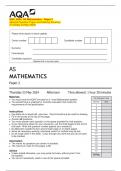
AQA_2024: AS Mathematics - Paper 2
(Merged Question Paper and Marking Scheme)
(Thursday 23 May 2024)
Please write clearly in block capitals.
Centre number Candidate number
Surname
Forename(s)
Candidate signature
I declare this is my own work.
AS
MATHEMATICS
Paper 2
Thursday 23 May 2024 Afternoon Time allowed: 1 hour 30 minutes
Materials For Examiner’s Use
You must have the AQA Formulae for A‑ level Mathematics booklet.
You should have a graphical or scientific calculator that meets the Question Mark
requirements of the specification. 1
2
3
Instructions
Use black ink or black ball‑ point pen. Pencil should only be used for drawing. 4
Fill in the boxes at the top of this page. 5
Answer all questions. 6
You must answer each question in the space provided for that question. 7
If you need extra space for your answer(s), use the lined pages at the end of 8
this book. Write the question number against your answer(s).
Do not write outside the box around each page or on blank pages. 9
Show all necessary working; otherwise marks for method may be lost. 10
Do all rough work in this book. Cross through any work that you do not want 11
to be marked. 12
13
Information
14
The marks for questions are shown in brackets.
The maximum mark for this paper is 80. 15
16
Advice 17
Unless stated otherwise, you may quote formulae, without proof, from
the booklet. TOTAL
You do not necessarily need to use all the space provided.
,AS Mathematics: Paper 2 (Thursday 23 May 2024)
Exam Preview Areas
This paper focuses on Applied Mathematics, specifically Mechanics and Statistics. It examines how
mathematical techniques can be applied to physical systems and data analysis.
1. Mechanics:
Kinematics: You’ll solve problems involving motion in a straight line, including using equations of
motion to calculate displacement, velocity, and acceleration for objects in uniform motion. You might
also analyze graphs representing motion (e.g., velocity-time graphs) and calculate areas under these
graphs to find distance traveled.
Forces: You’ll apply Newton’s laws of motion to solve problems involving forces acting on objects. This
includes resolving forces into components (e.g., horizontal and vertical components) and solving for
acceleration, tension, or friction in various contexts. Equilibrium problems (where the net force is zero)
will also be included.
Momentum: You will use the concept of momentum to solve problems involving collisions and
explosions, applying the principle of conservation of momentum to calculate velocities before and after
events. Both elastic and inelastic collisions will be explored.
Energy: You’ll explore the concepts of kinetic energy and potential energy, applying the work-
energy principle. Problems may involve calculating the total energy in a system, energy conversions,
or solving for variables in energy conservation equations.
2. Statistics:
Data Representation: You will need to interpret and analyze data represented in various forms like
histograms, cumulative frequency graphs, and box plots. This involves calculating and interpreting data
measures, such as the median, quartiles, and range, to describe the distribution of data.
Probability: You'll solve problems involving basic probability, including calculating the likelihood of
independent or dependent events. Using tree diagrams or Venn diagrams might be necessary to
solve multi-step probability problems.
Discrete Distributions: One of the primary distributions studied is the Binomial Distribution, which
models situations with two possible outcomes (e.g., success or failure). You'll use it to calculate
probabilities for events occurring over a fixed number of trials, given a fixed probability of success.
Measures of Central Tendency and Spread: You’ll work with statistical measures like the mean,
median, mode, variance, and standard deviation to summarize and analyze sets of data.
Understanding how to interpret and compare these measures in context will be important.
This paper tests your ability to apply mathematical techniques to real-life situations in both physical systems
(through mechanics) and statistical analysis. You'll need to work with both theoretical concepts and practical
problem-solving strategies to handle data and model physical phenomena
G/LM/Jun24/G4004/E8 7356/2
, 2
Do not write
outside the
box
Section A
Answer all questions in the spaces provided.
1 Line L has equation
5y = 4x + 6
Find the gradient of a line parallel to line L
Circle your answer.
[1 mark]
–5 –4 4 5
4 5 5 4
2 One of the equations below is true for all values of x
Identify the correct equation.
Tick () one box.
[1 mark]
cos2 x = –1 – sin2 x
cos2 x = –1 + sin2 x
cos2 x = 1 – sin2 x
cos2 x = 1 + sin2 x
G/Jun24/7356/2
, 3
Do not write
outside the
box
3 It is given that
3 loga x = loga 72 – 2 loga 3
Solve the equation to find the value of x
Fully justify your answer.
[4 marks]
Turn over for the next question
Turn over U
G/Jun24/7356/2
, 4
Do not write
outside the
box
4 Curve C has equation y = 8 sin x
4 (a) Curve C is transformed onto curve C1 by a translation of vector []
0
4
Find the equation of C1
[1 mark]
4 (b) Curve C is transformed onto curve C2 by a stretch of scale factor 4 in the y direction.
Find the equation of C2
[1 mark]
4 (c) Curve C is transformed onto curve C3 by a stretch of scale factor 2 in the x direction.
Find the equation of C3
[1 mark]
G/Jun24/7356/2
, 5
Do not write
outside the
box
5 A student suggests that for any positive integer n the value of the expression
4n2 + 3
is always a prime number.
Prove that the student’s statement is false by finding a counter example.
Fully justify your answer.
[3 marks]
Turn over for the next question
Turn over U
G/Jun24/7356/2
, 6
Do not write
outside the
box
6 In the expansion of (3 + ax)n, where a and n are integers, the coefficient of x 2 is 4860
6 (a) Show that
3n a 2 n (n – 1) = 87480
[3 marks]
6 (b) The constant term in the expansion is 729
The coefficient of x in the expansion is negative.
6 (b) (i) Verify that n = 6
[1 mark]
G/Jun24/7356/2
, 7
Do not write
outside the
box
6 (b) (ii) Find the value of a
[3 marks]
Turn over for the next question
Turn over U
G/Jun24/7356/2
(Merged Question Paper and Marking Scheme)
(Thursday 23 May 2024)
Please write clearly in block capitals.
Centre number Candidate number
Surname
Forename(s)
Candidate signature
I declare this is my own work.
AS
MATHEMATICS
Paper 2
Thursday 23 May 2024 Afternoon Time allowed: 1 hour 30 minutes
Materials For Examiner’s Use
You must have the AQA Formulae for A‑ level Mathematics booklet.
You should have a graphical or scientific calculator that meets the Question Mark
requirements of the specification. 1
2
3
Instructions
Use black ink or black ball‑ point pen. Pencil should only be used for drawing. 4
Fill in the boxes at the top of this page. 5
Answer all questions. 6
You must answer each question in the space provided for that question. 7
If you need extra space for your answer(s), use the lined pages at the end of 8
this book. Write the question number against your answer(s).
Do not write outside the box around each page or on blank pages. 9
Show all necessary working; otherwise marks for method may be lost. 10
Do all rough work in this book. Cross through any work that you do not want 11
to be marked. 12
13
Information
14
The marks for questions are shown in brackets.
The maximum mark for this paper is 80. 15
16
Advice 17
Unless stated otherwise, you may quote formulae, without proof, from
the booklet. TOTAL
You do not necessarily need to use all the space provided.
,AS Mathematics: Paper 2 (Thursday 23 May 2024)
Exam Preview Areas
This paper focuses on Applied Mathematics, specifically Mechanics and Statistics. It examines how
mathematical techniques can be applied to physical systems and data analysis.
1. Mechanics:
Kinematics: You’ll solve problems involving motion in a straight line, including using equations of
motion to calculate displacement, velocity, and acceleration for objects in uniform motion. You might
also analyze graphs representing motion (e.g., velocity-time graphs) and calculate areas under these
graphs to find distance traveled.
Forces: You’ll apply Newton’s laws of motion to solve problems involving forces acting on objects. This
includes resolving forces into components (e.g., horizontal and vertical components) and solving for
acceleration, tension, or friction in various contexts. Equilibrium problems (where the net force is zero)
will also be included.
Momentum: You will use the concept of momentum to solve problems involving collisions and
explosions, applying the principle of conservation of momentum to calculate velocities before and after
events. Both elastic and inelastic collisions will be explored.
Energy: You’ll explore the concepts of kinetic energy and potential energy, applying the work-
energy principle. Problems may involve calculating the total energy in a system, energy conversions,
or solving for variables in energy conservation equations.
2. Statistics:
Data Representation: You will need to interpret and analyze data represented in various forms like
histograms, cumulative frequency graphs, and box plots. This involves calculating and interpreting data
measures, such as the median, quartiles, and range, to describe the distribution of data.
Probability: You'll solve problems involving basic probability, including calculating the likelihood of
independent or dependent events. Using tree diagrams or Venn diagrams might be necessary to
solve multi-step probability problems.
Discrete Distributions: One of the primary distributions studied is the Binomial Distribution, which
models situations with two possible outcomes (e.g., success or failure). You'll use it to calculate
probabilities for events occurring over a fixed number of trials, given a fixed probability of success.
Measures of Central Tendency and Spread: You’ll work with statistical measures like the mean,
median, mode, variance, and standard deviation to summarize and analyze sets of data.
Understanding how to interpret and compare these measures in context will be important.
This paper tests your ability to apply mathematical techniques to real-life situations in both physical systems
(through mechanics) and statistical analysis. You'll need to work with both theoretical concepts and practical
problem-solving strategies to handle data and model physical phenomena
G/LM/Jun24/G4004/E8 7356/2
, 2
Do not write
outside the
box
Section A
Answer all questions in the spaces provided.
1 Line L has equation
5y = 4x + 6
Find the gradient of a line parallel to line L
Circle your answer.
[1 mark]
–5 –4 4 5
4 5 5 4
2 One of the equations below is true for all values of x
Identify the correct equation.
Tick () one box.
[1 mark]
cos2 x = –1 – sin2 x
cos2 x = –1 + sin2 x
cos2 x = 1 – sin2 x
cos2 x = 1 + sin2 x
G/Jun24/7356/2
, 3
Do not write
outside the
box
3 It is given that
3 loga x = loga 72 – 2 loga 3
Solve the equation to find the value of x
Fully justify your answer.
[4 marks]
Turn over for the next question
Turn over U
G/Jun24/7356/2
, 4
Do not write
outside the
box
4 Curve C has equation y = 8 sin x
4 (a) Curve C is transformed onto curve C1 by a translation of vector []
0
4
Find the equation of C1
[1 mark]
4 (b) Curve C is transformed onto curve C2 by a stretch of scale factor 4 in the y direction.
Find the equation of C2
[1 mark]
4 (c) Curve C is transformed onto curve C3 by a stretch of scale factor 2 in the x direction.
Find the equation of C3
[1 mark]
G/Jun24/7356/2
, 5
Do not write
outside the
box
5 A student suggests that for any positive integer n the value of the expression
4n2 + 3
is always a prime number.
Prove that the student’s statement is false by finding a counter example.
Fully justify your answer.
[3 marks]
Turn over for the next question
Turn over U
G/Jun24/7356/2
, 6
Do not write
outside the
box
6 In the expansion of (3 + ax)n, where a and n are integers, the coefficient of x 2 is 4860
6 (a) Show that
3n a 2 n (n – 1) = 87480
[3 marks]
6 (b) The constant term in the expansion is 729
The coefficient of x in the expansion is negative.
6 (b) (i) Verify that n = 6
[1 mark]
G/Jun24/7356/2
, 7
Do not write
outside the
box
6 (b) (ii) Find the value of a
[3 marks]
Turn over for the next question
Turn over U
G/Jun24/7356/2