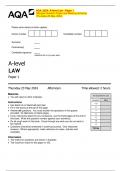
AQA_2024: A-level Law - Paper 1
(Merged Question Paper and Marking Scheme)
(Thursday 23 May 2024)
Please write clearly in block capitals.
Centre number Candidate number
Surname
Forename(s)
Candidate signat ure
I declare this is my own work.
A-level
LAW
Paper 1
Thursday 23 May 2024 Afternoon Time allowed: 2 hours
Materials
For Examiner’s Use
You will need no other materials.
Question Mark
Instructions 1–5
Use black ink or black ball-point pen.
Fill in the boxes at the top of this page. 6
Answer all questions. You must answer the questions in the spaces 7
provided. Do not write on blank pages. 8
If you need extra space for your answer(s), use the lined pages at the end of
9
this book. Write the question number against your answer(s).
Do all rough work in this book. Cross through any work you do not want to 10
be marked. 11
Questions should be answered in continuous prose. Give reasoned
TOTAL
answers. Where appropriate, make reference to cases, statutes and
examples.
Information
The marks for questions are shown in brackets.
The maximum mark for this paper is 100.
, A-Level Law: Paper 1 (Thursday 23 May 2024). Exam Summary
This paper typically covers the key principles of criminal law and tort law, providing an in-depth examination
of these areas, with a focus on applying legal rules to specific factual scenarios. Key topics usually include:
Criminal Law:
1. General Principles of Criminal Liability:
o Actus Reus (Guilty Act): Understanding the physical element of a crime, including voluntary acts,
omissions, and state of affairs crimes.
o Mens Rea (Guilty Mind): Exploring the mental element of a crime, such as intention, recklessness,
negligence, and knowledge.
2. Types of Offenses:
o Homicide: Key offenses like murder and manslaughter, including the legal definitions, defenses (such
as self-defense, diminished responsibility), and the mens rea required for each.
o Non-Fatal Offenses Against the Person: Crimes like assault, battery, ABH (Actual Bodily Harm),
and GBH (Grievous Bodily Harm), along with the relevant actus reus and mens rea for each.
o Theft: The elements of theft, including dishonest appropriation of property, and the defenses available.
o Robbery and Burglary: Defining these offenses and examining the mens rea and actus reus for each.
3. Defenses in Criminal Law:
o Insanity and Automatism: The legal tests for insanity and automatism and how they apply to criminal
cases.
o Self-Defense: The circumstances under which self-defense can be used as a defense, including
proportionality and the use of reasonable force.
o Intoxication: The impact of voluntary and involuntary intoxication on criminal liability.
Tort Law:
1. Negligence:
o Duty of Care: When a duty of care is owed and how it is established, including Donoghue v Stevenson
(1932) and the neighbor principle.
o Breach of Duty: What constitutes a breach of duty, and how the standard of care is determined.
o Causation: The "but for" test and the proximate cause rule, along with remoteness of damage.
o Defenses: Contributory negligence and volenti non fit injuria (consent to risk).
2. Liability in Tort:
o Occupiers' Liability: Understanding the duties owed by occupiers to visitors and trespassers under the
Occupiers' Liability Acts.
o Vicarious Liability: The circumstances under which an employer can be held liable for the torts
committed by their employees in the course of employment.
o Nuisance: The types of nuisance (public and private), and the elements required to prove a claim.
3. Intentional Torts:
o Assault and Battery: The definitions and elements of assault and battery, the defenses available, and
the harm required.
o False Imprisonment: The elements required to prove false imprisonment and the defenses available.
Evaluation of Legal Rules and Principles:
The paper may require students to critically evaluate the application and effectiveness of legal principles and
rules in specific contexts, comparing case law and statutory provisions.
IB/G/Jun24/G4004/E4 7162/1
, 2
Do not write
outside the
Answer all questions in the spaces provided. box
Only one answer per question is allowed.
For each question completely fill in the circle alongside the appropriate answer.
CORRECT METHOD WRONG METHODS
If you want to change your answer you must cross out your original answer as shown.
If you wish to return to an answer previously crossed out, ring the answer you now wish to select
as shown.
0 1 Which one of the following statements about the offence of murder is true?
[1 mark]
A The defendant must have acted involuntarily.
B The defendant must have committed an unlawful act.
C The defendant must have foreseen a risk of death.
D The defendant must have intended death or serious injury.
0 2 Which one of the following statements about the defence of duress is false?
[1 mark]
A The defence of duress, if successfully pleaded, leads to an
acquittal.
B The defence of duress is available if the defendant acted due to a
serious threat to their reputation.
C The defence of duress is not available for the crime of attempted
murder.
D The defence of duress may fail if the defendant had voluntarily
joined a violent gang.
IB/G/Jun24/7162/1
, 3
Do not write
outside the
0 3 box
Which one of the following statements about a trial in the criminal courts is true?
[1 mark]
A Any defence raised by the defendant must be proved beyond all
reasonable doubt.
B The defendant will be asked to plead guilty or not guilty.
C The prosecution must prove the case against the defendant on the
balance of probabilities.
D The trial will begin in the County Court.
0 4 In relation to the Bar Standards Board (BSB), which one of the following statements is
false?
[1 mark]
A The BSB can disbar a barrister who has breached the code of
conduct.
B The BSB is the body which regulates barristers.
C The BSB sets out a code of conduct for barristers.
D The BSB sets training and entry standards for barristers.
0 5 Which one of the following best describes the operation of the golden rule of statutory
interpretation?
[1 mark]
A The court asks what gap in the law led to the statute being
enacted.
B The courts can only give words in a statute their plain, ordinary
meaning.
C The courts consider the purpose for which the statute was passed.
D The courts may choose to modify the meaning of a word in a
statute to avoid an absurd outcome. 5
Turn over for the next question
Turn over ►
IB/G/Jun24/7162/1
, 4
Do not write
outside the
0 6 box
Explain three of the roles of magistrates in a criminal case.
[5 marks]
Extra space
5
IB/G/Jun24/7162/1
, 5
Do not write
outside the
box
0 7 Alicia went to a local bank armed with a gun, intending to commit a robbery. She was
about to enter the bank when she saw two police officers standing near the entrance.
Alicia walked straight past the bank and returned home.
Suggest why, in law, Alicia probably did not commit the actus reus of an attempted
robbery.
[5 marks]
Extra space
5
Turn over for the next question
Turn over ►
IB/G/Jun24/7162/1
(Merged Question Paper and Marking Scheme)
(Thursday 23 May 2024)
Please write clearly in block capitals.
Centre number Candidate number
Surname
Forename(s)
Candidate signat ure
I declare this is my own work.
A-level
LAW
Paper 1
Thursday 23 May 2024 Afternoon Time allowed: 2 hours
Materials
For Examiner’s Use
You will need no other materials.
Question Mark
Instructions 1–5
Use black ink or black ball-point pen.
Fill in the boxes at the top of this page. 6
Answer all questions. You must answer the questions in the spaces 7
provided. Do not write on blank pages. 8
If you need extra space for your answer(s), use the lined pages at the end of
9
this book. Write the question number against your answer(s).
Do all rough work in this book. Cross through any work you do not want to 10
be marked. 11
Questions should be answered in continuous prose. Give reasoned
TOTAL
answers. Where appropriate, make reference to cases, statutes and
examples.
Information
The marks for questions are shown in brackets.
The maximum mark for this paper is 100.
, A-Level Law: Paper 1 (Thursday 23 May 2024). Exam Summary
This paper typically covers the key principles of criminal law and tort law, providing an in-depth examination
of these areas, with a focus on applying legal rules to specific factual scenarios. Key topics usually include:
Criminal Law:
1. General Principles of Criminal Liability:
o Actus Reus (Guilty Act): Understanding the physical element of a crime, including voluntary acts,
omissions, and state of affairs crimes.
o Mens Rea (Guilty Mind): Exploring the mental element of a crime, such as intention, recklessness,
negligence, and knowledge.
2. Types of Offenses:
o Homicide: Key offenses like murder and manslaughter, including the legal definitions, defenses (such
as self-defense, diminished responsibility), and the mens rea required for each.
o Non-Fatal Offenses Against the Person: Crimes like assault, battery, ABH (Actual Bodily Harm),
and GBH (Grievous Bodily Harm), along with the relevant actus reus and mens rea for each.
o Theft: The elements of theft, including dishonest appropriation of property, and the defenses available.
o Robbery and Burglary: Defining these offenses and examining the mens rea and actus reus for each.
3. Defenses in Criminal Law:
o Insanity and Automatism: The legal tests for insanity and automatism and how they apply to criminal
cases.
o Self-Defense: The circumstances under which self-defense can be used as a defense, including
proportionality and the use of reasonable force.
o Intoxication: The impact of voluntary and involuntary intoxication on criminal liability.
Tort Law:
1. Negligence:
o Duty of Care: When a duty of care is owed and how it is established, including Donoghue v Stevenson
(1932) and the neighbor principle.
o Breach of Duty: What constitutes a breach of duty, and how the standard of care is determined.
o Causation: The "but for" test and the proximate cause rule, along with remoteness of damage.
o Defenses: Contributory negligence and volenti non fit injuria (consent to risk).
2. Liability in Tort:
o Occupiers' Liability: Understanding the duties owed by occupiers to visitors and trespassers under the
Occupiers' Liability Acts.
o Vicarious Liability: The circumstances under which an employer can be held liable for the torts
committed by their employees in the course of employment.
o Nuisance: The types of nuisance (public and private), and the elements required to prove a claim.
3. Intentional Torts:
o Assault and Battery: The definitions and elements of assault and battery, the defenses available, and
the harm required.
o False Imprisonment: The elements required to prove false imprisonment and the defenses available.
Evaluation of Legal Rules and Principles:
The paper may require students to critically evaluate the application and effectiveness of legal principles and
rules in specific contexts, comparing case law and statutory provisions.
IB/G/Jun24/G4004/E4 7162/1
, 2
Do not write
outside the
Answer all questions in the spaces provided. box
Only one answer per question is allowed.
For each question completely fill in the circle alongside the appropriate answer.
CORRECT METHOD WRONG METHODS
If you want to change your answer you must cross out your original answer as shown.
If you wish to return to an answer previously crossed out, ring the answer you now wish to select
as shown.
0 1 Which one of the following statements about the offence of murder is true?
[1 mark]
A The defendant must have acted involuntarily.
B The defendant must have committed an unlawful act.
C The defendant must have foreseen a risk of death.
D The defendant must have intended death or serious injury.
0 2 Which one of the following statements about the defence of duress is false?
[1 mark]
A The defence of duress, if successfully pleaded, leads to an
acquittal.
B The defence of duress is available if the defendant acted due to a
serious threat to their reputation.
C The defence of duress is not available for the crime of attempted
murder.
D The defence of duress may fail if the defendant had voluntarily
joined a violent gang.
IB/G/Jun24/7162/1
, 3
Do not write
outside the
0 3 box
Which one of the following statements about a trial in the criminal courts is true?
[1 mark]
A Any defence raised by the defendant must be proved beyond all
reasonable doubt.
B The defendant will be asked to plead guilty or not guilty.
C The prosecution must prove the case against the defendant on the
balance of probabilities.
D The trial will begin in the County Court.
0 4 In relation to the Bar Standards Board (BSB), which one of the following statements is
false?
[1 mark]
A The BSB can disbar a barrister who has breached the code of
conduct.
B The BSB is the body which regulates barristers.
C The BSB sets out a code of conduct for barristers.
D The BSB sets training and entry standards for barristers.
0 5 Which one of the following best describes the operation of the golden rule of statutory
interpretation?
[1 mark]
A The court asks what gap in the law led to the statute being
enacted.
B The courts can only give words in a statute their plain, ordinary
meaning.
C The courts consider the purpose for which the statute was passed.
D The courts may choose to modify the meaning of a word in a
statute to avoid an absurd outcome. 5
Turn over for the next question
Turn over ►
IB/G/Jun24/7162/1
, 4
Do not write
outside the
0 6 box
Explain three of the roles of magistrates in a criminal case.
[5 marks]
Extra space
5
IB/G/Jun24/7162/1
, 5
Do not write
outside the
box
0 7 Alicia went to a local bank armed with a gun, intending to commit a robbery. She was
about to enter the bank when she saw two police officers standing near the entrance.
Alicia walked straight past the bank and returned home.
Suggest why, in law, Alicia probably did not commit the actus reus of an attempted
robbery.
[5 marks]
Extra space
5
Turn over for the next question
Turn over ►
IB/G/Jun24/7162/1