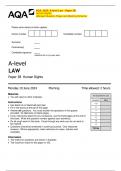
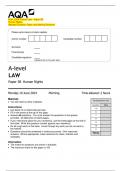
AQA_2024: A-level Law - Paper 3B
Human Rights
(Merged Question Paper and Marking Scheme)
Please write clearly in block capitals.
Centre number Candidate number
Surname
Forename(s)
Candidate signat ure
I declare this is my own work.
A-level
LAW
Paper 3B Human Rights
Monday 10 June 2024 Morning Time allowed: 2 hours
Materials
For Examiner’s Use
You will need no other materials.
Question Mark
Instructions 1–5
Use black ink or black ball-point pen.
Fill in the boxes at the top of this page. 6
Answer all questions. You must answer the questions in the spaces 7
provided. Do not write on blank pages. 8
If you need extra space for your answer(s), use the lined pages at the end of
9
this book. Write the question number against your answer(s).
Do all rough work in this book. Cross through any work you do not want to 10
be marked. 11
Questions should be answered in continuous prose. Give reasoned
TOTAL
answers. Where appropriate, make reference to cases, statutes and
examples.
Information
The marks for questions are shown in brackets.
The maximum mark for this paper is 100.
,A-Level Law: Paper 3B - Human Rights. Exam Preview
This paper focuses on the key principles and laws surrounding human rights, particularly under the framework of
UK law and international human rights instruments. Key areas typically covered include:
1. The Concept of Human Rights:
o Definition and Nature of Human Rights: Understanding human rights as fundamental freedoms
and protections that every individual is entitled to, based on dignity and equality.
o Sources of Human Rights: Overview of the sources of human rights law, including domestic
legislation, the European Convention on Human Rights (ECHR), the United Nations' Universal
2. The Human Rights Act 1998:
o Incorporation of the ECHR into UK Law: How the Human Rights Act 1998 brought the rights
under the ECHR into UK domestic law, allowing individuals to enforce their rights in UK courts
without needing to go to the European Court of Human Rights.
o Key Rights under the ECHR: The fundamental rights protected by the ECHR, such as the right
to life (Article 2), the prohibition of torture (Article 3), the right to a fair trial (Article 6), and the
right to respect for private and family life (Article 8).
3. Limitations on Human Rights:
o Derogation and Restrictions: The circumstances under which rights can be limited or derogated
(e.g., during times of national emergency).
o Balancing Competing Rights: How courts balance competing rights, for example, the right to
free speech (Article 10) versus the right to protection from hate speech or defamation.
4. Enforcement of Human Rights:
o Judicial Review: The process by which UK courts review the actions of public authorities to
ensure they comply with human rights standards.
o Role of the European Court of Human Rights: The role of the European Court of Human
Rights in Strasbourg, and how its rulings influence UK law and public policy, though it does not
have direct legislative power.
5. Key Human Rights Cases and Issues:
o Case Law: Important case law under the Human Rights Act, including landmark cases like R (on
the application of Daly) v Secretary of State for the Home Department (2001), Ghaidan v Godin-
Mendoza (2004), and R (on the application of Miller) v Secretary of State for Exiting the
European Union (2017)..
6. Rights and Responsibilities:
o Positive and Negative Obligations: The distinction between positive obligations (the duty of the
state to protect rights) and negative obligations (the duty of the state to refrain from infringing
upon rights).
o State Responsibility: The state’s responsibility for ensuring that laws, policies, and practices
comply with human rights standards, and the role of the judiciary in ensuring accountability.
This exam assesses students' understanding of the core principles of human rights law, their ability to apply these
principles to practical scenarios, and the critical analysis of human rights issues within UK law and international
contexts.
IB/G/Jun24/G4004/E7 7162/3B
, 2
Do not write
outside the
Answer all questions in the spaces provided. box
Only one answer per question is allowed.
For each question completely fill in the circle alongside the appropriate answer.
CORRECT METHOD WRONG METHODS
If you want to change your answer you must cross out your original answer as shown.
If you wish to return to an answer previously crossed out, ring the answer you now wish to select
as shown.
0 1 Select the false statement about various Articles of the European Convention on Human
Rights.
[1 mark]
A In Article 10, ‘expression’ means only the written or spoken word.
B The main aim of Article 5 is to protect all persons from the risk of
arbitrary deprivation of liberty.
C The right to life under Article 2 may be violated if there is a risk of
serious injury even if no one dies.
D Under Article 8, a public figure usually has greater protection for
privacy when acting in a private capacity than in a public capacity.
0 2 Select the true statement about various aspects of the Human Rights Act 1998 (‘the Act’).
[1 mark]
A A judge is not a ‘public authority’ under s6 of the Act.
B An alleged breach of s6 of the Act by a public authority can only be
challenged by an action for judicial review.
C English law had developed no protection at all for privacy before
the Act came into force.
D The Act makes special provision for the protection of the
Convention right to freedom of expression.
IB/G/Jun24/7162/3B
, 3
Do not write
outside the
0 3 box
In the context of delegated legislation, which of the following is most closely involved in the
creation of statutory instruments?
[1 mark]
A Government ministers
B Local councils
C The European Union
D The Supreme Court
0 4 A member state of the European Union is not properly implementing EU law.
Which institution is responsible for beginning legal action against that state?
[1 mark]
A The Council of the European Union
B The Court of Justice of the European Union
C The European Commission
D The European Parliament
0 5 Which of the following is not normally considered to be an aspect of the rule of law?
[1 mark]
A A defendant in a criminal trial must be offered proper legal
representation.
B Each person is equal before the law and has the same legal rights
and obligations.
C The House of Lords may propose amendments to a Bill.
D The independence of judges should be protected. 5
Turn over for the next question
Turn over ►
IB/G/Jun24/7162/3B
, 4
Do not write
outside the
0 6 box
Explain how by-laws are made and give two examples of matters which might be dealt
with using a by-law.
[5 marks]
Extra space
5
IB/G/Jun24/7162/3B
, 5
Do not write
outside the
box
0 7 Police were alerted to reports of a woman damaging cars in a number of streets.
Anji was seen running down one of the streets, holding a hammer. When police officers
stopped Anji, she gave her correct name and address. She was then arrested for
offences of causing criminal damage. However, she was later released without charge
when it was discovered that she had no connection with the damage to the cars.
Suggest why Anji’s arrest for offences of causing criminal damage to cars was probably
lawful under the Police and Criminal Evidence Act 1984, even though she had not in fact
committed any criminal offence.
[5 marks]
Extra space
5
Turn over for the next question
Turn over ►
IB/G/Jun24/7162/3B
, 6
Do not write
outside the
box
0 8 A police emergency call handler received a confused telephone call from a worried
neighbour suggesting that someone had been shot in an ongoing domestic incident.
In fact, though Brice had produced a gun during the incident, he had not fired it at
anyone. The call handler later discovered this, but she did not pass the information on.
By the time armed police attended the incident, Brice had violently beaten his
ex-partner, Callie, and her new boyfriend, Duke, and dragged them into the garden.
Despite repeated police attempts to calm the situation, Brice became increasingly
agitated. He pointed the gun at Duke’s head, shouting, “He can’t mess with my woman.
He’s dead.” Ellis, one of the police officers, immediately shot and killed Brice on
obtaining a clear shot. Brice’s ‘gun’ turned out to be a very realistic replica, incapable of
firing bullets.
Having regard to the right to life under Article 2 of the European Convention on Human
Rights, advise the police as to whether they are liable for any breach of the Human Rights
Act 1998 s6 in connection with the death of Brice.
[10 marks]
IB/G/Jun24/7162/3B
Human Rights
(Merged Question Paper and Marking Scheme)
Please write clearly in block capitals.
Centre number Candidate number
Surname
Forename(s)
Candidate signat ure
I declare this is my own work.
A-level
LAW
Paper 3B Human Rights
Monday 10 June 2024 Morning Time allowed: 2 hours
Materials
For Examiner’s Use
You will need no other materials.
Question Mark
Instructions 1–5
Use black ink or black ball-point pen.
Fill in the boxes at the top of this page. 6
Answer all questions. You must answer the questions in the spaces 7
provided. Do not write on blank pages. 8
If you need extra space for your answer(s), use the lined pages at the end of
9
this book. Write the question number against your answer(s).
Do all rough work in this book. Cross through any work you do not want to 10
be marked. 11
Questions should be answered in continuous prose. Give reasoned
TOTAL
answers. Where appropriate, make reference to cases, statutes and
examples.
Information
The marks for questions are shown in brackets.
The maximum mark for this paper is 100.
,A-Level Law: Paper 3B - Human Rights. Exam Preview
This paper focuses on the key principles and laws surrounding human rights, particularly under the framework of
UK law and international human rights instruments. Key areas typically covered include:
1. The Concept of Human Rights:
o Definition and Nature of Human Rights: Understanding human rights as fundamental freedoms
and protections that every individual is entitled to, based on dignity and equality.
o Sources of Human Rights: Overview of the sources of human rights law, including domestic
legislation, the European Convention on Human Rights (ECHR), the United Nations' Universal
2. The Human Rights Act 1998:
o Incorporation of the ECHR into UK Law: How the Human Rights Act 1998 brought the rights
under the ECHR into UK domestic law, allowing individuals to enforce their rights in UK courts
without needing to go to the European Court of Human Rights.
o Key Rights under the ECHR: The fundamental rights protected by the ECHR, such as the right
to life (Article 2), the prohibition of torture (Article 3), the right to a fair trial (Article 6), and the
right to respect for private and family life (Article 8).
3. Limitations on Human Rights:
o Derogation and Restrictions: The circumstances under which rights can be limited or derogated
(e.g., during times of national emergency).
o Balancing Competing Rights: How courts balance competing rights, for example, the right to
free speech (Article 10) versus the right to protection from hate speech or defamation.
4. Enforcement of Human Rights:
o Judicial Review: The process by which UK courts review the actions of public authorities to
ensure they comply with human rights standards.
o Role of the European Court of Human Rights: The role of the European Court of Human
Rights in Strasbourg, and how its rulings influence UK law and public policy, though it does not
have direct legislative power.
5. Key Human Rights Cases and Issues:
o Case Law: Important case law under the Human Rights Act, including landmark cases like R (on
the application of Daly) v Secretary of State for the Home Department (2001), Ghaidan v Godin-
Mendoza (2004), and R (on the application of Miller) v Secretary of State for Exiting the
European Union (2017)..
6. Rights and Responsibilities:
o Positive and Negative Obligations: The distinction between positive obligations (the duty of the
state to protect rights) and negative obligations (the duty of the state to refrain from infringing
upon rights).
o State Responsibility: The state’s responsibility for ensuring that laws, policies, and practices
comply with human rights standards, and the role of the judiciary in ensuring accountability.
This exam assesses students' understanding of the core principles of human rights law, their ability to apply these
principles to practical scenarios, and the critical analysis of human rights issues within UK law and international
contexts.
IB/G/Jun24/G4004/E7 7162/3B
, 2
Do not write
outside the
Answer all questions in the spaces provided. box
Only one answer per question is allowed.
For each question completely fill in the circle alongside the appropriate answer.
CORRECT METHOD WRONG METHODS
If you want to change your answer you must cross out your original answer as shown.
If you wish to return to an answer previously crossed out, ring the answer you now wish to select
as shown.
0 1 Select the false statement about various Articles of the European Convention on Human
Rights.
[1 mark]
A In Article 10, ‘expression’ means only the written or spoken word.
B The main aim of Article 5 is to protect all persons from the risk of
arbitrary deprivation of liberty.
C The right to life under Article 2 may be violated if there is a risk of
serious injury even if no one dies.
D Under Article 8, a public figure usually has greater protection for
privacy when acting in a private capacity than in a public capacity.
0 2 Select the true statement about various aspects of the Human Rights Act 1998 (‘the Act’).
[1 mark]
A A judge is not a ‘public authority’ under s6 of the Act.
B An alleged breach of s6 of the Act by a public authority can only be
challenged by an action for judicial review.
C English law had developed no protection at all for privacy before
the Act came into force.
D The Act makes special provision for the protection of the
Convention right to freedom of expression.
IB/G/Jun24/7162/3B
, 3
Do not write
outside the
0 3 box
In the context of delegated legislation, which of the following is most closely involved in the
creation of statutory instruments?
[1 mark]
A Government ministers
B Local councils
C The European Union
D The Supreme Court
0 4 A member state of the European Union is not properly implementing EU law.
Which institution is responsible for beginning legal action against that state?
[1 mark]
A The Council of the European Union
B The Court of Justice of the European Union
C The European Commission
D The European Parliament
0 5 Which of the following is not normally considered to be an aspect of the rule of law?
[1 mark]
A A defendant in a criminal trial must be offered proper legal
representation.
B Each person is equal before the law and has the same legal rights
and obligations.
C The House of Lords may propose amendments to a Bill.
D The independence of judges should be protected. 5
Turn over for the next question
Turn over ►
IB/G/Jun24/7162/3B
, 4
Do not write
outside the
0 6 box
Explain how by-laws are made and give two examples of matters which might be dealt
with using a by-law.
[5 marks]
Extra space
5
IB/G/Jun24/7162/3B
, 5
Do not write
outside the
box
0 7 Police were alerted to reports of a woman damaging cars in a number of streets.
Anji was seen running down one of the streets, holding a hammer. When police officers
stopped Anji, she gave her correct name and address. She was then arrested for
offences of causing criminal damage. However, she was later released without charge
when it was discovered that she had no connection with the damage to the cars.
Suggest why Anji’s arrest for offences of causing criminal damage to cars was probably
lawful under the Police and Criminal Evidence Act 1984, even though she had not in fact
committed any criminal offence.
[5 marks]
Extra space
5
Turn over for the next question
Turn over ►
IB/G/Jun24/7162/3B
, 6
Do not write
outside the
box
0 8 A police emergency call handler received a confused telephone call from a worried
neighbour suggesting that someone had been shot in an ongoing domestic incident.
In fact, though Brice had produced a gun during the incident, he had not fired it at
anyone. The call handler later discovered this, but she did not pass the information on.
By the time armed police attended the incident, Brice had violently beaten his
ex-partner, Callie, and her new boyfriend, Duke, and dragged them into the garden.
Despite repeated police attempts to calm the situation, Brice became increasingly
agitated. He pointed the gun at Duke’s head, shouting, “He can’t mess with my woman.
He’s dead.” Ellis, one of the police officers, immediately shot and killed Brice on
obtaining a clear shot. Brice’s ‘gun’ turned out to be a very realistic replica, incapable of
firing bullets.
Having regard to the right to life under Article 2 of the European Convention on Human
Rights, advise the police as to whether they are liable for any breach of the Human Rights
Act 1998 s6 in connection with the death of Brice.
[10 marks]
IB/G/Jun24/7162/3B