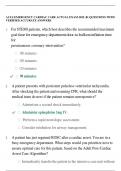
EMERGENCY CARDIAC CARE ACTUAL EXAM 2025 |149 QUESTIONS
WITH ACCURATE SOLUTIONS
1. What is the most reliable method of confirming &
monitoring correct placement of an endotracheal tube?
use of esophageal detection devices
continuous waveform capnography
use of pulse oximetry
device 5-point
auscultation
2. What medication is indicated for a patient
experiencing asystole? Atropine
Epinephrin
e
Amiodarone
Lidocaine
3. Post-cardiac arrest patients undergoing induced
hypothermia must have their core body temperature
, cooled to:
between 34-
36º C between
32-34º C between
20-22º C
between 28-30º C
4. What is the ideal targeted temperature for therapeutic
hypothermia?
31-34 degrees Celsius
28-35 degrees Celsius
32-25 degrees Celsius
28-34 degrees Celsius
,5. What is the term used to describe the abnormal type of
breaths that may occur in the initial minutes following
sudden cardiac arrest?
Choking breaths
Agonal gasps
Hyperventilation
Normal
respiration
6. How does a first-degree heart block differ from normal
sinus rhythm in terms of PR interval, and what does this
indicate about the conduction through the AV node?
The PR interval is shorter, indicating faster conduction
The PR interval is longer, indicating delayed
conduction The PR interval is irregular,
indicating erratic conduction The PR interval is
absent, indicating no conduction
7. Respiratory arrest is a possible complication of high
concentration oxygen administration for:
stroke
victims
, cardiac
patients
Children
COPD patients
8. In a scenario where a patient in cardiac arrest has received
two shocks and one dose of epinephrine, but remains in
pulseless ventricular tachycardia, what would be the next
steps in the emergency response protocol, including drug
administration and other interventions?
Administer amiodarone 300 mg and continue
CPR while preparing for advanced airway
management.
WITH ACCURATE SOLUTIONS
1. What is the most reliable method of confirming &
monitoring correct placement of an endotracheal tube?
use of esophageal detection devices
continuous waveform capnography
use of pulse oximetry
device 5-point
auscultation
2. What medication is indicated for a patient
experiencing asystole? Atropine
Epinephrin
e
Amiodarone
Lidocaine
3. Post-cardiac arrest patients undergoing induced
hypothermia must have their core body temperature
, cooled to:
between 34-
36º C between
32-34º C between
20-22º C
between 28-30º C
4. What is the ideal targeted temperature for therapeutic
hypothermia?
31-34 degrees Celsius
28-35 degrees Celsius
32-25 degrees Celsius
28-34 degrees Celsius
,5. What is the term used to describe the abnormal type of
breaths that may occur in the initial minutes following
sudden cardiac arrest?
Choking breaths
Agonal gasps
Hyperventilation
Normal
respiration
6. How does a first-degree heart block differ from normal
sinus rhythm in terms of PR interval, and what does this
indicate about the conduction through the AV node?
The PR interval is shorter, indicating faster conduction
The PR interval is longer, indicating delayed
conduction The PR interval is irregular,
indicating erratic conduction The PR interval is
absent, indicating no conduction
7. Respiratory arrest is a possible complication of high
concentration oxygen administration for:
stroke
victims
, cardiac
patients
Children
COPD patients
8. In a scenario where a patient in cardiac arrest has received
two shocks and one dose of epinephrine, but remains in
pulseless ventricular tachycardia, what would be the next
steps in the emergency response protocol, including drug
administration and other interventions?
Administer amiodarone 300 mg and continue
CPR while preparing for advanced airway
management.