Early Language and Literacy
Development Midterm with
complete verified solutions
already graded A+(100%
ACCURACY)
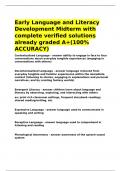
Contextualized Language - answer ability to engage in face to face
conversations about everyday tangible experiences (engaging in
conversations with others)
Decontextualized Language - answer language removed from
everyday tangible and familiar experiences within the immediate
context (listening to stories, engaging in explanations and personal
narratives, and by creating fantasy worlds)
Emergent Literacy - answer children learn about language and
literacy by observing, exploring, and interacting with others
ex: print rich classroom settings, frequent storybook readings,
shared reading/writing, etc.
Expressive Language - answer language used to communicate in
speaking and writing
Receptive Language - answer language used to comprehend in
listening and reading
Phonological Awareness - answer awareness of the speech sound
system
, Alphabet Knowledge - answer knowledge about the alphabetic
writing systems (letter names, sounds, groups)
Print Awareness - answer knowledge of the conventions and
characteristics of written language
Scientifically Based Reading Research - answer targeted instruction
that helps all children learn necessary literacy skills
large and small group instruction (oral language, phonological
awareness, alphabet knowledge, concepts about print - practice
these skills at center time)
Early Literacy Approach - answer Emergent Literacy and SBRR
combined
print rich classroom, active exploration, frequent storybook reading
Fast mapping - answer ability to related new words to preexisting
internalized concepts, then remember and use them after only one
exposure (children refine these definitions over time)
Phonology - answer sounds that make up a language
Phonemes - answer individual sounds that make up spoken words
Morphemes - answer smaller unit of meaning in oral language
Morphology - answer meaningful part of language, including words
and affixed
Echolalia - answer word like sounds babies make
Development Midterm with
complete verified solutions
already graded A+(100%
ACCURACY)
Contextualized Language - answer ability to engage in face to face
conversations about everyday tangible experiences (engaging in
conversations with others)
Decontextualized Language - answer language removed from
everyday tangible and familiar experiences within the immediate
context (listening to stories, engaging in explanations and personal
narratives, and by creating fantasy worlds)
Emergent Literacy - answer children learn about language and
literacy by observing, exploring, and interacting with others
ex: print rich classroom settings, frequent storybook readings,
shared reading/writing, etc.
Expressive Language - answer language used to communicate in
speaking and writing
Receptive Language - answer language used to comprehend in
listening and reading
Phonological Awareness - answer awareness of the speech sound
system
, Alphabet Knowledge - answer knowledge about the alphabetic
writing systems (letter names, sounds, groups)
Print Awareness - answer knowledge of the conventions and
characteristics of written language
Scientifically Based Reading Research - answer targeted instruction
that helps all children learn necessary literacy skills
large and small group instruction (oral language, phonological
awareness, alphabet knowledge, concepts about print - practice
these skills at center time)
Early Literacy Approach - answer Emergent Literacy and SBRR
combined
print rich classroom, active exploration, frequent storybook reading
Fast mapping - answer ability to related new words to preexisting
internalized concepts, then remember and use them after only one
exposure (children refine these definitions over time)
Phonology - answer sounds that make up a language
Phonemes - answer individual sounds that make up spoken words
Morphemes - answer smaller unit of meaning in oral language
Morphology - answer meaningful part of language, including words
and affixed
Echolalia - answer word like sounds babies make