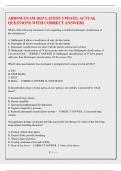
ABDSM EXAM 2025 LATEST UPDATE| ACTUAL QUESTIONS WITH CORRECT ANSWERS
Which of the following statements is true regarding a modified mallampati classification of the oral pharynx? A. Mallampati II allows visualization of only the hard palate B. Malampati III allows visualization of only the hard palate C. Malampati classifications are taken with the patient sedated and reclined D. Mallampati classifications of IV have greater odds ratio than Mallampati classifications of I for severe OSA - CORRECT ANSWER D. Mallampati classifications of IV have greater odds ratio than Mallampati classifications of I for severe OSA What 8 item questionnaire was developed to perioperatively screen for risk of OSA? A. ESS B. STOP-BANG C. MSLT D. Berlin - CORRECT ANSWER B. STOP-BANG In the pathophysiology of sleep apnea, airway patency and stability is promoted by which factor? A. Increased lung volume B. Shorter mandible C. Increased parapharyngeal fat deposition D. Negative inspiratory pressure E. Reduced pharyngeal muscle dilator activity - CORRECT ANSWER A. Increased lung volume Oral appliance therapy commonly provides successful sole therapy for which of the following sleep-related breathing disorders? A. Primary central sleep apnea B. Cheyne-Stoke periodic breathing C. Obesity hypoventilation D. Overlap syndrome (OSA and COPD) E. None of the above - CORRECT ANSWER E. None of the above 2 | P a g e Which of the following is true about OSA and HTN? A. Ambulatory BP is increased in OSA patients primarily due to increased salt intake associated with elevated ghrelin levels B. Ambulatory BP normally increases in the early AM before awakening - this increase is blunted in OSA C. Untreated OSA is associated with a similar risk of HTN at all severity levels D. The risk of HTN in untreated OSA is due to intermittent hypoxia, sympathetic overactivation, inflammation, and other complex factors - CORRECT ANSWER D. The risk of HTN in untreated OSA is due to intermittent hypoxia, sympathetic overactivation, inflammation, and other complex factors Across a general population, what is the most common sleep disorder? A. RLS B. Narcolepsy C. Delayed sleep phase syndrome D. Insomnia E. Obstructive sleep apnea - CORRECT ANSWER D. Insomnia Measurement has shown that patients with sleep apnea have smaller upper airways than those without sleep apnea but manage to keep an open airway during wakefulness by: A. Mouth Breathing B. Increased muscle tone on inspiration C. Increased blood flow to the soft tissue D. Frequent bruxing - CORRECT ANSWER B. Increased muscle tone on inspiration Key features of sleep apnea as recorded during an in-lab sleep study include marked reduction or absence of air flow, arousals from sleep, slowing of heart rate and: A. Choking or gasping for air B. Oxygen desaturation C. Flattening of the nasal pressure signal D. Flailing of the arms and legs E. Sawtooth waves in the EEG - CORRECT ANSWER B. Oxygen Desaturation Who publishes the CPT codebook? 3 | P a g e A. The Centers for Medicare and Medicaid Services B. The American Medical Association C. The Office of the Inspector General D. The Durable Medical Equipment Service E. The American Academy of Sleep Medicine - CORRECT ANSWER B. The American Medical Association A 48 year old man is treated with OAT for his moderate OSA. On repeat sleep testing, his apnea-hypopnea index (AHI) has decreased to 3 events per hour, and he reports resolution of snoring and daytime sleepiness. What is the most reasonable dental-medical sleep medicine follow up regimen for this patient? A. As needed B. Every 6 months for the first year, then annually C. Monthly for the first 6 months, then every 6 months D. Every other year - CORRECT ANSWER B. Every 6 months for the first year, then annually Which of the following would exclude oral appliance therapy as a first treatment trial for OSA? A. Xerostomia B. Edentulism C. Micrognathia D. Steep mandibular plane angle - CORRECT ANSWER B. Edentulism Reviewing your patient's diagnostic polysomnogram, you note more than a 50% epoch consists of alpha waves. According to the current PSG scoring guidelines, the patient is in which stage of sleep? A. Stage I NREM B. Stage II NREM C. Stage III NREM D. Stage REM - CORRECT ANSWER A. Stage I NREM A patient presents for an evaluation to determine their candidacy for an oral appliance to treat their mild OSA. During your examination, you note the presence of TMD. This might include the following:
Written for
- Institution
- Abdsm
- Course
- Abdsm
Document information
- Uploaded on
- February 3, 2025
- Number of pages
- 55
- Written in
- 2024/2025
- Type
- Exam (elaborations)
- Contains
- Questions & answers
Subjects
- abdsm exam 2025
- abdsm
- abdsm exam 2025
-
abdsm exam 2025 latest update actual questions w
-
abdsm exam 2025 latest update
-
abdsm exam 2025 latest update actual questions w
-
which of the following statement

Also available in package deal