Blaire Messmann
Biology
Exam 3 Test Review
General
- Diploid: the cell contains two copies of each chromosome (homologous pair)
- Haploid: the cell only contains only one copy of each chromosome
- Each person has two alleles for each gene because they have two copies of each
chromosome
- Asexual reproduction: an organism that reproduces by itself
- Does not involve the union of sex cells or gametes
- Sexual reproduction: needs two partners to reproduce
- Union of sex cells/gametes
- Creates genetic diversity in organisms
- Apoptosis: the death of cells that occurs as a normal and controlled part of an organism’s
growth or development
- Cells receive signals telling them to go through apoptosis and self destruct
- Cancer cells don’t listen to signals and continue to divide instead of going through
apoptosis
,DNA Replication
- Function of DNA: contains the instructions needed for an organism to develop, survive
and reproduce. To carry out these functions, DNA sequences must be converted into
messages that can be used to produce proteins, which are the complex molecules that do
most of the work in our bodies.
- DNA is a polymer
- Monomers: Nucleotides (A, T, G, C)
- Phosphodiester bonds hold together the monomers in a single strand of DNA
- Adenine base-pairs with Thymine, Guanine base-pairs with Cytosine
- Hydrogen bonds hold base pairs together between two strands of DNA
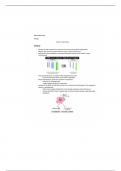
-
- DNA Replication: occurring in the S phase of the cell cycle, the purpose is to make an
exact copy of a DNA molecule prior to cell division (mitosis) so each daughter cell has
the full set of genetic material, ensuring that each resulting cell is able to receive a
complete set of genes from the original cell
- 1.) Helicase breaks the hydrogen bonds that hold the complementary bases of
DNA together, unzipping the double helix, creating the replication fork, and
separating the DNA into two strands (leading and lagging)
- The replication fork serves as the template for replication
- The leading strand is oriented in the 3’ to 5’ direction while the lagging
strand is oriented in the 5’ to 3’ direction
- DNA Polymerase can only copy strands in the 5’ 3’ direction so it can
only add new nucleotides to the free 3’ end of a primer, so making a new
DNA strand for the leading strand is easier than for the lagging strand
- 2.) A primer made by an enzyme, RNA Primase, binds to the end of the leading
strand, acting as the starting point for DNA synthesis. Numerous RNA primers
bind at various points on the lagging strand.
, - 3.) DNA Polymerase binds and adds new nucleotide bases to the leading strand in
the 5’ 3’ direction. Chunks of DNA, called Okazaki Fragments, are added to the
lagging strand in the 5’ to 3’ direction.
- 4.) DNA Ligase then seals up the sequence of DNA into two continuous double
strands
- Chargaff’s Rule: there is always equality in quantity between the bases A and T and
between the bases G and C
- Double Helix: molecular shape formed by double-stranded DNA
- The two strands of DNA are antiparallel and complementary to each other, physically
parallel to each other but they run in opposite directions
- DNA Helicase: unwinds the double helix at the replication fork
- DNA Gyrase: relieves torsional strain on the DNA caused by helicase.
- DNA Primase: an enzyme that synthesizes short RNA sequences called primers, which
serve as a starting point for DNA synthesis
- DNA Polymerase: responsible for forming new copies of DNA, reads the old DNA
strands to synthesize new DNA strands by adding complementary nucleotides.
- DNA polymerase requires an RNA primer to initiate strand formation,
polymerase cannot start a new strand of DNA by itself.
- DNA Ligase: glues Okazaki fragments together to create one continuous strand of DNA
- DNA replication is semidiscontinuous: the leading strand is synthesized continuously
and the lagging strand is synthesized discontinuously.
- This is because DNA Polymerase can only add nucleotides in the 5’ 3’ direction
and only the leading strand runs in this direction so the lagging strand must be
replicated in fragments as new sections of DNA are unwound.
Biology
Exam 3 Test Review
General
- Diploid: the cell contains two copies of each chromosome (homologous pair)
- Haploid: the cell only contains only one copy of each chromosome
- Each person has two alleles for each gene because they have two copies of each
chromosome
- Asexual reproduction: an organism that reproduces by itself
- Does not involve the union of sex cells or gametes
- Sexual reproduction: needs two partners to reproduce
- Union of sex cells/gametes
- Creates genetic diversity in organisms
- Apoptosis: the death of cells that occurs as a normal and controlled part of an organism’s
growth or development
- Cells receive signals telling them to go through apoptosis and self destruct
- Cancer cells don’t listen to signals and continue to divide instead of going through
apoptosis
,DNA Replication
- Function of DNA: contains the instructions needed for an organism to develop, survive
and reproduce. To carry out these functions, DNA sequences must be converted into
messages that can be used to produce proteins, which are the complex molecules that do
most of the work in our bodies.
- DNA is a polymer
- Monomers: Nucleotides (A, T, G, C)
- Phosphodiester bonds hold together the monomers in a single strand of DNA
- Adenine base-pairs with Thymine, Guanine base-pairs with Cytosine
- Hydrogen bonds hold base pairs together between two strands of DNA
-
- DNA Replication: occurring in the S phase of the cell cycle, the purpose is to make an
exact copy of a DNA molecule prior to cell division (mitosis) so each daughter cell has
the full set of genetic material, ensuring that each resulting cell is able to receive a
complete set of genes from the original cell
- 1.) Helicase breaks the hydrogen bonds that hold the complementary bases of
DNA together, unzipping the double helix, creating the replication fork, and
separating the DNA into two strands (leading and lagging)
- The replication fork serves as the template for replication
- The leading strand is oriented in the 3’ to 5’ direction while the lagging
strand is oriented in the 5’ to 3’ direction
- DNA Polymerase can only copy strands in the 5’ 3’ direction so it can
only add new nucleotides to the free 3’ end of a primer, so making a new
DNA strand for the leading strand is easier than for the lagging strand
- 2.) A primer made by an enzyme, RNA Primase, binds to the end of the leading
strand, acting as the starting point for DNA synthesis. Numerous RNA primers
bind at various points on the lagging strand.
, - 3.) DNA Polymerase binds and adds new nucleotide bases to the leading strand in
the 5’ 3’ direction. Chunks of DNA, called Okazaki Fragments, are added to the
lagging strand in the 5’ to 3’ direction.
- 4.) DNA Ligase then seals up the sequence of DNA into two continuous double
strands
- Chargaff’s Rule: there is always equality in quantity between the bases A and T and
between the bases G and C
- Double Helix: molecular shape formed by double-stranded DNA
- The two strands of DNA are antiparallel and complementary to each other, physically
parallel to each other but they run in opposite directions
- DNA Helicase: unwinds the double helix at the replication fork
- DNA Gyrase: relieves torsional strain on the DNA caused by helicase.
- DNA Primase: an enzyme that synthesizes short RNA sequences called primers, which
serve as a starting point for DNA synthesis
- DNA Polymerase: responsible for forming new copies of DNA, reads the old DNA
strands to synthesize new DNA strands by adding complementary nucleotides.
- DNA polymerase requires an RNA primer to initiate strand formation,
polymerase cannot start a new strand of DNA by itself.
- DNA Ligase: glues Okazaki fragments together to create one continuous strand of DNA
- DNA replication is semidiscontinuous: the leading strand is synthesized continuously
and the lagging strand is synthesized discontinuously.
- This is because DNA Polymerase can only add nucleotides in the 5’ 3’ direction
and only the leading strand runs in this direction so the lagging strand must be
replicated in fragments as new sections of DNA are unwound.