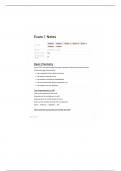
Exam 1 Notes
chapter 1 chapter 2 chapter 3 chapter 4 chapter 5
chapter 6 chapter 7
N/A
Basic Chemistry
In the 1700’s scientists thought that sperm contained a fully formed miniature human.
All life shares five characteristics:
Life is organized; it has a distinct structure
Life requires an energy source
Life maintains consistency. (Homeostasis)
Life stores information (genes) and passes it on.
Life changes over time. (Evolves)
The Characteristics of Life
Cells are the fundamental unit of life
Organelles are the working parts in cells
Molecules are even smaller groups of atoms
Atoms are the smallest chemical unit of a substance
Atoms → Molecule → Organelle → Cell
How could we test if popcorn kernels are alive?
, Hypothesis- explains <why= (casual statement)
Popcorn kernels are not living because they do not respire (take O2, give off CO2)
Prediction: If popcorn kernels are alive then they will respire
Popcorn kernels would be the experimental group in this experiment because we are test
see if they are living or not.
Constant is different from the control. Constants are things that don’t change throughout
whole study. ex. how many grams of liquid you use, what you are testing, etc.
Water molecule (H2O)
— covalent bonds- strong (intra-molecular)
\/ hydrogen bonds- weak (inter-molecular)
Oxygen is attracting electrons from the hydrogen atoms
Protons (+) attract Electrons (-)
1st shell: 2 electrons
, 2nd shell: 8 electrons
3rd shell: 8 electrons
All shells are filled by the sharing of electrons (covalent bonds)
pic of H2O molecule
Elements of organic molecules
Definition-Electronegativity: ability to attract and steal electrons
Non-polar covalent 0.4 difference
Polar covalent ≥ 0.4 difference
Ionic bonds form when one atom transfers (donates) its electron to another atom
OIL RIG
Oxidation Is Loss
Reduction Is Gain
Na is oxidized (loss)
Cl is reduced (gain)
Transfer of electrons creates a charge
Na+ Cl- ions form ionic bonds
Water
Water is polar, cohesive, and adhesive
The cohesive and adhesive properties allow water to transpire
chapter 1 chapter 2 chapter 3 chapter 4 chapter 5
chapter 6 chapter 7
N/A
Basic Chemistry
In the 1700’s scientists thought that sperm contained a fully formed miniature human.
All life shares five characteristics:
Life is organized; it has a distinct structure
Life requires an energy source
Life maintains consistency. (Homeostasis)
Life stores information (genes) and passes it on.
Life changes over time. (Evolves)
The Characteristics of Life
Cells are the fundamental unit of life
Organelles are the working parts in cells
Molecules are even smaller groups of atoms
Atoms are the smallest chemical unit of a substance
Atoms → Molecule → Organelle → Cell
How could we test if popcorn kernels are alive?
, Hypothesis- explains <why= (casual statement)
Popcorn kernels are not living because they do not respire (take O2, give off CO2)
Prediction: If popcorn kernels are alive then they will respire
Popcorn kernels would be the experimental group in this experiment because we are test
see if they are living or not.
Constant is different from the control. Constants are things that don’t change throughout
whole study. ex. how many grams of liquid you use, what you are testing, etc.
Water molecule (H2O)
— covalent bonds- strong (intra-molecular)
\/ hydrogen bonds- weak (inter-molecular)
Oxygen is attracting electrons from the hydrogen atoms
Protons (+) attract Electrons (-)
1st shell: 2 electrons
, 2nd shell: 8 electrons
3rd shell: 8 electrons
All shells are filled by the sharing of electrons (covalent bonds)
pic of H2O molecule
Elements of organic molecules
Definition-Electronegativity: ability to attract and steal electrons
Non-polar covalent 0.4 difference
Polar covalent ≥ 0.4 difference
Ionic bonds form when one atom transfers (donates) its electron to another atom
OIL RIG
Oxidation Is Loss
Reduction Is Gain
Na is oxidized (loss)
Cl is reduced (gain)
Transfer of electrons creates a charge
Na+ Cl- ions form ionic bonds
Water
Water is polar, cohesive, and adhesive
The cohesive and adhesive properties allow water to transpire