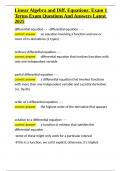
Linear Algebra and Diff. Equations: Exam 1
Terms Exam Questions And Answers Latest
2025
differential equation - - - differential equation - - -
correct answer ✅an equation involving a function and one or
more of its derivatives (2 types)
ordinary differential equation - - -
correct answer ✅differential equation that involves functions with
only one independent variable
partial differential equation - - -
correct answer ✅a differential equation that involves functions
with more than one independent variable and a partial derivative
(i.e. ∂y/∂x)
order of a differential equation - - -
correct answer ✅the highest order of the derivative that appears
solution to a differential equation - - -
correct answer ✅a function or relation that satisfies the
differential equation
-some of these might only work for a particular interval
-if this is a function, we call it explicit, otherwise, it's implicit
,Linear Algebra and Diff. Equations: Exam 1
Terms Exam Questions And Answers Latest
2025
direction field (slope field) - - -
correct answer ✅a graph plotting line segments for a DE of the
form dy/dx=f(x,y)
existence and uniqueness theorem - - -
correct answer ✅given the IVP: dy/dx=f(x,y) and y(x₀)=y₀
the IVP (initial value problem) has a unique solition on an open
interval containing x₀, provided f(x,y) and δf/δy are both
continuous on a rectangle around (x₀,y₀)
separable differential equation - - -
correct answer ✅given: dy/dx=f(x,y)
f(x,y)=g(x)h(y) (or if the DE can be rearranged into that form)
linear first-order differential equation - - -
correct answer ✅a₁(x)(dy/dx)+a₀(x)y=F(x)
, Linear Algebra and Diff. Equations: Exam 1
Terms Exam Questions And Answers Latest
2025
general case: linear first-order DE - - -
correct answer ✅dy/dx+P(x)y=Q(x)
linear first-order DE theorem - - -
correct answer ✅If P(x) and Q(x) are continuous on an interval
(a,b) containing x, then for any choice of initial value y, then the IVP
[dy/dx+P(x)y=Q(x), y(x₀)=y₀] has exactly one solution on (a,b)
exact solution - - -
correct answer ✅M(x,y)dx+N(x,y)dy is exact if there is an f(x,y)
such that (δf/δx)(x,y)=M(x,y) and (δf/δy)(x,y)=N(x,y)
homogenous equations (substitution 1) - - -
correct answer ✅dy/dx=f(x,y)=G(y/x), v=y/x
-is f(x,y)=f(tx,ty) for all t≠0?
dy/dx=G(v)
substitution 2 - - -
correct answer ✅dy/dx=G(ax+by), v=ax+by
Terms Exam Questions And Answers Latest
2025
differential equation - - - differential equation - - -
correct answer ✅an equation involving a function and one or
more of its derivatives (2 types)
ordinary differential equation - - -
correct answer ✅differential equation that involves functions with
only one independent variable
partial differential equation - - -
correct answer ✅a differential equation that involves functions
with more than one independent variable and a partial derivative
(i.e. ∂y/∂x)
order of a differential equation - - -
correct answer ✅the highest order of the derivative that appears
solution to a differential equation - - -
correct answer ✅a function or relation that satisfies the
differential equation
-some of these might only work for a particular interval
-if this is a function, we call it explicit, otherwise, it's implicit
,Linear Algebra and Diff. Equations: Exam 1
Terms Exam Questions And Answers Latest
2025
direction field (slope field) - - -
correct answer ✅a graph plotting line segments for a DE of the
form dy/dx=f(x,y)
existence and uniqueness theorem - - -
correct answer ✅given the IVP: dy/dx=f(x,y) and y(x₀)=y₀
the IVP (initial value problem) has a unique solition on an open
interval containing x₀, provided f(x,y) and δf/δy are both
continuous on a rectangle around (x₀,y₀)
separable differential equation - - -
correct answer ✅given: dy/dx=f(x,y)
f(x,y)=g(x)h(y) (or if the DE can be rearranged into that form)
linear first-order differential equation - - -
correct answer ✅a₁(x)(dy/dx)+a₀(x)y=F(x)
, Linear Algebra and Diff. Equations: Exam 1
Terms Exam Questions And Answers Latest
2025
general case: linear first-order DE - - -
correct answer ✅dy/dx+P(x)y=Q(x)
linear first-order DE theorem - - -
correct answer ✅If P(x) and Q(x) are continuous on an interval
(a,b) containing x, then for any choice of initial value y, then the IVP
[dy/dx+P(x)y=Q(x), y(x₀)=y₀] has exactly one solution on (a,b)
exact solution - - -
correct answer ✅M(x,y)dx+N(x,y)dy is exact if there is an f(x,y)
such that (δf/δx)(x,y)=M(x,y) and (δf/δy)(x,y)=N(x,y)
homogenous equations (substitution 1) - - -
correct answer ✅dy/dx=f(x,y)=G(y/x), v=y/x
-is f(x,y)=f(tx,ty) for all t≠0?
dy/dx=G(v)
substitution 2 - - -
correct answer ✅dy/dx=G(ax+by), v=ax+by