Mercantile Law 292
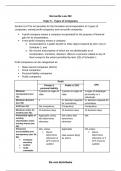
Topic 5 – Types of Companies
Section 8 of The Act provides for the formation and incorporation of 2 types of
companies, namely profit companies and non-profit companies.
A profit company means a company incorporated for the purpose of financial
gain for its shareholders.
A non-profit company means a company
o incorporated for a public benefit or other object required by item 1(1) of
Schedule 1; and
o the income and property of which are not distributable to its
incorporators, members, directors, officers or persons related to any of
them except to the extent permitted by item 1(3) of Schedule 1
Profit companies can be categorised as:
State-owned companies (SOCs)
Privat companies
Personal liability companies
Public companies
Profit
Private & Public & SOC NPC
personal liability
Minimum 1 person or organ of 1 person or organ of 1 organ of state/legal
incorporators (sec state state personality or 3
13): individuals
Minimum directors 1 3+ directors required 3+ directors required for
(sec 66): for committees committees
AGM (sec 61): Not compulsory Compulsory Compulsory
Minimum notice for 10 business days 15 business days 15 business days
meeting (sec 62):
Preferential rights of Applicable unless N/A unless MoI N/A
existing MoI determines determines
shareholders when otherwise otherwise
issuing shares (sec
39):
Enhanced N/A, unless Applicable N/A unless
accountability and Memo Memo
transparency (sec 34, determines Note section 84(3) determines
84): otherwise or otherwise or if
for SOCs
Company
AFS must be AFS must be
secretary
audited audited
Auditor
Audit
committee
Do not distribute
,Private Company:
Section 1: “private company” means a profit company that is not a public,
personal liability, or state-owned company and satisfies the criteria set out
in section 8(2)(b)
Name must end with “Proprietary Limited” or “(Pty) Ltd.” (sec 11(3)(c)(ii))
Section 8(2)(b) – Memorandum of Incorporation:
o Prohibit offering securities to the public; and
o Restrict transferability of securities
Restricting transferability of securities:
o Right of pre-emption (Sindler NO v Gees and Six Other Cases 2006)
o Discretion to directors to refuse transfer
One or more directors (sec 66(2) and (3))
Personal Liability Company:
Section 1: “personal liability company” means a profit company that satisfies
the criteria in section 8(2)(c)
Section 8(2)(c) A profit company is a personal liability company if it meets
the criteria for a private company and its Memorandum of Incorporation states
that it is a personal liability company
Section 19(3) If a company is a personal liability company the directors and
past directors are jointly and severally liable, together with the company, for
any debts and liabilities of the company as are or were contracted during their
respective periods of office
Name must end with “Incorporated” or “Inc.” (sec 11(3)(c)(i))
Constructive notice sec 19(5)(b): A person must be regarded as having
notice and knowledge of the effect of subsection (3) on a personal liability
company
Used mainly by professional associations (e.g. attorneys)
Cases:
o Which type of debts? (Fundstrust (Pty) Ltd (In Liquidation) v Van
Deventer 1997 (1) SA 710 (A))
o Right of recourse for the company? (Sonnenberg McCloughlin Inc v
Spiro 2004 1 SA 90 (C))
o Can a creditor agree not to hold a director personally liable? (MedX
(Randburg) (Pty) Ltd v Branfield (676/2012) [2013] ZASCA 113 (18
September 2013))
o What to prove to hold a director personally liable? (Ola v Negota SSH
(Gauteng) Inc (GSJ) Case No. 09/35083:20/02/2013)
Do not distribute
, Conversion into other type of company sec16(10) & (11):
o Memorandum of Incorporation must be amended (notice of
amendment must be submitted)
o Notice to certain persons (see next slide) 10 business days before
notice of amendment is submitted
o Persons can apply to court to protect his/her interests
Notice provided to:
o Relevant professional regulatory authority
o Any person who:
Acted in reliance upon the joint and several liability of any of the
directors for the debts and liabilities of the company; or
May be adversely affected if the joint and several liability of any
of the directors for the debts and liabilities of the company is
terminated
Public company:
Section 1: “public company” means a profit company that is not a state-owned
company, a private company or a personal liability company
Default company
Name must end with “Limited” or “Ltd.” Sec 11(3)(c)(iii)
Shares may be offered to the public and freely transferable
Shares can be listed – JSE has own set of rules and listing requirements
State-Owned Company:
Sec 1 definition “state-owned co”: means an enterprise that is registered in
terms of this Act as a company, and either –
(a) is listed as a public entity in Schedule 2 or 3 of the Public Finance
Management Act, 1999 (Act No. 1 of 1999); or
(b) is owned by a municipality, as contemplated in the Local Government:
Municipal Systems Act, 2000 (Act No. 32 of 2000), and is otherwise similar
to an enterprise referred to in paragraph (a)
Listed as a public entity in Schedule 2 or 3 of the Public Finance Management
Act OR owned by a municipality
A national government business enterprise under the ownership and control of
the national executive
Examples: Transnet, SAA, Public Interest Corporation, SA Post Office
Name must end with “SOC Ltd.” sec 11(3)(c)(iv)
1973 Act no similar type of company Schedule 5 item 4(1)(c)
Usually treated as public company (sec 9(1)):
o But Minister may grant exceptions (sec 9(2), 9(3) and 118(1)(b))
o See also sec 5(4), 5(5) and 84(3)(a) for interaction with other legislation
o Specific provisions only applicable to or not applicable to SOCs (e.g.
sec 57, 66(4) and 84(3))
Do not distribute
, Conversion:
Section 16(6): If a profit company amends its Memorandum of Incorporation in
such a manner that it no longer meets the criteria for its particular category of
profit company, the company must also amend its name at the same time by
altering the ending expression as appropriate to reflect the category of profit
company into which it now falls
Amend Memorandum
Non-Profit Companies:
Section 1: “non-profit company” means a company –
(a) incorporated for a public benefit or other object as required by item
1(1) of Schedule 1; and
(b) the income and property of which are not distributable to its incorporators,
members, directors, officers or persons related to any of them except to
the extent permitted by item 1(3) of Schedule 1
Established for one of the following purposes:
o Public interest / benefit
o Cultural activities
o Social activities
o Communal or group interests
Must use property and income for its purpose
May not distribute property and income to its members or directors
Upon liquidation/dissolution net assets must be distributed to other non-profit
companies with similar objects (or similar entities)
Name must end with “NPC” sec 11(3)(c)(v)
Schedule 1: Provisions concerning non-profit companies
Transition from 1973 Act (Schedule 5, item 4): Section 21 companies
Not all provisions apply to NPCs (sec 10(2) & (3))
May not be converted into “profit company” (Schedule 1, item 2)
No shareholders
May have members (but not necessarily):
o If members can only have 2 classes of members – voting and non-
voting members (Schedule 1, item 4)
o Amending Memorandum if no voting members (sec 16(3))
Importance of categories:
Do not distribute
Topic 5 – Types of Companies
Section 8 of The Act provides for the formation and incorporation of 2 types of
companies, namely profit companies and non-profit companies.
A profit company means a company incorporated for the purpose of financial
gain for its shareholders.
A non-profit company means a company
o incorporated for a public benefit or other object required by item 1(1) of
Schedule 1; and
o the income and property of which are not distributable to its
incorporators, members, directors, officers or persons related to any of
them except to the extent permitted by item 1(3) of Schedule 1
Profit companies can be categorised as:
State-owned companies (SOCs)
Privat companies
Personal liability companies
Public companies
Profit
Private & Public & SOC NPC
personal liability
Minimum 1 person or organ of 1 person or organ of 1 organ of state/legal
incorporators (sec state state personality or 3
13): individuals
Minimum directors 1 3+ directors required 3+ directors required for
(sec 66): for committees committees
AGM (sec 61): Not compulsory Compulsory Compulsory
Minimum notice for 10 business days 15 business days 15 business days
meeting (sec 62):
Preferential rights of Applicable unless N/A unless MoI N/A
existing MoI determines determines
shareholders when otherwise otherwise
issuing shares (sec
39):
Enhanced N/A, unless Applicable N/A unless
accountability and Memo Memo
transparency (sec 34, determines Note section 84(3) determines
84): otherwise or otherwise or if
for SOCs
Company
AFS must be AFS must be
secretary
audited audited
Auditor
Audit
committee
Do not distribute
,Private Company:
Section 1: “private company” means a profit company that is not a public,
personal liability, or state-owned company and satisfies the criteria set out
in section 8(2)(b)
Name must end with “Proprietary Limited” or “(Pty) Ltd.” (sec 11(3)(c)(ii))
Section 8(2)(b) – Memorandum of Incorporation:
o Prohibit offering securities to the public; and
o Restrict transferability of securities
Restricting transferability of securities:
o Right of pre-emption (Sindler NO v Gees and Six Other Cases 2006)
o Discretion to directors to refuse transfer
One or more directors (sec 66(2) and (3))
Personal Liability Company:
Section 1: “personal liability company” means a profit company that satisfies
the criteria in section 8(2)(c)
Section 8(2)(c) A profit company is a personal liability company if it meets
the criteria for a private company and its Memorandum of Incorporation states
that it is a personal liability company
Section 19(3) If a company is a personal liability company the directors and
past directors are jointly and severally liable, together with the company, for
any debts and liabilities of the company as are or were contracted during their
respective periods of office
Name must end with “Incorporated” or “Inc.” (sec 11(3)(c)(i))
Constructive notice sec 19(5)(b): A person must be regarded as having
notice and knowledge of the effect of subsection (3) on a personal liability
company
Used mainly by professional associations (e.g. attorneys)
Cases:
o Which type of debts? (Fundstrust (Pty) Ltd (In Liquidation) v Van
Deventer 1997 (1) SA 710 (A))
o Right of recourse for the company? (Sonnenberg McCloughlin Inc v
Spiro 2004 1 SA 90 (C))
o Can a creditor agree not to hold a director personally liable? (MedX
(Randburg) (Pty) Ltd v Branfield (676/2012) [2013] ZASCA 113 (18
September 2013))
o What to prove to hold a director personally liable? (Ola v Negota SSH
(Gauteng) Inc (GSJ) Case No. 09/35083:20/02/2013)
Do not distribute
, Conversion into other type of company sec16(10) & (11):
o Memorandum of Incorporation must be amended (notice of
amendment must be submitted)
o Notice to certain persons (see next slide) 10 business days before
notice of amendment is submitted
o Persons can apply to court to protect his/her interests
Notice provided to:
o Relevant professional regulatory authority
o Any person who:
Acted in reliance upon the joint and several liability of any of the
directors for the debts and liabilities of the company; or
May be adversely affected if the joint and several liability of any
of the directors for the debts and liabilities of the company is
terminated
Public company:
Section 1: “public company” means a profit company that is not a state-owned
company, a private company or a personal liability company
Default company
Name must end with “Limited” or “Ltd.” Sec 11(3)(c)(iii)
Shares may be offered to the public and freely transferable
Shares can be listed – JSE has own set of rules and listing requirements
State-Owned Company:
Sec 1 definition “state-owned co”: means an enterprise that is registered in
terms of this Act as a company, and either –
(a) is listed as a public entity in Schedule 2 or 3 of the Public Finance
Management Act, 1999 (Act No. 1 of 1999); or
(b) is owned by a municipality, as contemplated in the Local Government:
Municipal Systems Act, 2000 (Act No. 32 of 2000), and is otherwise similar
to an enterprise referred to in paragraph (a)
Listed as a public entity in Schedule 2 or 3 of the Public Finance Management
Act OR owned by a municipality
A national government business enterprise under the ownership and control of
the national executive
Examples: Transnet, SAA, Public Interest Corporation, SA Post Office
Name must end with “SOC Ltd.” sec 11(3)(c)(iv)
1973 Act no similar type of company Schedule 5 item 4(1)(c)
Usually treated as public company (sec 9(1)):
o But Minister may grant exceptions (sec 9(2), 9(3) and 118(1)(b))
o See also sec 5(4), 5(5) and 84(3)(a) for interaction with other legislation
o Specific provisions only applicable to or not applicable to SOCs (e.g.
sec 57, 66(4) and 84(3))
Do not distribute
, Conversion:
Section 16(6): If a profit company amends its Memorandum of Incorporation in
such a manner that it no longer meets the criteria for its particular category of
profit company, the company must also amend its name at the same time by
altering the ending expression as appropriate to reflect the category of profit
company into which it now falls
Amend Memorandum
Non-Profit Companies:
Section 1: “non-profit company” means a company –
(a) incorporated for a public benefit or other object as required by item
1(1) of Schedule 1; and
(b) the income and property of which are not distributable to its incorporators,
members, directors, officers or persons related to any of them except to
the extent permitted by item 1(3) of Schedule 1
Established for one of the following purposes:
o Public interest / benefit
o Cultural activities
o Social activities
o Communal or group interests
Must use property and income for its purpose
May not distribute property and income to its members or directors
Upon liquidation/dissolution net assets must be distributed to other non-profit
companies with similar objects (or similar entities)
Name must end with “NPC” sec 11(3)(c)(v)
Schedule 1: Provisions concerning non-profit companies
Transition from 1973 Act (Schedule 5, item 4): Section 21 companies
Not all provisions apply to NPCs (sec 10(2) & (3))
May not be converted into “profit company” (Schedule 1, item 2)
No shareholders
May have members (but not necessarily):
o If members can only have 2 classes of members – voting and non-
voting members (Schedule 1, item 4)
o Amending Memorandum if no voting members (sec 16(3))
Importance of categories:
Do not distribute