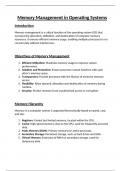
Memory Management in Operating Systems
Introduction
Memory management is a critical function of the operating system (OS) that
oversees the allocation, utilization, and deallocation of computer memory
resources. It ensures efficient memory usage, enabling multiple processes to run
concurrently without interference.
Objectives of Memory Management
1. Efficient Utilization: Maximize memory usage to improve system
performance.
2. Isolation and Protection: Ensure processes cannot interfere with each
other’s memory space.
3. Transparency: Provide processes with the illusion of exclusive memory
access.
4. Flexibility: Allow dynamic allocation and deallocation of memory during
runtime.
5. Security: Protect memory from unauthorized access or corruption.
Memory Hierarchy
Memory in a computer system is organized hierarchically based on speed, cost,
and size:
1. Registers: Fastest but limited memory, located within the CPU.
2. Cache: High-speed memory close to the CPU, used for frequently accessed
data.
3. Main Memory (RAM): Primary memory for active processes.
4. Secondary Storage: Persistent storage, such as hard drives and SSDs.
5. Virtual Memory: Extension of RAM on secondary storage, used for
temporary data.
, Memory Management Techniques
1. Single Contiguous Allocation:
o Entire memory space is allocated to a single process.
o Simple but inefficient for multitasking systems.
2. Partitioned Memory:
o Memory is divided into fixed or variable-sized partitions.
o Processes are allocated to available partitions.
3. Paged Memory Management:
o Memory is divided into fixed-sized blocks called pages.
o Processes are divided into pages, loaded into memory as needed.
o Avoids fragmentation but may incur overhead.
4. Segmented Memory Management:
o Memory is divided into variable-sized segments based on logical
divisions (e.g., code, data).
o Provides a more natural way to map processes to memory.
5. Virtual Memory:
o Allows execution of processes larger than physical memory by using
disk space.
o Implements paging or segmentation to swap data between RAM and
disk.
Memory Allocation Strategies
1. First Fit:
o Allocates the first available block of memory large enough for the
process.
2. Best Fit:
o Allocates the smallest block that satisfies the process’s requirements.
o Minimizes wasted memory but may increase fragmentation.
3. Worst Fit:
o Allocates the largest available block, leaving more space for smaller
processes.
o Rarely used due to inefficiency.
Introduction
Memory management is a critical function of the operating system (OS) that
oversees the allocation, utilization, and deallocation of computer memory
resources. It ensures efficient memory usage, enabling multiple processes to run
concurrently without interference.
Objectives of Memory Management
1. Efficient Utilization: Maximize memory usage to improve system
performance.
2. Isolation and Protection: Ensure processes cannot interfere with each
other’s memory space.
3. Transparency: Provide processes with the illusion of exclusive memory
access.
4. Flexibility: Allow dynamic allocation and deallocation of memory during
runtime.
5. Security: Protect memory from unauthorized access or corruption.
Memory Hierarchy
Memory in a computer system is organized hierarchically based on speed, cost,
and size:
1. Registers: Fastest but limited memory, located within the CPU.
2. Cache: High-speed memory close to the CPU, used for frequently accessed
data.
3. Main Memory (RAM): Primary memory for active processes.
4. Secondary Storage: Persistent storage, such as hard drives and SSDs.
5. Virtual Memory: Extension of RAM on secondary storage, used for
temporary data.
, Memory Management Techniques
1. Single Contiguous Allocation:
o Entire memory space is allocated to a single process.
o Simple but inefficient for multitasking systems.
2. Partitioned Memory:
o Memory is divided into fixed or variable-sized partitions.
o Processes are allocated to available partitions.
3. Paged Memory Management:
o Memory is divided into fixed-sized blocks called pages.
o Processes are divided into pages, loaded into memory as needed.
o Avoids fragmentation but may incur overhead.
4. Segmented Memory Management:
o Memory is divided into variable-sized segments based on logical
divisions (e.g., code, data).
o Provides a more natural way to map processes to memory.
5. Virtual Memory:
o Allows execution of processes larger than physical memory by using
disk space.
o Implements paging or segmentation to swap data between RAM and
disk.
Memory Allocation Strategies
1. First Fit:
o Allocates the first available block of memory large enough for the
process.
2. Best Fit:
o Allocates the smallest block that satisfies the process’s requirements.
o Minimizes wasted memory but may increase fragmentation.
3. Worst Fit:
o Allocates the largest available block, leaving more space for smaller
processes.
o Rarely used due to inefficiency.