N138 Midterm 1 Questions With Complete Solutions
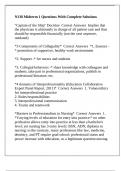
"Captain of the Ship" Doctrine Correct Answers Implies that
the physician is ultimately in charge of all patient care and thus
should be responsible financially (not the case anymore,
outdated)
*3 Components of Collegiality* Correct Answers *1. Essence -
* promotion of supportive, healthy work environment
*2. Support -* for nurses and students
*3. Collegial behaviors -* share knowledge with colleagues and
students, take part in professional organizations, publish in
professional literature, etc.
*4 domains of Interprofessionality (Education Collaborative
Expert Panel Report, 2011)* Correct Answers 1. Values/ethics
for interprofessional practice
2. Roles/responsibilities
3. Interprofessional communication
4. Teams and teamwork
*Barriers to Professionalism in Nursing* Correct Answers 1.
*Varying levels of education for entry into practice:* no other
profession allows entry into practice at less than a bachelor's
level; yet nursing has 3 entry levels: BSN, ADN, diploma in
nursing; to the contrary, many professions like law, medicine,
dentistry, and PT require grad school; professional status and
power increase with education, so a legitimate question nursing
,must ask itself is how professional peers level with nurses when
most nurses don't hold a bachelor's degree?
2. *Gender Issues:* Continues to play a role in the perceived
value of professions dominated by women such as teaching,
social work, and nursing; the persistent devaluing of women's
work in our society has created an ongoing struggle for
professions such as nursing and teaching to increase their status,
increase their compensation, and improve working conditions;
recognize that gender politics does affect nursing's professional
development
3. *Historical Influences:* Nursing's historical connections with
religious orders and the military continue to have influence; e.g.
unquestioning obedience, which runs counter to the professional
values of autonomy and self-determination in nursing; also
altruism, which prevents nurses from demanding fair economic
valuation of their work without looking greedy or selfish
4. *External Conflicts:* Tensions between medicine and nursing
have risen; lobbying efforts in state legislatures to ensure the
legal scope of nursing practice is protected and reflects current
training and expertise of professional nurses; however, nurses
must strive for collaboration, NOT COMPETITION, with
physicians and other health care providers
5. *Internal Conflicts:* Power and influence within nursing are
fragmented by subgroups and dissension; tensions among nurses
with various levels of education reduce the vitality of th
,*Kelly's Criteria: 8 Characteristics of a Profession (1981)*
Correct Answers Contemporary nursing embodies the
characteristics of these criteria:
1. The *services provided are vital* to humanity and the welfare
of society.
2. There is a special body of knowledge that is continually
enlarged through
*research*.
3. The services involve *intellectual activities*; individual
responsibility
*(accountability)* is a strong feature.
4. Practitioners are *educated* in institutions of higher learning
(first university based nursing education was established at the
University of Minnesota in 1909).
5. Practitioners are relatively independent and control their own
policies and
activities *(autonomy)* -> .
6. Practitioners are *motivated by service (altruism)* and
consider their work an
important component of their lives.
7. There is a *code of ethics* to guide the decisions and conduct
of practitioners.
8. There is an organization *(association)* that encourages and
supports high
standards of practice.
*Miller's Wheel of Professionalism in Nursing (1985)* Correct
Answers Identified "behaviors deemed necessary in maintaining
or increasing nurses' professionalism. They are:
, 1. Competence and continuing education
2. Adherence to the code of ethics
3. Participation in the primary and professional organizations
(i.e., ANA and state constituent member association)
4. Publication and communication
5. Orientation toward community services
6. Theory and research development and utilization
7. Self-regulation and autonomy
*Nursing Standards est. by Profession Itself* Correct Answers
1. *Nursing's Social Policy Statement* -> describes *obligation
to the patients*; includes the ANA's contemporary definition of
nursing
2. *Nursing: Scope and Standards of Practice* -> expectations
of the professional role and lists of standard competencies (latest
one is from 2015)
3. *Code of Ethics for Nurses with Interpretive Statements*;
dates back to Florence Nightingale; ultimately, strengthens and
guides decision-making
(a) statement of the ethical values, obligations, duties, an
professional ideals of nurses individually and collectively
(b) nursing's non-negotiable ethical standard
(c) expresses nursing's own understanding of its commitment to
society
*Professional Preparation & Commitment* Correct Answers
*Professional preparation and commitment include:*
1. *instruction* within the specialized body of knowledge and
techniques of the profession
"Captain of the Ship" Doctrine Correct Answers Implies that
the physician is ultimately in charge of all patient care and thus
should be responsible financially (not the case anymore,
outdated)
*3 Components of Collegiality* Correct Answers *1. Essence -
* promotion of supportive, healthy work environment
*2. Support -* for nurses and students
*3. Collegial behaviors -* share knowledge with colleagues and
students, take part in professional organizations, publish in
professional literature, etc.
*4 domains of Interprofessionality (Education Collaborative
Expert Panel Report, 2011)* Correct Answers 1. Values/ethics
for interprofessional practice
2. Roles/responsibilities
3. Interprofessional communication
4. Teams and teamwork
*Barriers to Professionalism in Nursing* Correct Answers 1.
*Varying levels of education for entry into practice:* no other
profession allows entry into practice at less than a bachelor's
level; yet nursing has 3 entry levels: BSN, ADN, diploma in
nursing; to the contrary, many professions like law, medicine,
dentistry, and PT require grad school; professional status and
power increase with education, so a legitimate question nursing
,must ask itself is how professional peers level with nurses when
most nurses don't hold a bachelor's degree?
2. *Gender Issues:* Continues to play a role in the perceived
value of professions dominated by women such as teaching,
social work, and nursing; the persistent devaluing of women's
work in our society has created an ongoing struggle for
professions such as nursing and teaching to increase their status,
increase their compensation, and improve working conditions;
recognize that gender politics does affect nursing's professional
development
3. *Historical Influences:* Nursing's historical connections with
religious orders and the military continue to have influence; e.g.
unquestioning obedience, which runs counter to the professional
values of autonomy and self-determination in nursing; also
altruism, which prevents nurses from demanding fair economic
valuation of their work without looking greedy or selfish
4. *External Conflicts:* Tensions between medicine and nursing
have risen; lobbying efforts in state legislatures to ensure the
legal scope of nursing practice is protected and reflects current
training and expertise of professional nurses; however, nurses
must strive for collaboration, NOT COMPETITION, with
physicians and other health care providers
5. *Internal Conflicts:* Power and influence within nursing are
fragmented by subgroups and dissension; tensions among nurses
with various levels of education reduce the vitality of th
,*Kelly's Criteria: 8 Characteristics of a Profession (1981)*
Correct Answers Contemporary nursing embodies the
characteristics of these criteria:
1. The *services provided are vital* to humanity and the welfare
of society.
2. There is a special body of knowledge that is continually
enlarged through
*research*.
3. The services involve *intellectual activities*; individual
responsibility
*(accountability)* is a strong feature.
4. Practitioners are *educated* in institutions of higher learning
(first university based nursing education was established at the
University of Minnesota in 1909).
5. Practitioners are relatively independent and control their own
policies and
activities *(autonomy)* -> .
6. Practitioners are *motivated by service (altruism)* and
consider their work an
important component of their lives.
7. There is a *code of ethics* to guide the decisions and conduct
of practitioners.
8. There is an organization *(association)* that encourages and
supports high
standards of practice.
*Miller's Wheel of Professionalism in Nursing (1985)* Correct
Answers Identified "behaviors deemed necessary in maintaining
or increasing nurses' professionalism. They are:
, 1. Competence and continuing education
2. Adherence to the code of ethics
3. Participation in the primary and professional organizations
(i.e., ANA and state constituent member association)
4. Publication and communication
5. Orientation toward community services
6. Theory and research development and utilization
7. Self-regulation and autonomy
*Nursing Standards est. by Profession Itself* Correct Answers
1. *Nursing's Social Policy Statement* -> describes *obligation
to the patients*; includes the ANA's contemporary definition of
nursing
2. *Nursing: Scope and Standards of Practice* -> expectations
of the professional role and lists of standard competencies (latest
one is from 2015)
3. *Code of Ethics for Nurses with Interpretive Statements*;
dates back to Florence Nightingale; ultimately, strengthens and
guides decision-making
(a) statement of the ethical values, obligations, duties, an
professional ideals of nurses individually and collectively
(b) nursing's non-negotiable ethical standard
(c) expresses nursing's own understanding of its commitment to
society
*Professional Preparation & Commitment* Correct Answers
*Professional preparation and commitment include:*
1. *instruction* within the specialized body of knowledge and
techniques of the profession