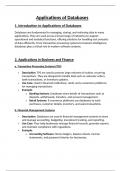
Applications of Databases
1. Introduction to Applications of Databases
Databases are fundamental to managing, storing, and retrieving data in many
applications. They are used across a broad range of industries to support
operational and analytical functions, offering solutions for handling vast amounts
of data efficiently. From transaction processing systems to business intelligence,
databases play a critical role in modern software systems.
2. Applications in Business and Finance
a. Transaction Processing Systems (TPS)
Description: TPS are used to process large volumes of routine, recurring
transactions. They are designed to handle data such as customer orders,
bank transactions, or inventory updates.
Use Case: Used in financial institutions, retail, and e-commerce platforms
for managing transactions.
Example:
o Banking Systems: Databases store details of transactions such as
deposits, withdrawals, transfers, and account management.
o Retail Systems: E-commerce platforms use databases to track
purchases, customer details, inventory, and sales transactions.
b. Financial Management Systems
Description: Databases are used in financial management systems to store
and manage accounting, budgeting, investment tracking, and reporting.
Use Case: They help businesses manage financial records, generate reports,
and maintain compliance with regulations.
Example:
o Accounting Software: Stores ledgers, balance sheets, income
statements, and payment histories for businesses.
, c. Customer Relationship Management (CRM)
Description: CRM systems use databases to manage customer interactions,
track sales, and improve customer service.
Use Case: Used by sales, marketing, and support teams to manage
customer relationships and drive business growth.
Example:
o Salesforce: Uses databases to track customer information, sales
opportunities, and marketing campaigns.
3. Applications in Healthcare
a. Electronic Health Records (EHR)
Description: EHR systems store patient health records, medical history,
diagnoses, treatments, and prescriptions in digital format.
Use Case: Healthcare providers use databases to improve patient care by
allowing easy access to patient information.
Example:
o Hospital Management Systems: Store patient details, lab results,
medical histories, and appointments.
b. Medical Research Databases
Description: Researchers use databases to store large datasets for medical
research, such as genetic information, clinical trials, and epidemiological
data.
Use Case: Databases help researchers analyze patterns in health data and
assist in discovering new treatments and medicines.
Example:
o Genomic Databases: Store genetic data for research into genetics,
diseases, and personalized medicine.
1. Introduction to Applications of Databases
Databases are fundamental to managing, storing, and retrieving data in many
applications. They are used across a broad range of industries to support
operational and analytical functions, offering solutions for handling vast amounts
of data efficiently. From transaction processing systems to business intelligence,
databases play a critical role in modern software systems.
2. Applications in Business and Finance
a. Transaction Processing Systems (TPS)
Description: TPS are used to process large volumes of routine, recurring
transactions. They are designed to handle data such as customer orders,
bank transactions, or inventory updates.
Use Case: Used in financial institutions, retail, and e-commerce platforms
for managing transactions.
Example:
o Banking Systems: Databases store details of transactions such as
deposits, withdrawals, transfers, and account management.
o Retail Systems: E-commerce platforms use databases to track
purchases, customer details, inventory, and sales transactions.
b. Financial Management Systems
Description: Databases are used in financial management systems to store
and manage accounting, budgeting, investment tracking, and reporting.
Use Case: They help businesses manage financial records, generate reports,
and maintain compliance with regulations.
Example:
o Accounting Software: Stores ledgers, balance sheets, income
statements, and payment histories for businesses.
, c. Customer Relationship Management (CRM)
Description: CRM systems use databases to manage customer interactions,
track sales, and improve customer service.
Use Case: Used by sales, marketing, and support teams to manage
customer relationships and drive business growth.
Example:
o Salesforce: Uses databases to track customer information, sales
opportunities, and marketing campaigns.
3. Applications in Healthcare
a. Electronic Health Records (EHR)
Description: EHR systems store patient health records, medical history,
diagnoses, treatments, and prescriptions in digital format.
Use Case: Healthcare providers use databases to improve patient care by
allowing easy access to patient information.
Example:
o Hospital Management Systems: Store patient details, lab results,
medical histories, and appointments.
b. Medical Research Databases
Description: Researchers use databases to store large datasets for medical
research, such as genetic information, clinical trials, and epidemiological
data.
Use Case: Databases help researchers analyze patterns in health data and
assist in discovering new treatments and medicines.
Example:
o Genomic Databases: Store genetic data for research into genetics,
diseases, and personalized medicine.