VOLADURAS TEMA 10
TEMA 10
VOLADURAS DE INTERIOR
10.1 – SUBNIVELES CON BARRENOS
SUBNIVELES CON BARRENOS LARGOS:
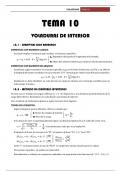
Se puede emplear Gustafsson para estimar el consumo específico:
0,4
qn: Dependerá del grado de fragmentación deseado.
qe = qn + 0,03 · H + (kg/m )
3
B H: Altura del subnivel cubierto por mineral volado anteriormente.
SUBNIVELES CON BARRENOS EN ABANICO:
Gustafsson sugiere aumentar el consumo específico (qe) en el fondo del barreno un 25% y un 20% de
la longitud del mismo y trabajar con una relación “E/V” elevada para reducir la perforación específica.
0,4
qef = 1,25 · (qn + 0,03 · H + ) (kg/m3)
B
Finalmente se debe distribuir en cada barreno la carga de columna con retacados variables para no
sobrecargar la misma.
10.2 – MÉTODO DE CRÁTERES INVERTIDOS
En este caso se trabaja con cargas esféricas (L < 6 · D) dispuestas a una distancia predeterminada de la
carga libre inferior, llevándose con cada disparo una franja de mineral.
Para el cálculo de la distancia óptima se aplica la teoría de Livingston.
TEORÍA DE LIVINGSTON:
Según Livingston para la distancia crítica se cumple que:
E: Factor de energía de tensión. D0
Nc = E · √W
3
Δ0 =
W: Peso de la carga. Nc
Si la altura de corte es aproximadamente igual a la distancia óptima (D0), el radio del cráter será_
3 (V/W)0 · W 𝐕
r0 = √ · → : Constantes para cada par roca/explosivo.
π D0 𝐖
Si después de hacer los ensayos con “Wi” se quieren obtener “D0” y “r0” para “W2”:
(D0 )W1 = Δ0 · (Nc )W1 = Δ0 · E · 3√W1 (D0 )W2 3 W
(D0 )W1
= √ W2
(D0 )W2 = Δ0 · (Nc )W2 = Δ0 · E · 3√W2 1
Como “r” es proporcional a la raíz de “W/D” se cumplirá la misma relación para los radios.
El consumo específico, en cambio se mantendrá.
Normalmente se trabaja con esquemas cuadrados con separación entre barrenos de “(1,2 – 1,6) · r0”.
TEMA 10
VOLADURAS DE INTERIOR
10.1 – SUBNIVELES CON BARRENOS
SUBNIVELES CON BARRENOS LARGOS:
Se puede emplear Gustafsson para estimar el consumo específico:
0,4
qn: Dependerá del grado de fragmentación deseado.
qe = qn + 0,03 · H + (kg/m )
3
B H: Altura del subnivel cubierto por mineral volado anteriormente.
SUBNIVELES CON BARRENOS EN ABANICO:
Gustafsson sugiere aumentar el consumo específico (qe) en el fondo del barreno un 25% y un 20% de
la longitud del mismo y trabajar con una relación “E/V” elevada para reducir la perforación específica.
0,4
qef = 1,25 · (qn + 0,03 · H + ) (kg/m3)
B
Finalmente se debe distribuir en cada barreno la carga de columna con retacados variables para no
sobrecargar la misma.
10.2 – MÉTODO DE CRÁTERES INVERTIDOS
En este caso se trabaja con cargas esféricas (L < 6 · D) dispuestas a una distancia predeterminada de la
carga libre inferior, llevándose con cada disparo una franja de mineral.
Para el cálculo de la distancia óptima se aplica la teoría de Livingston.
TEORÍA DE LIVINGSTON:
Según Livingston para la distancia crítica se cumple que:
E: Factor de energía de tensión. D0
Nc = E · √W
3
Δ0 =
W: Peso de la carga. Nc
Si la altura de corte es aproximadamente igual a la distancia óptima (D0), el radio del cráter será_
3 (V/W)0 · W 𝐕
r0 = √ · → : Constantes para cada par roca/explosivo.
π D0 𝐖
Si después de hacer los ensayos con “Wi” se quieren obtener “D0” y “r0” para “W2”:
(D0 )W1 = Δ0 · (Nc )W1 = Δ0 · E · 3√W1 (D0 )W2 3 W
(D0 )W1
= √ W2
(D0 )W2 = Δ0 · (Nc )W2 = Δ0 · E · 3√W2 1
Como “r” es proporcional a la raíz de “W/D” se cumplirá la misma relación para los radios.
El consumo específico, en cambio se mantendrá.
Normalmente se trabaja con esquemas cuadrados con separación entre barrenos de “(1,2 – 1,6) · r0”.