Cloud Databases
Introduction to Cloud Databases
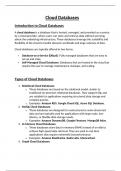
A cloud database is a database that is hosted, managed, and provided as a service
by a cloud provider, where users can store and retrieve data without worrying
about the underlying infrastructure. These databases leverage the scalability and
flexibility of the cloud to handle dynamic workloads and large volumes of data.
Cloud databases are typically offered in two forms:
Database-as-a-Service (DBaaS): Fully managed databases that are easy to
set up and scale.
Self-Managed Cloud Databases: Databases that are hosted in the cloud but
require the user to manage maintenance, backups, and scaling.
Types of Cloud Databases
1. Relational Cloud Databases:
o These databases are based on the relational model, similar to
traditional on-premises relational databases. They support SQL and
are suitable for applications requiring structured data storage and
complex queries.
o Examples: Amazon RDS, Google Cloud SQL, Azure SQL Database.
2. NoSQL Cloud Databases:
o These databases are designed for unstructured or semi-structured
data and are typically used for applications with large-scale, low-
latency, or flexible data storage needs.
o Examples: Amazon DynamoDB, Google Firestore, MongoDB Atlas.
3. In-Memory Cloud Databases:
o These databases store data in memory (RAM) instead of on disk to
achieve high-speed data retrieval. They are used in real-time
applications that require extremely fast performance.
o Examples: Amazon ElastiCache, Redis Labs, Memcached.
4. Graph Cloud Databases:
, o These databases are designed to handle graph data models and are
used to manage complex relationships between entities.
o Examples: Amazon Neptune, Azure Cosmos DB (Graph API), Neo4j
Aura.
5. Time-Series Cloud Databases:
o These databases are optimized for time-stamped or time-series data,
commonly used in monitoring, IoT, and analytics applications.
o Examples: InfluxDB Cloud, Amazon Timestream, TimescaleDB.
Benefits of Cloud Databases
1. Scalability:
o Cloud databases can scale up or down based on workload demands.
This is especially useful for applications with fluctuating traffic or
unpredictable data growth.
2. High Availability:
o Cloud providers typically offer built-in redundancy, backups, and
failover mechanisms to ensure high availability of the database, even
in the case of hardware failure.
3. Cost-Effectiveness:
o With cloud databases, users only pay for what they use. This can be
more cost-effective than maintaining on-premises infrastructure,
particularly for small-to-medium-sized businesses.
4. Automatic Backups and Updates:
o Cloud databases often include automatic backup and software
update features, reducing the administrative burden on users and
ensuring that the database is up-to-date with security patches.
5. Managed Services:
o With DBaaS, users don’t need to manage the underlying
infrastructure, hardware, or database software. This frees up time to
focus on application development rather than database
maintenance.
6. Global Accessibility:
o Cloud databases are accessible from anywhere with an internet
connection, enabling organizations with distributed teams or global
users to access data seamlessly.
Introduction to Cloud Databases
A cloud database is a database that is hosted, managed, and provided as a service
by a cloud provider, where users can store and retrieve data without worrying
about the underlying infrastructure. These databases leverage the scalability and
flexibility of the cloud to handle dynamic workloads and large volumes of data.
Cloud databases are typically offered in two forms:
Database-as-a-Service (DBaaS): Fully managed databases that are easy to
set up and scale.
Self-Managed Cloud Databases: Databases that are hosted in the cloud but
require the user to manage maintenance, backups, and scaling.
Types of Cloud Databases
1. Relational Cloud Databases:
o These databases are based on the relational model, similar to
traditional on-premises relational databases. They support SQL and
are suitable for applications requiring structured data storage and
complex queries.
o Examples: Amazon RDS, Google Cloud SQL, Azure SQL Database.
2. NoSQL Cloud Databases:
o These databases are designed for unstructured or semi-structured
data and are typically used for applications with large-scale, low-
latency, or flexible data storage needs.
o Examples: Amazon DynamoDB, Google Firestore, MongoDB Atlas.
3. In-Memory Cloud Databases:
o These databases store data in memory (RAM) instead of on disk to
achieve high-speed data retrieval. They are used in real-time
applications that require extremely fast performance.
o Examples: Amazon ElastiCache, Redis Labs, Memcached.
4. Graph Cloud Databases:
, o These databases are designed to handle graph data models and are
used to manage complex relationships between entities.
o Examples: Amazon Neptune, Azure Cosmos DB (Graph API), Neo4j
Aura.
5. Time-Series Cloud Databases:
o These databases are optimized for time-stamped or time-series data,
commonly used in monitoring, IoT, and analytics applications.
o Examples: InfluxDB Cloud, Amazon Timestream, TimescaleDB.
Benefits of Cloud Databases
1. Scalability:
o Cloud databases can scale up or down based on workload demands.
This is especially useful for applications with fluctuating traffic or
unpredictable data growth.
2. High Availability:
o Cloud providers typically offer built-in redundancy, backups, and
failover mechanisms to ensure high availability of the database, even
in the case of hardware failure.
3. Cost-Effectiveness:
o With cloud databases, users only pay for what they use. This can be
more cost-effective than maintaining on-premises infrastructure,
particularly for small-to-medium-sized businesses.
4. Automatic Backups and Updates:
o Cloud databases often include automatic backup and software
update features, reducing the administrative burden on users and
ensuring that the database is up-to-date with security patches.
5. Managed Services:
o With DBaaS, users don’t need to manage the underlying
infrastructure, hardware, or database software. This frees up time to
focus on application development rather than database
maintenance.
6. Global Accessibility:
o Cloud databases are accessible from anywhere with an internet
connection, enabling organizations with distributed teams or global
users to access data seamlessly.