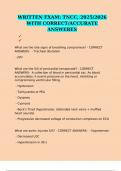
WRITTEN EXAM: TNCC, 2025/2026
WITH CORRECT/ACCURATE
ANSWERES
What are the late signs of breathing compromise? - CORRECT
ANSWERS- - Tracheal deviation
- JVD
What are the S/S of pericardial tamponade? - CORRECT
ANSWERS- A collection of blood in pericardial sac. As blood
accumulates, it exerts pressure on the heart, inhibiting or
compromising ventricular filling.
- Hyotension
- Tachycardia or PEA
- Dyspnea
- Cyanosis
- Beck's Triad (hypotension, distended neck veins + muffled
heart sounds)
- Progressive decreased voltage of conduction complexes on ECG
What are aortic injuries S/S? - CORRECT ANSWERS- - Hypotension
- Decreased LOC
- Hypertension in UE's
,- Decreased quality (amplitude) of femoral pulses compared to
UE pulses
- Loud systolic murmur in parascapular region
- Chest pain
- Chest wall ecchymosis
- Widened mediastinum on chest xray
- Paraplegia
How would you assess a pt with a thoracic injury? - CORRECT
ANSWERS- (Initial assessment)
Obtain Hx.
PHYSICAL:
Inspection:
- Observe chest wall
- Assess breathing effort and RR
- Symmetry
- Inspect jugular veins (Distended = increased intrathoracic
pressure as result of tension pneumothorax or pericardial
tamponade. Flat = external jugular veins may reflect
hypovolemia)
- Inspect upper abdominal region for injury
Percussion:
- Percuss the chest (Dullness = hemothorax, Hyperresonance =
pneumothorax)
Palpation:
,- Palpate chest wall, clavicles and neck for:
- Tenderness
- Swelling or hematoma
- Subcutaneous emphysema
- Note presence of bony crepitus
- Palpate central and peripheral pulses and compare quality
between:
- Right and left extremities
- Upper and lower extremities
- Palpate the trachea (above suprasternal notch. Trach shift may
indicate late sign of tension pneumothorax or massive
hemothorax)
- Palpate extremities for motor and sensory function (lower
extremitiy paresis or paralysis may indicate aortic injury).
Auscultation:
- Auscultate compare BP in both UE's and LE's
- Auscultate breath sounds (decreased or absent breath =
pneumo or hemothorax. Diminshed BS = splinting. Shallow = b/c
of pain).
- Auscultate chest for presence of BS (diaphragmatic rupture)
- Auscultate Heart sounds (muffled = pericardial tamponade)
- Auscultate neck vessels for bruits (vascular injury)
Diagnostic Procedures:
- Xrays
- Arteriography
, - Bronchoscopy and laryngoscopy
- CT's
- FAST
- Labs (cardiac enzymes)
- ECG, CVP
What are S/S of Hepatic Injuries? - CORRECT ANSWERS- -Upper
Right Quadrant Pain
-Abdominal Wall Muscle Rigidity, Spasm, Involuntary Guarding
-Rebound Tenderness
-Hypoactive or Absent Bowel Sounds
-Signs of hemorrhage or hypovolemic shock
What are S/S of Splenic Injuries? - CORRECT ANSWERS- -Signs of
hemorrhage or hypovolemic shock
-Pain in the left shoulder (Kehr's sign) when lying supine or
Trendelenburg
-Tenderness in the upper left quadrant
-Abdominal wall muscle rigidity, spasm, or involuntary guarding
S/S of Large and Small Bowel Injuries? - CORRECT ANSWERS- -
Peritoneal irritation manifested by abdominal wall muscle rigidity,
spasm, involuntary guarding, rebound tenderness, or pain
-Evisceration of small bowel or stomach
WITH CORRECT/ACCURATE
ANSWERES
What are the late signs of breathing compromise? - CORRECT
ANSWERS- - Tracheal deviation
- JVD
What are the S/S of pericardial tamponade? - CORRECT
ANSWERS- A collection of blood in pericardial sac. As blood
accumulates, it exerts pressure on the heart, inhibiting or
compromising ventricular filling.
- Hyotension
- Tachycardia or PEA
- Dyspnea
- Cyanosis
- Beck's Triad (hypotension, distended neck veins + muffled
heart sounds)
- Progressive decreased voltage of conduction complexes on ECG
What are aortic injuries S/S? - CORRECT ANSWERS- - Hypotension
- Decreased LOC
- Hypertension in UE's
,- Decreased quality (amplitude) of femoral pulses compared to
UE pulses
- Loud systolic murmur in parascapular region
- Chest pain
- Chest wall ecchymosis
- Widened mediastinum on chest xray
- Paraplegia
How would you assess a pt with a thoracic injury? - CORRECT
ANSWERS- (Initial assessment)
Obtain Hx.
PHYSICAL:
Inspection:
- Observe chest wall
- Assess breathing effort and RR
- Symmetry
- Inspect jugular veins (Distended = increased intrathoracic
pressure as result of tension pneumothorax or pericardial
tamponade. Flat = external jugular veins may reflect
hypovolemia)
- Inspect upper abdominal region for injury
Percussion:
- Percuss the chest (Dullness = hemothorax, Hyperresonance =
pneumothorax)
Palpation:
,- Palpate chest wall, clavicles and neck for:
- Tenderness
- Swelling or hematoma
- Subcutaneous emphysema
- Note presence of bony crepitus
- Palpate central and peripheral pulses and compare quality
between:
- Right and left extremities
- Upper and lower extremities
- Palpate the trachea (above suprasternal notch. Trach shift may
indicate late sign of tension pneumothorax or massive
hemothorax)
- Palpate extremities for motor and sensory function (lower
extremitiy paresis or paralysis may indicate aortic injury).
Auscultation:
- Auscultate compare BP in both UE's and LE's
- Auscultate breath sounds (decreased or absent breath =
pneumo or hemothorax. Diminshed BS = splinting. Shallow = b/c
of pain).
- Auscultate chest for presence of BS (diaphragmatic rupture)
- Auscultate Heart sounds (muffled = pericardial tamponade)
- Auscultate neck vessels for bruits (vascular injury)
Diagnostic Procedures:
- Xrays
- Arteriography
, - Bronchoscopy and laryngoscopy
- CT's
- FAST
- Labs (cardiac enzymes)
- ECG, CVP
What are S/S of Hepatic Injuries? - CORRECT ANSWERS- -Upper
Right Quadrant Pain
-Abdominal Wall Muscle Rigidity, Spasm, Involuntary Guarding
-Rebound Tenderness
-Hypoactive or Absent Bowel Sounds
-Signs of hemorrhage or hypovolemic shock
What are S/S of Splenic Injuries? - CORRECT ANSWERS- -Signs of
hemorrhage or hypovolemic shock
-Pain in the left shoulder (Kehr's sign) when lying supine or
Trendelenburg
-Tenderness in the upper left quadrant
-Abdominal wall muscle rigidity, spasm, or involuntary guarding
S/S of Large and Small Bowel Injuries? - CORRECT ANSWERS- -
Peritoneal irritation manifested by abdominal wall muscle rigidity,
spasm, involuntary guarding, rebound tenderness, or pain
-Evisceration of small bowel or stomach