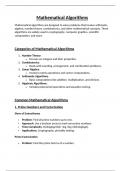
Mathematical Algorithms
Mathematical algorithms are designed to solve problems that involve arithmetic,
algebra, number theory, combinatorics, and other mathematical concepts. These
algorithms are widely used in cryptography, computer graphics, scientific
computation, and more.
Categories of Mathematical Algorithms
1. Number Theory:
o Focuses on integers and their properties.
2. Combinatorics:
o Deals with counting, arrangement, and combination problems.
3. Linear Algebra:
o Involves matrix operations and vector computations.
4. Arithmetic Algorithms:
o Basic computations like addition, multiplication, and division.
5. Algebraic Algorithms:
o Includes polynomial operations and equation solving.
Common Mathematical Algorithms
1. Prime Numbers and Factorization
Sieve of Eratosthenes
Problem: Find all prime numbers up to nnn.
Approach: Use a boolean array to mark non-prime numbers.
Time Complexity: O(nloglogn)O(n \log \log n)O(nloglogn).
Applications: Cryptography, primality testing.
Prime Factorization
Problem: Find the prime factors of a number.
, Approach: Divide the number by successive primes.
Time Complexity: O(n)O(\sqrt{n})O(n).
Applications: GCD, LCM, RSA algorithm.
2. Greatest Common Divisor (GCD) and Least Common Multiple (LCM)
Euclid's Algorithm
Problem: Find the GCD of two numbers.
Approach: Use the relation GCD(a,b)=GCD(b,a%b)GCD(a, b) = GCD(b, a \%
b)GCD(a,b)=GCD(b,a%b).
Time Complexity: O(log(min(a,b)))O(\log(\min(a, b)))O(log(min(a,b))).
Applications: Simplifying fractions.
LCM
Relation: LCM(a,b)=∣a⋅b∣GCD(a,b)LCM(a, b) = \frac{|a \cdot b|}{GCD(a,
b)}LCM(a,b)=GCD(a,b)∣a⋅b∣.
Time Complexity: Depends on GCD computation.
3. Modular Arithmetic
Modular Exponentiation
Problem: Compute abmod ca^b \mod cabmodc.
Approach: Use the property (a⋅b)mod c=[(amod c)⋅(bmod c)]mod c(a \
cdot b) \mod c = [(a \mod c) \cdot (b \mod c)] \mod
c(a⋅b)modc=[(amodc)⋅(bmodc)]modc.
Time Complexity: O(logb)O(\log b)O(logb).
Applications: Cryptography, fast power computation.
Chinese Remainder Theorem
Problem: Solve systems of simultaneous modular equations.
Approach: Combine congruences using modular inverses.
Mathematical algorithms are designed to solve problems that involve arithmetic,
algebra, number theory, combinatorics, and other mathematical concepts. These
algorithms are widely used in cryptography, computer graphics, scientific
computation, and more.
Categories of Mathematical Algorithms
1. Number Theory:
o Focuses on integers and their properties.
2. Combinatorics:
o Deals with counting, arrangement, and combination problems.
3. Linear Algebra:
o Involves matrix operations and vector computations.
4. Arithmetic Algorithms:
o Basic computations like addition, multiplication, and division.
5. Algebraic Algorithms:
o Includes polynomial operations and equation solving.
Common Mathematical Algorithms
1. Prime Numbers and Factorization
Sieve of Eratosthenes
Problem: Find all prime numbers up to nnn.
Approach: Use a boolean array to mark non-prime numbers.
Time Complexity: O(nloglogn)O(n \log \log n)O(nloglogn).
Applications: Cryptography, primality testing.
Prime Factorization
Problem: Find the prime factors of a number.
, Approach: Divide the number by successive primes.
Time Complexity: O(n)O(\sqrt{n})O(n).
Applications: GCD, LCM, RSA algorithm.
2. Greatest Common Divisor (GCD) and Least Common Multiple (LCM)
Euclid's Algorithm
Problem: Find the GCD of two numbers.
Approach: Use the relation GCD(a,b)=GCD(b,a%b)GCD(a, b) = GCD(b, a \%
b)GCD(a,b)=GCD(b,a%b).
Time Complexity: O(log(min(a,b)))O(\log(\min(a, b)))O(log(min(a,b))).
Applications: Simplifying fractions.
LCM
Relation: LCM(a,b)=∣a⋅b∣GCD(a,b)LCM(a, b) = \frac{|a \cdot b|}{GCD(a,
b)}LCM(a,b)=GCD(a,b)∣a⋅b∣.
Time Complexity: Depends on GCD computation.
3. Modular Arithmetic
Modular Exponentiation
Problem: Compute abmod ca^b \mod cabmodc.
Approach: Use the property (a⋅b)mod c=[(amod c)⋅(bmod c)]mod c(a \
cdot b) \mod c = [(a \mod c) \cdot (b \mod c)] \mod
c(a⋅b)modc=[(amodc)⋅(bmodc)]modc.
Time Complexity: O(logb)O(\log b)O(logb).
Applications: Cryptography, fast power computation.
Chinese Remainder Theorem
Problem: Solve systems of simultaneous modular equations.
Approach: Combine congruences using modular inverses.