EDU120 Exam Unit 4 Old Adulthood With Verified Solutions
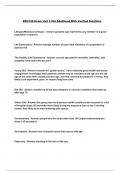
Lifespan/Maximum Lifespan - Answer greatest age reached by any member of a given
population or species
Life Expectancy - Answer average number of years that members of a population or
species live
The Healthy Life Expectancy - Answer current age specific mortality, morbidity, and
disability risks taken into account
Young Old - Answer considered "golden years;" have relatively good health and social
engagement, knowledge and expertise; people may be considered old age and not old
age at the same time; usually positive age, married, working for pleasure > money; less
likely to be dependent, poor, or require long term care
Old Old - Answer usually live (I) but have diseases or chronic conditions that ramp up
after age 75
Oldest Old - Answer this group has more serious health conditions and account for a lot
of hospital stays; 85 and older more likely to require long term care or be in nursing
homes; less likely to be married/living with spouse
Centenarians - Answer people who live to be older than 100 (supercentenarians are
those 110 and older)
Sarcopenia - Answer loss of muscle tissue that occurs with age
Cataracts - Answer clouding in the lens of the eye
, Age related macular degeneration - Answer loss of clarity in the center field of vision
due to deterioration of the macula (the center of the retina)
Glaucoma - Answer loss of peripheral vision, usually due to buildup of fluid in the eye
that damages the optic nerve
Presbycusis - Answer common form of hearing loss in late adulthood that results in a
gradual loss of hearing
Tinnitus - Answer a ringing, hissing or roaring sound in the ears
Presbyosmia - Answer loss of smell due to aging
Anosmia - Answer total loss of smell
Chronic illnesses - Answer illnesses that are ongoing, generally incurable conditions
that require continuing medical intervention and effect daily life
Osteoporosis - Answer disease that weakens and thins bones to the point that they
become fragile and break easily
Kyphosis - Answer adults gradually lose height and become hunched over due to bones
weakening in the spine
Chronic obstructive pulmonary disease (COPD) - Answer progressive lung disease
where the airways become damaged making it harder to breathe
Cirrhosis - Answer disease where the liver becomes scarred and does not function
properly
Lifespan/Maximum Lifespan - Answer greatest age reached by any member of a given
population or species
Life Expectancy - Answer average number of years that members of a population or
species live
The Healthy Life Expectancy - Answer current age specific mortality, morbidity, and
disability risks taken into account
Young Old - Answer considered "golden years;" have relatively good health and social
engagement, knowledge and expertise; people may be considered old age and not old
age at the same time; usually positive age, married, working for pleasure > money; less
likely to be dependent, poor, or require long term care
Old Old - Answer usually live (I) but have diseases or chronic conditions that ramp up
after age 75
Oldest Old - Answer this group has more serious health conditions and account for a lot
of hospital stays; 85 and older more likely to require long term care or be in nursing
homes; less likely to be married/living with spouse
Centenarians - Answer people who live to be older than 100 (supercentenarians are
those 110 and older)
Sarcopenia - Answer loss of muscle tissue that occurs with age
Cataracts - Answer clouding in the lens of the eye
, Age related macular degeneration - Answer loss of clarity in the center field of vision
due to deterioration of the macula (the center of the retina)
Glaucoma - Answer loss of peripheral vision, usually due to buildup of fluid in the eye
that damages the optic nerve
Presbycusis - Answer common form of hearing loss in late adulthood that results in a
gradual loss of hearing
Tinnitus - Answer a ringing, hissing or roaring sound in the ears
Presbyosmia - Answer loss of smell due to aging
Anosmia - Answer total loss of smell
Chronic illnesses - Answer illnesses that are ongoing, generally incurable conditions
that require continuing medical intervention and effect daily life
Osteoporosis - Answer disease that weakens and thins bones to the point that they
become fragile and break easily
Kyphosis - Answer adults gradually lose height and become hunched over due to bones
weakening in the spine
Chronic obstructive pulmonary disease (COPD) - Answer progressive lung disease
where the airways become damaged making it harder to breathe
Cirrhosis - Answer disease where the liver becomes scarred and does not function
properly