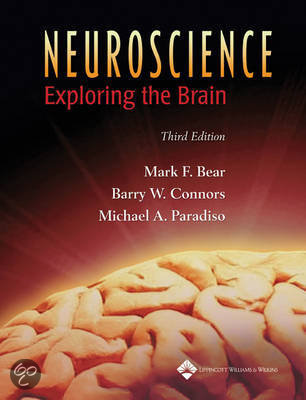
TEST BANK Test Bank For Neuroscience: Exploring The Brain, 4th Edition
Table of Contents:
Part 1 Foundations
Chapter 1 Neuroscience: Past, Present, and Future
NEUROSCIENCE: Chapter 2 Neurons and Glia
Chapter 3 The Neuronal Membrane at Rest
Chapter 4 The Action Potential
Exploring the Brain
Chapter 5 Synaptic Transmission
Chapter 6 Neurotransmitter Systems
Chapter 7 The Structure of the Nervous System
Appendix An Illustrated Guide to Human Neuroanatomy
Part 2 Sensory and Motor Systems
4th Edition, Mark Bear Chapter 8 The Chemical Senses
Chapter 9 The Eye
Chapter 10 The Central Visual System
Chapter 11 The Auditory and Vestibular Systems
Chapter 12 The Somatic Sensory System
Chapter 13 Spinal Control of Movement
Chapter 14 Brain Control of Movement
Part 3 The Brain and Behavior
Chapter 15 Chemical Control of the Brain and Behavior
Chapter 16 Motivation
Chapter 17 Sex and the Brain
Chapter 18 Brain Mechanisms of Emotion
Chapter 19 Brain Rhythms and Sleep
Chapter 20 Language
Chapter 21 The Resting Brain, Attention, and Consciousness
Chapter 22 Mental Illness
Part 4 The Changing Brain
Chapter 23 Wiring the Brain
Chapter 24 Memory Systems
Chapter 25 Molecular Mechanisms of Learning and Memory
TEST BANK
,Chapter 1: Neuroscience: Past, Present, and Future
Neuroscience: Exploring the Brain, 4th Edition Bear Test Bank
1. Why are a broad perspective and an interdisciplinary approach required for 6. For what purpose did Franz Joseph Gall study the dimensions of the human head?
understanding the brain? Choose the correct option. Choose the correct option.
A) Understanding the brain is a focused area in natural science with the brain serving A) To understand the propensity for certain personality traits
as the common point of focus. B) To demonstrate equal participation of all regions of the brain in all cerebral
B) Understanding the brain requires knowledge about many things, from the structure functions
of the water molecule to the electrical and chemical properties of the brain. C) To show that nerves conduct electrical signals to and from the brain
C) Understanding the brain requires the study of the different species of the brain. D) To show that unique human mental capabilities exist outside the brain
D) Understanding the brain requires the analysis of one approach at a time to yield a
new synthesis.
7. On what basis did Broca defend functional localization of the brain? Choose the correct
option.
2. Galen's study of sheep brains was the basis for a theory of brain function that prevailed A) By establishing a relationship between the production of speech and the right
for almost 1500 years. Which of the following represents this view? Choose the correct frontal lobe
option. B) By establishing a relationship between the production of speech and the occipital
A) The heart as the center of intellect and the brain as the cooling system lobe
B) Localization of brain function in the cerebrum and cerebellum C) By establishing a relationship between the production of speech and the left frontal
C) Mind–brain duality lobe
D) Parceling the cerebrum into lobes D) By establishing a relationship between the production of speech and the cerebellum
3. What is “mind–brain problem”? Choose the correct option. 8. To whom can we attribute the theory that behavior is among the heritable traits that can
A) Individually, human mental capacities exist in the mind that is outside the brain. develop? Choose the correct option.
B) The mind is the same as the brain. A) Marie-Jean-Pierre Flourens
C) Both animals and people possess intellect and a God-given soul. B) Charles Darwin
D) The pineal gland is a spiritual entity. C) Gustav Fritsch and Edward Hitzig
D) Franz Joseph Gall
4. What notion was displaced by the concept of nerves being described as wires? Choose
the correct option. 9. Which of the following is a correct explanation of a disorder that affects the nervous
A) Nerves are channels that communicate with the brain by the movement of fluids. system? Choose the correct option.
B) Muscles can be twitched when nerves are stimulated electrically and the brain itself A) Cerebral palsy is a motor disorder caused by damage to the cerebrum before,
may generate electricity. during, or soon after birth.
C) Signals to the muscles causing movement use the same wires as those that register B) Epilepsy is a progressive disease that affects nerve conduction, characterized by
sensations from the skin. episodes of weakness, lack of coordination, and speech disturbance.
D) Nerves conduct electrical signals to and from the brain. C) Stroke involves a loss of feeling and movement caused by traumatic damage to the
spinal cord.
D) Alzheimer's disease is a severe psychotic illness characterized by delusions,
5. The combined work of Bell and Magendie revealed a fundamental fact about the spinal hallucinations, and bizarre behavior.
nerves. Choose the correct option.
A) Spinal nerves are myelinated.
B) Spinal nerves are bundles of sensory and motor nerves, and in each sensory and
motor nerve fiber, transmission is strictly one-way.
C) Spinal nerves are not hollow tubes carrying fluid.
D) Both humans and animals have spinal nerves.
Page 1 Page 2
,10. A neuroscientist is investigating how different neural circuits in the brain analyze 15. Galen suggested that the cerebrum, which was soft, should be the recipient of
sensory information, form perceptions of the external world, make decisions, and sensations. He was of the view that to form memories, sensations should be imprinted
execute movements. At what level of analysis is this research conducted? Choose the onto the brain. Thus, this must occur in the doughy cerebrum. Although the conclusion
correct option. is right, the reason suggested by Galen is incorrect. True or false?
A) Molecular neuroscience level A) True
B) Cellular neuroscience level B) False
C) Systems neuroscience level
D) Cognitive neuroscience level
16. Scientists during the seventeenth and eighteenth centuries proposed the structure–
function relationship between the white matter and gray matter in the brain. According to
11. What is the rationale behind the use of animal models to understand the human brain? this relationship, gray matter contained the fibers that bring information to
Choose the correct option. and from the white matter. True or false?
A) Animal brains are identical to human brains but only smaller in size. A) True
B) Brain mechanisms that motivate any reaction are identical in animal and human B) False
brains.
C) The nervous systems of different species of animals and humans share many
common mechanisms. 17. Rats are considered valuable models for the effects of psychoactive drugs on the
D) Animal brains are easier to obtain than human brains. nervous system. True or false?
A) True
B) False
12. How do neuroscientists identify the parts of the brain that are specialized for different
behavioral functions related to the niche a species normally occupies? Choose the
correct option. 18. The Institutional Animal Care and Use Committee is formed of the animal rights
A) By studying the similarities in response pattern to fear in different species representatives. True or false?
B) By studying neurons one at a time A) True
C) By comparing the specializations of the brains of different species B) False
D) By systematically destroying each part of the brain and studying its implication
19. Scientists use a approach to understand how the brain works. In this
13. At which level of analysis do neuroscientists study the different types of neurons and approach, neuroscientists break a complex problem into pieces for
their functions? Choose the correct option. systematic experimental analysis.
A) Cellular neuroscience
B) Cognitive neuroscience
C) Molecular neuroscience 20. The process of verification, if , establishes new scientific fact or, if
D) Behavioral neuroscience , suggests new interpretations for the original observation.
14. What is the difference between replication and verification? Choose the correct option.
A) Replication tests a hypothesis, whereas verification rechecks the hypothesis.
B) Replication can only be done once, whereas verification can be done many times.
C) Replication is repeating the experiment in other subjects to rule out the possibility
of chance. In verification, the experiment is repeated and the same observations are
obtained by any scientist following the same protocol as the original observer.
D) Replication and verification are not essentially different.
Page 3 Page 4
, Chapter 2: Neurons and Glia
Answer Key 1. What does the “neuron doctrine” state? Choose the correct option.
A) Neurites of different cells fuse together to form a continuous reticulum.
1. B B) Individual cells communicate by contact and not continuity.
2. B C) The cell body of a neuron contains organelles.
3. A D) The elementary functional unit of all tissues is the individual cell.
4. A
5. B
6. A 2. What is a primary function of MAPs? Choose the correct option.
7. C A) Regulate the function and assembly of microtubules
8. B B) Regulate the function and assembly of microfilaments
9. A C) Regulate the function and assembly of neurofilaments
10. C D) Regulate the function and assembly of cytoskeleton
11. C
12. C
13. A 3. Neurons comprise two main structures: axons and dendrites. What is a major difference
14. C between the two? Choose the correct option.
15. A A) Dendrites are of uniform diameter throughout, whereas axons taper to a point.
16. B B) Dendrites receive incoming signals from other neurons, whereas axons carry the
17. A output of neurons.
18. B C) A cell body gives rise to a single dendrite and multiple axons.
19. reductionist, smaller D) Dendrites travel long distances, whereas axons are always short.
20. affirmative, negative
4. A scientist looks through a microscope at the structure of a neuron. The scientist notices
a layer of molecules separating the neuron's intracellular space from the extracellular
space. What is this part of the neuron known as? Choose the correct option.
A) Organelle
B) Soma
C) Neuronal membrane
D) Nuclear envelope
5. What do you understand by the term translation? Choose the correct option.
A) Assembling a piece of mRNA
B) Assembling proteins from amino acids
C) Removal of introns and specific exons
D) The “reading” of DNA
6. What is the most important function of the rough endoplasmic reticulum? Choose the
correct option.
A) RNA splicing
B) Post-translational protein processing
C) Site of protein synthesis
D) Cellular respiration
Page 5 Page 1
Table of Contents:
Part 1 Foundations
Chapter 1 Neuroscience: Past, Present, and Future
NEUROSCIENCE: Chapter 2 Neurons and Glia
Chapter 3 The Neuronal Membrane at Rest
Chapter 4 The Action Potential
Exploring the Brain
Chapter 5 Synaptic Transmission
Chapter 6 Neurotransmitter Systems
Chapter 7 The Structure of the Nervous System
Appendix An Illustrated Guide to Human Neuroanatomy
Part 2 Sensory and Motor Systems
4th Edition, Mark Bear Chapter 8 The Chemical Senses
Chapter 9 The Eye
Chapter 10 The Central Visual System
Chapter 11 The Auditory and Vestibular Systems
Chapter 12 The Somatic Sensory System
Chapter 13 Spinal Control of Movement
Chapter 14 Brain Control of Movement
Part 3 The Brain and Behavior
Chapter 15 Chemical Control of the Brain and Behavior
Chapter 16 Motivation
Chapter 17 Sex and the Brain
Chapter 18 Brain Mechanisms of Emotion
Chapter 19 Brain Rhythms and Sleep
Chapter 20 Language
Chapter 21 The Resting Brain, Attention, and Consciousness
Chapter 22 Mental Illness
Part 4 The Changing Brain
Chapter 23 Wiring the Brain
Chapter 24 Memory Systems
Chapter 25 Molecular Mechanisms of Learning and Memory
TEST BANK
,Chapter 1: Neuroscience: Past, Present, and Future
Neuroscience: Exploring the Brain, 4th Edition Bear Test Bank
1. Why are a broad perspective and an interdisciplinary approach required for 6. For what purpose did Franz Joseph Gall study the dimensions of the human head?
understanding the brain? Choose the correct option. Choose the correct option.
A) Understanding the brain is a focused area in natural science with the brain serving A) To understand the propensity for certain personality traits
as the common point of focus. B) To demonstrate equal participation of all regions of the brain in all cerebral
B) Understanding the brain requires knowledge about many things, from the structure functions
of the water molecule to the electrical and chemical properties of the brain. C) To show that nerves conduct electrical signals to and from the brain
C) Understanding the brain requires the study of the different species of the brain. D) To show that unique human mental capabilities exist outside the brain
D) Understanding the brain requires the analysis of one approach at a time to yield a
new synthesis.
7. On what basis did Broca defend functional localization of the brain? Choose the correct
option.
2. Galen's study of sheep brains was the basis for a theory of brain function that prevailed A) By establishing a relationship between the production of speech and the right
for almost 1500 years. Which of the following represents this view? Choose the correct frontal lobe
option. B) By establishing a relationship between the production of speech and the occipital
A) The heart as the center of intellect and the brain as the cooling system lobe
B) Localization of brain function in the cerebrum and cerebellum C) By establishing a relationship between the production of speech and the left frontal
C) Mind–brain duality lobe
D) Parceling the cerebrum into lobes D) By establishing a relationship between the production of speech and the cerebellum
3. What is “mind–brain problem”? Choose the correct option. 8. To whom can we attribute the theory that behavior is among the heritable traits that can
A) Individually, human mental capacities exist in the mind that is outside the brain. develop? Choose the correct option.
B) The mind is the same as the brain. A) Marie-Jean-Pierre Flourens
C) Both animals and people possess intellect and a God-given soul. B) Charles Darwin
D) The pineal gland is a spiritual entity. C) Gustav Fritsch and Edward Hitzig
D) Franz Joseph Gall
4. What notion was displaced by the concept of nerves being described as wires? Choose
the correct option. 9. Which of the following is a correct explanation of a disorder that affects the nervous
A) Nerves are channels that communicate with the brain by the movement of fluids. system? Choose the correct option.
B) Muscles can be twitched when nerves are stimulated electrically and the brain itself A) Cerebral palsy is a motor disorder caused by damage to the cerebrum before,
may generate electricity. during, or soon after birth.
C) Signals to the muscles causing movement use the same wires as those that register B) Epilepsy is a progressive disease that affects nerve conduction, characterized by
sensations from the skin. episodes of weakness, lack of coordination, and speech disturbance.
D) Nerves conduct electrical signals to and from the brain. C) Stroke involves a loss of feeling and movement caused by traumatic damage to the
spinal cord.
D) Alzheimer's disease is a severe psychotic illness characterized by delusions,
5. The combined work of Bell and Magendie revealed a fundamental fact about the spinal hallucinations, and bizarre behavior.
nerves. Choose the correct option.
A) Spinal nerves are myelinated.
B) Spinal nerves are bundles of sensory and motor nerves, and in each sensory and
motor nerve fiber, transmission is strictly one-way.
C) Spinal nerves are not hollow tubes carrying fluid.
D) Both humans and animals have spinal nerves.
Page 1 Page 2
,10. A neuroscientist is investigating how different neural circuits in the brain analyze 15. Galen suggested that the cerebrum, which was soft, should be the recipient of
sensory information, form perceptions of the external world, make decisions, and sensations. He was of the view that to form memories, sensations should be imprinted
execute movements. At what level of analysis is this research conducted? Choose the onto the brain. Thus, this must occur in the doughy cerebrum. Although the conclusion
correct option. is right, the reason suggested by Galen is incorrect. True or false?
A) Molecular neuroscience level A) True
B) Cellular neuroscience level B) False
C) Systems neuroscience level
D) Cognitive neuroscience level
16. Scientists during the seventeenth and eighteenth centuries proposed the structure–
function relationship between the white matter and gray matter in the brain. According to
11. What is the rationale behind the use of animal models to understand the human brain? this relationship, gray matter contained the fibers that bring information to
Choose the correct option. and from the white matter. True or false?
A) Animal brains are identical to human brains but only smaller in size. A) True
B) Brain mechanisms that motivate any reaction are identical in animal and human B) False
brains.
C) The nervous systems of different species of animals and humans share many
common mechanisms. 17. Rats are considered valuable models for the effects of psychoactive drugs on the
D) Animal brains are easier to obtain than human brains. nervous system. True or false?
A) True
B) False
12. How do neuroscientists identify the parts of the brain that are specialized for different
behavioral functions related to the niche a species normally occupies? Choose the
correct option. 18. The Institutional Animal Care and Use Committee is formed of the animal rights
A) By studying the similarities in response pattern to fear in different species representatives. True or false?
B) By studying neurons one at a time A) True
C) By comparing the specializations of the brains of different species B) False
D) By systematically destroying each part of the brain and studying its implication
19. Scientists use a approach to understand how the brain works. In this
13. At which level of analysis do neuroscientists study the different types of neurons and approach, neuroscientists break a complex problem into pieces for
their functions? Choose the correct option. systematic experimental analysis.
A) Cellular neuroscience
B) Cognitive neuroscience
C) Molecular neuroscience 20. The process of verification, if , establishes new scientific fact or, if
D) Behavioral neuroscience , suggests new interpretations for the original observation.
14. What is the difference between replication and verification? Choose the correct option.
A) Replication tests a hypothesis, whereas verification rechecks the hypothesis.
B) Replication can only be done once, whereas verification can be done many times.
C) Replication is repeating the experiment in other subjects to rule out the possibility
of chance. In verification, the experiment is repeated and the same observations are
obtained by any scientist following the same protocol as the original observer.
D) Replication and verification are not essentially different.
Page 3 Page 4
, Chapter 2: Neurons and Glia
Answer Key 1. What does the “neuron doctrine” state? Choose the correct option.
A) Neurites of different cells fuse together to form a continuous reticulum.
1. B B) Individual cells communicate by contact and not continuity.
2. B C) The cell body of a neuron contains organelles.
3. A D) The elementary functional unit of all tissues is the individual cell.
4. A
5. B
6. A 2. What is a primary function of MAPs? Choose the correct option.
7. C A) Regulate the function and assembly of microtubules
8. B B) Regulate the function and assembly of microfilaments
9. A C) Regulate the function and assembly of neurofilaments
10. C D) Regulate the function and assembly of cytoskeleton
11. C
12. C
13. A 3. Neurons comprise two main structures: axons and dendrites. What is a major difference
14. C between the two? Choose the correct option.
15. A A) Dendrites are of uniform diameter throughout, whereas axons taper to a point.
16. B B) Dendrites receive incoming signals from other neurons, whereas axons carry the
17. A output of neurons.
18. B C) A cell body gives rise to a single dendrite and multiple axons.
19. reductionist, smaller D) Dendrites travel long distances, whereas axons are always short.
20. affirmative, negative
4. A scientist looks through a microscope at the structure of a neuron. The scientist notices
a layer of molecules separating the neuron's intracellular space from the extracellular
space. What is this part of the neuron known as? Choose the correct option.
A) Organelle
B) Soma
C) Neuronal membrane
D) Nuclear envelope
5. What do you understand by the term translation? Choose the correct option.
A) Assembling a piece of mRNA
B) Assembling proteins from amino acids
C) Removal of introns and specific exons
D) The “reading” of DNA
6. What is the most important function of the rough endoplasmic reticulum? Choose the
correct option.
A) RNA splicing
B) Post-translational protein processing
C) Site of protein synthesis
D) Cellular respiration
Page 5 Page 1