🏖️
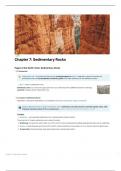
Chapter 7: Sedimentary Rocks
Pages of the Earth’s Past: Sedimentary Rocks
7.1 Introduction
🏖️ Sedimentary rock = rock that forms either by: the cementing together of clasts (= fragments or grains from broken off
preexisting rocks) or by the precipitation of mineral crystals out of water solutions at or near the Earth’s surface.
Bed = a layer of sedimentary rocks.
Sedimentary rocks occur only in the upper part of the crust, where they form a cover that buries the underlying
basement of igneous and/or metamorphic rock.
7.2 Classes of Sedimentary Rocks
Adjectives to characterise sedimentary rock composition are clastic, biochemical, organic or chemical.
🪨 Clastic sedimentary rocks (or detrital sedimentary rock) = sedimentary rocks that consist of cemented-together clasts, solid
fragments and grains broken off of pre-exisitng rocks. Clastic comes from the Greek word klastos = broken.
Formation
Sandstone = coarse-grained sedimentary rock consisting almost entirely of quartz
The production of a clastic sedimentary rock involves five steps:
1. Weathering: the clasts from which clastic rocks form come from pre-exisitng bedrock getting separated into grains due to weathering.
2. Erosion = the grinding away and removal of the Earth’s surface materials by moving water, air or ice. Erosion moves the grains away.
3. Transportation: the grinded away clasts get transported by a transporting medium.
Chapter 7: Sedimentary Rocks 1
, 4. Deposition = the process by which sediment settles out of a transporting
medium.
5. Lithification = the transformation of loose sediment into solid rock through:
Compaction = when the pressure of the overlying material squeezes out
the water and air that is trapped between the clasts.
Cementation = when minerals precipitate from groundwater and fill spaces
between clasts, the resulting cement acts like a glue.
Classification
The following features are important for classifying clastic sedimentary rocks:
Clast size or grain size: the diameter of the grain or clast. As the distance of
transport of a sediment increases, the sediment tends to become finer grained.
Clast composition: the make up of clasts in the rock.
Angularity and sphericity: the degree to which clasts have smooth or angular
corners and edges. As the distance of transport of a sediment increases, the
sediment tends to become rounded.
Sorting: the degree to which the clasts in a rock all have the same size.
informal definition:
Sedimentary maturity: the degree to which a sediment evolved from being just a
crushed-up version of its source rock accumulation of pebbles and
Gravel
cobbles
Character of cement: what the cement consists of, eg. quartz or calcite.
accumulation of wet clay and fine
Mud
silt
Clast size Clast character Rock name
- Conglomerate
-
- Rounded pebbles and cobbles Breccia
Coarse to very → -
coarse (> 2 mm) - Angular clasts → Diamictite
- Large clasts in muddy matrix →
forms from glacial till or debris
flows
Sandstone
Sand-sized grains
Adjective contains: - Quartz sandstone (quartz
- Quartz grains only →
arenite)
Siliceous mostly quartz Medium to coarse - Quartz and feldspar sand →
- Arkose
(0.07 - 2 mm) - Sand-sized rock fragments →
Argillaceous mostly clay minerals - Lithic sandstone
- Sand and rock fragments in a
Carbonate mostly calcite and/or dolomite - Wacke (informally graywacke),
→ clay-rich matrix
forms from submarine avalanches
Fine Mudstone: siltstone (has a slightly
Silt-sized clasts
(0.004 - 0.06 mm) rough feel)
Shale, if it breaks into platy sheets
Very fine
Clay and/or very fine silt
(< 0.004 mm) Mudstone: claystone or siltstone,
if it doesn’t break into platy sheets
🐚 Biochemical sedimentary rocks = sedimentary rocks that consist of shells grown by organisms.
How do organisms make shells? They extract dissolved calcium carbonate (CaCO₃) from seawater and create a solid shell that consists
of calcite or its polymorph, aragonite.
Biochemical limestone = limestone incorporating containing visible fossil shells or shell
shells produced by organisms, it usually occurs as a Fossiliferous limestone
fragments
massive light-grey to dark-bluish-grey rock that breaks
Micrite consisting of very fine carbonate mud
into chunky blocks.
Chalk consisting of plankton shells
Typically all the aragonite transforms into calcite
during the lithification of the rock.
Chapter 7: Sedimentary Rocks 2
Chapter 7: Sedimentary Rocks
Pages of the Earth’s Past: Sedimentary Rocks
7.1 Introduction
🏖️ Sedimentary rock = rock that forms either by: the cementing together of clasts (= fragments or grains from broken off
preexisting rocks) or by the precipitation of mineral crystals out of water solutions at or near the Earth’s surface.
Bed = a layer of sedimentary rocks.
Sedimentary rocks occur only in the upper part of the crust, where they form a cover that buries the underlying
basement of igneous and/or metamorphic rock.
7.2 Classes of Sedimentary Rocks
Adjectives to characterise sedimentary rock composition are clastic, biochemical, organic or chemical.
🪨 Clastic sedimentary rocks (or detrital sedimentary rock) = sedimentary rocks that consist of cemented-together clasts, solid
fragments and grains broken off of pre-exisitng rocks. Clastic comes from the Greek word klastos = broken.
Formation
Sandstone = coarse-grained sedimentary rock consisting almost entirely of quartz
The production of a clastic sedimentary rock involves five steps:
1. Weathering: the clasts from which clastic rocks form come from pre-exisitng bedrock getting separated into grains due to weathering.
2. Erosion = the grinding away and removal of the Earth’s surface materials by moving water, air or ice. Erosion moves the grains away.
3. Transportation: the grinded away clasts get transported by a transporting medium.
Chapter 7: Sedimentary Rocks 1
, 4. Deposition = the process by which sediment settles out of a transporting
medium.
5. Lithification = the transformation of loose sediment into solid rock through:
Compaction = when the pressure of the overlying material squeezes out
the water and air that is trapped between the clasts.
Cementation = when minerals precipitate from groundwater and fill spaces
between clasts, the resulting cement acts like a glue.
Classification
The following features are important for classifying clastic sedimentary rocks:
Clast size or grain size: the diameter of the grain or clast. As the distance of
transport of a sediment increases, the sediment tends to become finer grained.
Clast composition: the make up of clasts in the rock.
Angularity and sphericity: the degree to which clasts have smooth or angular
corners and edges. As the distance of transport of a sediment increases, the
sediment tends to become rounded.
Sorting: the degree to which the clasts in a rock all have the same size.
informal definition:
Sedimentary maturity: the degree to which a sediment evolved from being just a
crushed-up version of its source rock accumulation of pebbles and
Gravel
cobbles
Character of cement: what the cement consists of, eg. quartz or calcite.
accumulation of wet clay and fine
Mud
silt
Clast size Clast character Rock name
- Conglomerate
-
- Rounded pebbles and cobbles Breccia
Coarse to very → -
coarse (> 2 mm) - Angular clasts → Diamictite
- Large clasts in muddy matrix →
forms from glacial till or debris
flows
Sandstone
Sand-sized grains
Adjective contains: - Quartz sandstone (quartz
- Quartz grains only →
arenite)
Siliceous mostly quartz Medium to coarse - Quartz and feldspar sand →
- Arkose
(0.07 - 2 mm) - Sand-sized rock fragments →
Argillaceous mostly clay minerals - Lithic sandstone
- Sand and rock fragments in a
Carbonate mostly calcite and/or dolomite - Wacke (informally graywacke),
→ clay-rich matrix
forms from submarine avalanches
Fine Mudstone: siltstone (has a slightly
Silt-sized clasts
(0.004 - 0.06 mm) rough feel)
Shale, if it breaks into platy sheets
Very fine
Clay and/or very fine silt
(< 0.004 mm) Mudstone: claystone or siltstone,
if it doesn’t break into platy sheets
🐚 Biochemical sedimentary rocks = sedimentary rocks that consist of shells grown by organisms.
How do organisms make shells? They extract dissolved calcium carbonate (CaCO₃) from seawater and create a solid shell that consists
of calcite or its polymorph, aragonite.
Biochemical limestone = limestone incorporating containing visible fossil shells or shell
shells produced by organisms, it usually occurs as a Fossiliferous limestone
fragments
massive light-grey to dark-bluish-grey rock that breaks
Micrite consisting of very fine carbonate mud
into chunky blocks.
Chalk consisting of plankton shells
Typically all the aragonite transforms into calcite
during the lithification of the rock.
Chapter 7: Sedimentary Rocks 2