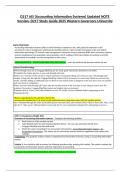
D217 AIS (Accounting Information Systems) Updated NOTE
Version- D217 Study Guide 2025 Western Governors University
ourse Overview
Accounting Information Systems (AIS for short) introduces students to AIS, with particular emphasis on the
accountant’s role in management and financial reporting systems. Topics include transaction cycles and related
information technology (IT) controls, data management, enterprise resource planning (ERP) and e-commerce systems,
systems development and acquisition, documentation, and IT auditing. D103 Intermediate Accounting I and D104
Intermediate Accounting II are the prerequisites to this course.
GREEN HIGHLIGHTS – STUDY GUIDE OBJECTIVES PER MODULE – note: the textbook info has been chosen for you
Course Overall Strategy
€Work through each unit in Cengage/MindTap per the study guide instructions detailed by unit below.
€Complete the chapter quizzes as you work through each unit.
€There are 2 versions of the unit tests. Course instructors recommend taking one version as you work through each
module. Going back through the Cengage/MindTap content will be necessary for some units. Based on your unit test
results, consider adding an additional layer of detail to your student notes or progress to the next unit if you are satisfied
with your level of competency.
€Once you have been through all 6 units; take the second version of the Unit tests in one sitting to assess your PA
readiness. Re-review Cengage/MindTap content and student notes as necessary.
€Attempt the PA. Your CI will offer feedback on your PA results. Review feedback before progressing to OA.
€Attempt the OA.
*Before I attempted the OA and after I did the PA:
I reviewed the module that I was weak on and studied the areas using these notes AND the module quizzes.
then I skimmed through the notes and module quizzes one more time, and watched cohort videos 1 more time. Note: I felt
like the 4th video wasn’t sufÏcient before I even took the OA so I recommend reading Unit 6 and getting to know it.
UNIT 2: (Competency Weight 20%)
Overview of Accounting Information Systems – Complete the following activities:
€ Read/Listen to all the module content.
€ Take detailed notes for each learning objective below. You can copy and paste directly from
Cengage/MindTap into Microsoft word.
€ Watch the cohort recording for An Accountant’s Perspective: Accounting Information Systems - An
Accountant's Perspective. The videos are not all inclusive and are meant to supplement (not replace) the
readings.
Competency: The graduate analyzes system components and transaction processes, using an accounting information
system.
Module 1: You should be able to answer the following questions after studying this module: The student analyzes the
components of information systems and their importance to accounting.
Recognize the primary information flows within the business environment.
, Specific information objectives will differ from firm to firm as specific user needs vary. Three
fundamental objectives are, however, common to all organizations:
1. To support the firm’s day-to-day operations. Operations personnel use
information to assist them in the efÏcient and effective discharge of their daily
tasks.
2. To support management decision making. Managers use information to assist
them in planning and control decisions related to their areas of responsibility.
3. To support the stewardship function of management. Stewardship refers to
managers’ responsibility to properly manage the resources of the firm and to report
on their activities. External users receive stewardship information through
traditional financial statements and other mandated reports. Internally, managers
receive stewardship information from various responsibility reports.
Differential between accounting information systems (AIS) and management information systems (MIS)
** Memorize AIS structure
,Differential between financial transactions and nonfinancial transactions. ***KNOW
The distinction between AIS and MIS centers on the concept of a transaction. The information system accepts
inputs, called transactions, which are converted through various processes into output information that goes to
users. Transactions fall into two classes: financial transactions and nonfinancial transactions.
(AIS) processes financial transaction: an economic event that affects the assets and equities of the organization,
is reflected in its accounts, and is measured in monetary terms.
, (MIS) processes Nonfinancial transactions: events that do not meet the narrow definition of a financial
transaction. For example, adding a new supplier of raw materials to the list of valid suppliers is an event that may
be processed by the enterprise’s information system as a transaction.
Identify the principal components of the general model for accounting information systems. ***KNOW
This is a general model because it applies to all AIS, regardless of their underlying technologies.
Data Collection: first operational stage in Information system
Data Sources: financial transactions that enter the info systems from internal or external sources
Data Processing: group that manages the computer resources used to perform day to day processing of transactions
Database Management:
Data Attribute collection of attributes = record collection of record = file
Information Generation
Information generation is the process of compiling, arranging, formatting, and presenting
information to users. Information can be an operational document such as a sales order, a structured
report, or a message on a computer screen. Regardless of physical form, useful information has the
following characteristics: relevance, timeliness, accuracy, completeness, and summarization.
Version- D217 Study Guide 2025 Western Governors University
ourse Overview
Accounting Information Systems (AIS for short) introduces students to AIS, with particular emphasis on the
accountant’s role in management and financial reporting systems. Topics include transaction cycles and related
information technology (IT) controls, data management, enterprise resource planning (ERP) and e-commerce systems,
systems development and acquisition, documentation, and IT auditing. D103 Intermediate Accounting I and D104
Intermediate Accounting II are the prerequisites to this course.
GREEN HIGHLIGHTS – STUDY GUIDE OBJECTIVES PER MODULE – note: the textbook info has been chosen for you
Course Overall Strategy
€Work through each unit in Cengage/MindTap per the study guide instructions detailed by unit below.
€Complete the chapter quizzes as you work through each unit.
€There are 2 versions of the unit tests. Course instructors recommend taking one version as you work through each
module. Going back through the Cengage/MindTap content will be necessary for some units. Based on your unit test
results, consider adding an additional layer of detail to your student notes or progress to the next unit if you are satisfied
with your level of competency.
€Once you have been through all 6 units; take the second version of the Unit tests in one sitting to assess your PA
readiness. Re-review Cengage/MindTap content and student notes as necessary.
€Attempt the PA. Your CI will offer feedback on your PA results. Review feedback before progressing to OA.
€Attempt the OA.
*Before I attempted the OA and after I did the PA:
I reviewed the module that I was weak on and studied the areas using these notes AND the module quizzes.
then I skimmed through the notes and module quizzes one more time, and watched cohort videos 1 more time. Note: I felt
like the 4th video wasn’t sufÏcient before I even took the OA so I recommend reading Unit 6 and getting to know it.
UNIT 2: (Competency Weight 20%)
Overview of Accounting Information Systems – Complete the following activities:
€ Read/Listen to all the module content.
€ Take detailed notes for each learning objective below. You can copy and paste directly from
Cengage/MindTap into Microsoft word.
€ Watch the cohort recording for An Accountant’s Perspective: Accounting Information Systems - An
Accountant's Perspective. The videos are not all inclusive and are meant to supplement (not replace) the
readings.
Competency: The graduate analyzes system components and transaction processes, using an accounting information
system.
Module 1: You should be able to answer the following questions after studying this module: The student analyzes the
components of information systems and their importance to accounting.
Recognize the primary information flows within the business environment.
, Specific information objectives will differ from firm to firm as specific user needs vary. Three
fundamental objectives are, however, common to all organizations:
1. To support the firm’s day-to-day operations. Operations personnel use
information to assist them in the efÏcient and effective discharge of their daily
tasks.
2. To support management decision making. Managers use information to assist
them in planning and control decisions related to their areas of responsibility.
3. To support the stewardship function of management. Stewardship refers to
managers’ responsibility to properly manage the resources of the firm and to report
on their activities. External users receive stewardship information through
traditional financial statements and other mandated reports. Internally, managers
receive stewardship information from various responsibility reports.
Differential between accounting information systems (AIS) and management information systems (MIS)
** Memorize AIS structure
,Differential between financial transactions and nonfinancial transactions. ***KNOW
The distinction between AIS and MIS centers on the concept of a transaction. The information system accepts
inputs, called transactions, which are converted through various processes into output information that goes to
users. Transactions fall into two classes: financial transactions and nonfinancial transactions.
(AIS) processes financial transaction: an economic event that affects the assets and equities of the organization,
is reflected in its accounts, and is measured in monetary terms.
, (MIS) processes Nonfinancial transactions: events that do not meet the narrow definition of a financial
transaction. For example, adding a new supplier of raw materials to the list of valid suppliers is an event that may
be processed by the enterprise’s information system as a transaction.
Identify the principal components of the general model for accounting information systems. ***KNOW
This is a general model because it applies to all AIS, regardless of their underlying technologies.
Data Collection: first operational stage in Information system
Data Sources: financial transactions that enter the info systems from internal or external sources
Data Processing: group that manages the computer resources used to perform day to day processing of transactions
Database Management:
Data Attribute collection of attributes = record collection of record = file
Information Generation
Information generation is the process of compiling, arranging, formatting, and presenting
information to users. Information can be an operational document such as a sales order, a structured
report, or a message on a computer screen. Regardless of physical form, useful information has the
following characteristics: relevance, timeliness, accuracy, completeness, and summarization.