WGU Performance Assessment
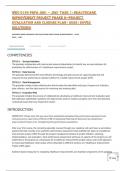
EVIDENCE-BASED MEASURES FOR EVALUATING HEALTHCARE IMPROVEMENTS — D159
PRFA — JIM1
TASK OVERVIEW SUBMISSIONS EVALUATION REPORT
COMPETENCIES
7073.5.1 : Success Indicators
The graduate collaborates with internal and external stakeholders to identify key success indicators for
evaluating the effectiveness of a healthcare improvement project.
7073.5.2 : Data Sources
The graduate determines the most effective technology and data sources for capturing data that will
measure the key performance indicators (KPIs) for a health improvement project (HIP).
7073.5.3 : Data Management
The graduate creates a data collection plan that includes the data fields and types, frequency of collection,
data collector, and the data sources for retrieving and entering data.
7073.5.4 : Evaluation Plan
The graduate initiates the process of collaboratively developing a healthcare improvement evaluation plan
that addresses stakeholder questions and high-priority areas to measure progress over time and describes
contextual issues that may impact the results.
INTRODUCTION
IMPORTANT: Please note that you must have completed and passed the performance assessment and
clinical practice experience (CPE) for D158: Strategically Planning the Execution of a Healthcare
Improvement Project prior to beginning this performance assessment.
After your first course, the remaining specialty courses through your capstone will each have a summative
assessment that consists of an authentic performance assessment that scaffolds the tasks of a healthcare
improvement project (HIP) through the project management phases of project initiation, planning,
implementation, and evaluation. Each performance assessment will focus on aspects of the project you will
implement or the project you will propose for a healthcare improvement project using a real-world approach
to improving healthcare. Each phase will be described in different sections of a Healthcare Improvement
Project (HIP) paper.
Evidence-based measures for evaluating healthcare improvements are essential components of the planning
1/1
1
, phase of a HIP. Another important component is learning to identify key performance indicators and metrics
used to determine the success of a HIP.
2/1
1
EVIDENCE-BASED MEASURES FOR EVALUATING HEALTHCARE IMPROVEMENTS — D159
PRFA — JIM1
TASK OVERVIEW SUBMISSIONS EVALUATION REPORT
COMPETENCIES
7073.5.1 : Success Indicators
The graduate collaborates with internal and external stakeholders to identify key success indicators for
evaluating the effectiveness of a healthcare improvement project.
7073.5.2 : Data Sources
The graduate determines the most effective technology and data sources for capturing data that will
measure the key performance indicators (KPIs) for a health improvement project (HIP).
7073.5.3 : Data Management
The graduate creates a data collection plan that includes the data fields and types, frequency of collection,
data collector, and the data sources for retrieving and entering data.
7073.5.4 : Evaluation Plan
The graduate initiates the process of collaboratively developing a healthcare improvement evaluation plan
that addresses stakeholder questions and high-priority areas to measure progress over time and describes
contextual issues that may impact the results.
INTRODUCTION
IMPORTANT: Please note that you must have completed and passed the performance assessment and
clinical practice experience (CPE) for D158: Strategically Planning the Execution of a Healthcare
Improvement Project prior to beginning this performance assessment.
After your first course, the remaining specialty courses through your capstone will each have a summative
assessment that consists of an authentic performance assessment that scaffolds the tasks of a healthcare
improvement project (HIP) through the project management phases of project initiation, planning,
implementation, and evaluation. Each performance assessment will focus on aspects of the project you will
implement or the project you will propose for a healthcare improvement project using a real-world approach
to improving healthcare. Each phase will be described in different sections of a Healthcare Improvement
Project (HIP) paper.
Evidence-based measures for evaluating healthcare improvements are essential components of the planning
1/1
1
, phase of a HIP. Another important component is learning to identify key performance indicators and metrics
used to determine the success of a HIP.
2/1
1