Assessment of Social Determinants of Health in Tuscola, Texas-Taylor County.
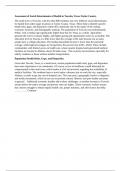
The small town of Tuscola, with less than 800 residents, has very different social determinants
for health from other larger locations in Taylor County, Texas. These help to identify specific
health risks, gaps, and disparities within this community due to the nature of the setting,
economic structure, and demographic makeup. The population of Tuscola was predominantly
White, with a median age significantly higher than that for Texas as a whole. Agriculture
grounds the town's economy highly, and higher-paying job opportunities aren't as accessible. The
education level in Tuscola is a little lower than the average in the state because not as many
people have a college education. The median household income is lower than the statewide
average, while high percentages are living below the poverty line (CDC, 2022). These include
communities with limited access to health care, whose nearest hospital and specialized medical
facilities are located in Abilene, about 20 miles away. This is pretty inconvenient, especially for
elderly residents or those without reliable transportation.
Population Health Risks, Gaps, and Disparities.
Given that Tuscola, Texas, is a small town, certain population health risks, gaps, and disparities
bear more importance to its community. Of course, access to healthcare would inherently be
compromised in this rural town, which makes it a bit inconvenient regarding the availability of
medical facilities. The residents have to travel quite a distance just to reach the city, especially
Abilene, in order to get any sort of hospital care. This may pose a geographic barrier to diagnosis
and medical treatment, which in turn can exacerbate chronic illnesses and poor health outcomes
in general. Additional economic hurdles add to these challenges, as median incomes in Tuscola
remain below the state's average and poverty rates are higher. These economic realities ensure
that citizens struggle to obtain regular health care, proper nutrition, and other basics that help
…………… Continue
The small town of Tuscola, with less than 800 residents, has very different social determinants
for health from other larger locations in Taylor County, Texas. These help to identify specific
health risks, gaps, and disparities within this community due to the nature of the setting,
economic structure, and demographic makeup. The population of Tuscola was predominantly
White, with a median age significantly higher than that for Texas as a whole. Agriculture
grounds the town's economy highly, and higher-paying job opportunities aren't as accessible. The
education level in Tuscola is a little lower than the average in the state because not as many
people have a college education. The median household income is lower than the statewide
average, while high percentages are living below the poverty line (CDC, 2022). These include
communities with limited access to health care, whose nearest hospital and specialized medical
facilities are located in Abilene, about 20 miles away. This is pretty inconvenient, especially for
elderly residents or those without reliable transportation.
Population Health Risks, Gaps, and Disparities.
Given that Tuscola, Texas, is a small town, certain population health risks, gaps, and disparities
bear more importance to its community. Of course, access to healthcare would inherently be
compromised in this rural town, which makes it a bit inconvenient regarding the availability of
medical facilities. The residents have to travel quite a distance just to reach the city, especially
Abilene, in order to get any sort of hospital care. This may pose a geographic barrier to diagnosis
and medical treatment, which in turn can exacerbate chronic illnesses and poor health outcomes
in general. Additional economic hurdles add to these challenges, as median incomes in Tuscola
remain below the state's average and poverty rates are higher. These economic realities ensure
that citizens struggle to obtain regular health care, proper nutrition, and other basics that help
…………… Continue