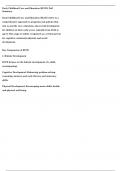
Early Childhood Care and Education (ECCE): Full
Summary
Early Childhood Care and Education (ECCE) refers to a
comprehensive approach to programs and policies that
aim to provide care, education, and overall development
for children in their early years, typically from birth to
age 8. This stage is widely recognized as a critical period
for cognitive, emotional, physical, and social
development.
Key Components of ECCE
1. Holistic Development
ECCE focuses on the holistic development of a child,
encompassing:
Cognitive Development: Enhancing problem-solving,
reasoning, memory, and early literacy and numeracy
skills.
Physical Development: Encouraging motor skills, health,
and physical well-being.
, Social and Emotional Development: Fostering emotional
intelligence, empathy, and interpersonal skills.
Language Development: Building vocabulary,
comprehension, and communication skills.
2. Inclusive and Equitable Access
ECCE aims to ensure all children, regardless of socio-
economic background, gender, or abilities, have access to
quality early education and care services. This includes:
Providing special provisions for marginalized or
disadvantaged groups.
Addressing gender equality and the inclusion of children
with disabilities.
3. Quality Early Learning Environment
The quality of early learning environments is critical to
the success of ECCE programs. Key aspects include:
Well-trained and qualified educators.
Safe, stimulating, and child-friendly facilities.
Summary
Early Childhood Care and Education (ECCE) refers to a
comprehensive approach to programs and policies that
aim to provide care, education, and overall development
for children in their early years, typically from birth to
age 8. This stage is widely recognized as a critical period
for cognitive, emotional, physical, and social
development.
Key Components of ECCE
1. Holistic Development
ECCE focuses on the holistic development of a child,
encompassing:
Cognitive Development: Enhancing problem-solving,
reasoning, memory, and early literacy and numeracy
skills.
Physical Development: Encouraging motor skills, health,
and physical well-being.
, Social and Emotional Development: Fostering emotional
intelligence, empathy, and interpersonal skills.
Language Development: Building vocabulary,
comprehension, and communication skills.
2. Inclusive and Equitable Access
ECCE aims to ensure all children, regardless of socio-
economic background, gender, or abilities, have access to
quality early education and care services. This includes:
Providing special provisions for marginalized or
disadvantaged groups.
Addressing gender equality and the inclusion of children
with disabilities.
3. Quality Early Learning Environment
The quality of early learning environments is critical to
the success of ECCE programs. Key aspects include:
Well-trained and qualified educators.
Safe, stimulating, and child-friendly facilities.