NHA CCMA REVIEW
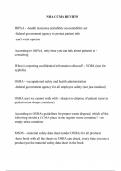
HIPAA - -health insurance portability accountability act -federal government agency to protect patient info -can't write opinion According to HIPAA, only time you can talk about patients is - consulting When is reporting confidential information allowed? - VDRL (test for syphilis) OSHA - -occupational safety and health administration -federal government agency for all employee safety (not just medical) OSHA says we cannot walk with - sharps (so dispose of patient razor in patient room sharps container) According to OSHAs guidelines for proper waste disposal, which of the following should a CCMA place in the regular waste container? - an empty urine container MSDS - -material safety data sheet (under OSHA) for all products -have book with all the sheets so OSHA can check, every time you use a product put the material safety data sheet in the book DEA - -drug enforcement agency -federal government agency involved in ALL drugs (medical, illegal, etc) -DEA has to approve doctors to write prescriptions, so not all doctors can FDA - -food and drug administration, approve all ingested materials CDC - -centers for disease control -headquarters in ATL but every state has one -protects americans from health, safety, and security threats both foreign and in the U.S. CLIA - -clinical laboratory improvement act -federal government agency that dictates what we can and cannot do in labs, medical settings, etc WHO - -world health organization -works with CDC, monitor diseases etc internationally Fires: Class A - -combustible materials -water or H2O based solution Fires: Class B - -flammable liquid or vapor -extinguisher (remove O2) Fires: Class C - -electrical -non-conductive extinguisher Fires: Class K - -kitchen Refusing treatment: if 18 or older - allowed to refuse treatment Refusing treatment: younger than 18 - cannot refuse, need guardian permission Refusing treatment: 12 or older - can refuse if care related to substance abuse, pregnancy, or sexual abuse Polyuria - excessive urination (poly= many) Nocturia - urination at night (not supposed to urinate while you sleep) Hematuria - -blood in urine -if female has hematuria, ask about LMP (last menstrual period) -if male has hematuria, indicates prostate cancer UTI - -urinary tract infection -bacterial infection -90% of time it is an STI (just means its transmitted through sexual contact) -use clean-catch midstream specimen -nitrite in urine HCG - -Human Chorionic Gonadotropin hormone -pregnancy test -can do test two ways: blood or urine (both serum) Urine culture, what goes on collection cup? - -label container not the lid -label (patient name, date and time of collection, initials of who collected) Tests (cartridge) - -S stands for specimen or serum (blood or urine) -C stands for control -T stands for test 2 lines on test means - positive One line on control means - negative One line on test means - defective test -osis/-asis - condition of Hemostasis - -process of causing bleeding to stop (clotting, WBCs, etc) -hemophiliacs can't do hemostasis 5 types of white blood cells - never let monkeys eat bananas neutrophils, lymphocytes, monocytes, eosinophils, basophils New white blood cells every - 7-10 days In hemostasis, what is the main blood component? - platelets (aka thrombocytes) Other words for blood clot - embolism, fibrinogen clot, platelet plug, thrombocytes, platelets Liquid portion of blood - plasma New RBCs every - 120 days -oma - tumor Hematoma - -blood tumor (not really tumor), blood accumulates under the skin when tissue is injured -heat and pressure to dilate vessels -from *prolonged tourniquet*, also needle probing Hemolysis/hemolytic - -breaking of blood cells -from tourniquet, also shaking blood collection tubes (why we do inversions instead) Hemoconcentration - accumulation of blood in one area Hemoglobin - -gives blood iron -carries O2 from lungs to body -a molecular protein CO2 carries oxygen back to heart as - bicarbonate Hemoglobin A1C Assay (HgbA1C) - -diabetes test, for diabetes screening, to see how diabetes is progressing -tells you about long-term glucose levels (why it is different than glucometer) -test every few months -normal range is below 6% Post-prandial - after meals Pee - urine, void, micturate Poop - feces, defecation, stool, bowel movement Period - menses, menstrual, cycle Diarrhea - body rejects what you ate so it doesn't go through all the cycles it should Amenorrhea - (-rrhea= flow) -absence of menstrual cycle, can be only missing 1-2 periods Capillary puncture - -finger or heel stick, also *earlobes* -most important step= wipe away first drop of blood Finger Stick - -blood sugar, microhematocrits, iron test -side of middle (great) or ring finger CCMA is preparing to perform a hand draw what should you assemble? - Winged infusion set and adapter Before babies leave hospital in the US, within 24-48 hours of birth, have to pass - PKU and abgar test Abgar test - lungs are working (if baby cries) PKU - -infant heel stick (phenylketonuria) -lateral or medial sides of heel -warm heel up -depth no more than *2 mm* (APA_ -*filter paper* NOT capillary tubes, saturate circles, only one side -let filter paper air dry for *3 hours* -test after *24 hours* of age -specimen received in no more than *14 days* -write patient info and refrigerate ABG - -Arterial Blood Gas -measure of gases in blood/arteries (oxygen) -to transport it must be *chilled (ice)* -MAs cannot do ABG - green tube What is normal oxygen saturation level (in arterial blood)? - 94-100 If patient has 89% oxygen saturation what do you do? - call 911 Lungs vs alveoli - lungs= air, alveoli= oxygen All gases must be transported - cold Semen always transported at - body temp Homeostasis - body balance between internal and external environment, controls temperature etc. What blood system supplies the heart? - coronary system Vitiligo - lack of melanocytes, pigmentation disorder More melanin in - darker places of body (areolas, knees, etc) Diaphoretic - excessive sweating (only bodily fluid that's not contaminated) Vertigo - ear cannot balance your equilibrium -dizziness, excessive sweating (diaphoretic) Anthropometric measurements - body measurements (height, weight, vital signs, etc) Anthropometric measurement for 0-3 years - -head circumference (round to 1/2in or 1mm) -infants also measure length until able to stand What is normal HR (heart rate) at rest? - -in the 70s (range is 60-100 bpm) Athlete heart rate at rest - 40s bpm Metastasize - to enlarge or spread (not necessarily cancer) "lit" - stone Nephrolithiasis - condition of kidney stones Cholect - gall bladder Cholectlithiasis - -condition of gall bladder stones -would do abdominal ultrasound -cause right upper quadrant pain Quality control - controlling quality of instruments, specimens, environment, etc POC testing requires quality control to - ensure accuracy of results Clean a site - inward to outward 3 times Thyroid gland produce - hormones Organ producing insulin - pancreas Hypoglycemic - -low glucose levels -would give orange juice Diabetes mellitus - -Type II diabetes -most common -too much insulin (insulin resistance) -can have convulsions/comas, fruity urine and breath Diabetes insipidus - -Type I diabetes -born with, insulin deficiency -frequent urination, clear urine, sometimes no odor Necrotic/necrosis - -tissue death within body system (death of living tissue) through injury -sometimes called premature tissue death Infarction - not enough blood supply to tissue, refers to arterial MI - myocardial infarction Ischemia - lack of or inadequate oxygen supply (oxygenated blood) to tissues Infarction and ischemia usually related to - heart attack or CVA CVA - -Cerebral Vascular Accident -from infarction, ischemia, or necrosis -stroke, aneurysm, hemorrhaging, etc TIA - -Transient Ischemic Attacks -lack of blood flow or oxygen Stroke - brain cells not receiving enough nutrients/O2 Aneurysm - bulging of artery or very weak artery-> artery bursts (aneurysms causes stroke) Patient is shaking, twitching, and eyes rolling back in head - -patient is having a seizure -put *supine on the floor* Seizure - abnormal electrical activity of the brain EEG - -electroencephalogram -record electrical activity, will tell you about seizure Body Mechanics - -medical professionals: bend at knees not back, don't reach go closer to item, push don't pull, open legs wide when supporting something, don't twist pivot -for patients it's positions When lifting patient, make sure at - your eye level (not theirs) When transferring a patient on mechanical lift, what position are bars? - facing the patient, extending towards the patient Mechanical lift - -aka Hoyer lift, machine or device that transports patient, gurney to gurney -has swing with open buttocks Fowler's position - 90 degrees sitting, knees can be bent or straight Semi-fowler's - 45 degrees sitting Only position that is only for women - -lithotomy (legs in stirrups) -used for pap smears, vaginal birth, etc Sims' position - -laying on left side with right knee sharply bent -for rectal temperature Trendelenberg position - laying with feet elevated 30 degrees Supine - laying flat face up Prone - face down Knee-chest position - laying face down with head to the side and knees to chest Dorsal recumbent - -legs are bent and knees pointed straight up in the air with feet flat on the bed -for catheterization TB - -tuberculosis -pulmonary disease (lungs) -airborne route of transmission, can be transmitted live or dead -you will be put in isolation TB test - -intradermal (ID) injection -inject PPD (purified protein derivative) -read after 48-72 hours (sometimes 96) -use a tuberculin or insulin needle (25 gauge) -put in at 0.1 mc/cc -can't wear face mask PPD - -purified protein derivative (antigen TB) -what you put in body for TB test Who can test positive for TB without having it? - people from foreign (3rd world) countries bc exposed to it at some time in life but do not have it A CCMA is caring for a patient who has active tuberculosis. What PPE must be used during the patient's care? - N95 respirator Herpes - -virus that lives in spinal cord, dormant until triggered -everyone has herpes -not an STI because it can be transmitted other ways -when herpes comes out a lot -> chicken pox -chicken pox when an adult -> shingles PT/INR - -prothrombin test/international nationalized test -checks for bleeding time or clotting -use blue tube (has anticoagulant) -INR= 1:9, 1= parts amount of additive (sodium citrate), 9= parts blood Number of inversions blue - 3-4 Number of inversions red - 5 Number of inversions rest of tubes - 8-10 Expired tubes - lose their vacuum NG - -nasal-gastric -feeding tube, insert catheter into stomach through nose -patient in semi-Fowler's position G - -gastric tube (feeding tube) -directly to stomach GTT - -Glucose Tolerance Test -way body metabolizes glucose -urine, blood, or glucocola (for gestational diabetes) -must fast for any GTT -30-60 min Syncope - fainting Basal state - no drinking, eating, talking, stress, sex, etc. Fasting state - no food or drink Point of care - extra care given for something you didn't come to the office for Snellen chart - -distance visual acuity test -letters, Es in different positions, etc -stand 20 ft away (why it's 20/20 vision) -usually for myopia and hyperopia -start at 20/70 line -stop when patient says they can't see or makes more than 2 mistakes (line right before is their vision for that eye) -for hyperopia, hold card 14-16 in from face Myopia - near-sightedness (can't see far) my= close to me Hyperopia - far-sightedness (can't see near) hyper person= get away from me Presbyopia - elderly Ishihara - -color vision acuity test (colorblind can't see red or green) -patient holds card at arms length OS - right eye OD - left eye OU - both eyes AS - right ear AD - left ear AU - both ears Sterilize - -kill microorganisms with high temp -surgical or sterile scrub or field= area that is sterile -autoclave (heat and steam pressure, for medical instruments, 250-320F) or incinerate (can only sterilize metal) or in autoclave/sterilization pouches Aseptic - -clean, free of germs -septic hand washing= wrist to fingertip and point hands downwards Disinfect - -kill microorganisms with chemicals ex: bleach Sanitation - -reduce microorganisms ex. hot water, scrub brush -do on instruments before autoclaving Muslin - blue sheet that you put instruments in for autoclave (black stripe= instruments ready) Cannot sterilize - human being (only way to sterilize is autoclave or incinerate) Scrub assistant - in surgery, stays in front of sterile field, if something compromises sterile field must redo everything ICS - intercostal space NPO - nothing by mouth BID - twice a day LOP - level of pain BLS - basic life support Chain of Custody - -anytime victim is associated with law enforcement (paternity, rape, DUI) -everyone must sign date and time Streptococcal - -virus in the throat, strep throat -can lead to rheumatic fever COPD - -chronic obstructive pulmonary disease -issue in pulmonary system -emphysema, bronchitis, pneumonia PFT - -pulmonary function test -spirometer (or peak flow meter) (inhale & exhale deeply) -need 3 acceptable test -sitting position -no nebulizers, bronchodilators or smoking 6 hrs before -CCMA responsibility to coach through test Spirometer - -postop, asthma, bronchitis -measures amount of air entering and leaving the lungs -how much air in one breath cycle -exhale then inhale (how much air you can hold in) Peak Flow Meter - -post operative to help them breathe again on their own -inhale then exhale as hard as you can Asthma - allergies Bronchitis - inflammation of bronchioles -itis - inflammation Shock - -symptoms= cyanotic, weak pulse, blank stare, rapid breathing, pale skin -put in Trendelenberg position CPR-BPM: According to AHA, how many compressions per minute for CPR? - 120 bpm DR. CAB - danger, responsiveness, compressions/circulation, airway, breathing Denture Removal - top first then bottom Implied Consent - -can be verbal or nonverbal, gesture or not -ex: can I take your pulse? if they give you their arm it is implied that they are consenting to have their pulse taken -if patient is unconscious, it is implied that they consent to you resuscitating them Informed Consent - -WRITTEN consent form that the DOCTOR only can give and explain to patient Patient transfer most important thing - lock the wheels Patient transfer from bed to wheelchair - -Position and lock wheelchair close to bed. Remove the armrest nearest to the bed, and swing away both leg rests. -Help patient turn onto their side, facing the wheelchair. -Put an arm under the patient's neck with your hand supporting the shoulder blade; put your other hand under the knees. -Swing the patient's legs over the edge of the bed, helping the patient to sit up and have patient scoot to edge of bed. -Put your arms around patient's chest and clasp your hands behind their back. (can also use a transfer belt) -Supporting the leg farthest from the wheelchair between your legs, lean back, shift your weight, and lift. -Have the patient pivot toward the chair, as you continue to clasp your hands around the patient. -As the patient bends toward you, bend your knees and lower the patient into the back of the wheelchair. Patient transfer from wheelchair to bed - -Park the wheelchair next to bed, close to you. -Put brakes on and move the footrests out of the way. -Get patient into a seated position, roll the patient onto the same side as the wheelchair. -Put one of your arms under the patient's shoulders and one behind the knees. Bend your knees. -Swing the patient's feet off the edge of the bed and use the momentum to help the patient into a sitting position. -Move the patient to the edge of the bed and lower the bed so the patient's feet are touching the ground. -Place the patient's outside leg (the one farthest from the wheelchair) between your knees for support. Bend your knees and keep your back straight -Slowly stand up. Use your legs to lift. -At the same time, the patient should place their hands by their sides and help push off the bed. -The patient should help support their weight on their good leg during the transfer. -Pivot towards the wheelchair, moving your feet so your back is aligned with your hips. -Once the patient's legs are touching the seat of the wheelchair, bend your knees to lower the patient into the seat. At the same time, ask the patient to reach for the wheelchair armrest. Manual Blood Pressure - -use sphygmomanometer (blood pressure cuff) -palpate *brachial artery* in antecubital fossa region of arm (use RIGHT arm unless pulse stronger in left) -Position patient arm in outstretched, relaxed position at heart level, patient seated with both feet flat on floor -Blood pressure cuff approx *1 inch* about bend in elbow -Place stethoscope where brachial pulse was felt -Release dial on bulb by approx *2 mm per second* -When you hear first beat, record number (systolic) -When beat stops, record number (diastolic)1 How much do you inflate the blood pressure cuff or sphygmomanometer? - 30 mm above the *radial* pulse cessation Korotkoff sounds - -for listening for systole and diastole -systolic: Korotkoff I -diastolic: Korotkoff V
Written for
- Institution
- NHA CCMA
- Course
- NHA CCMA
Document information
- Uploaded on
- January 20, 2025
- Number of pages
- 73
- Written in
- 2024/2025
- Type
- Exam (elaborations)
- Contains
- Questions & answers
Subjects

Also available in package deal