
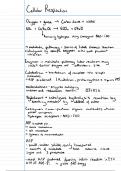
Cellular Respiration
Oxygen glucose + - Carbon dioxide + water
GO2 + CoHizO0 -
> SCO2 + OH2O
S.I units ↓
Removing hydrogen using Coenzymes NAD FAD
+
metabolic
pathway Series of linked chemical reactions
-
> =
catalysed by specific enzymes
with end
product
inhibition
Enzymes in metabolic
pathway later reaction
may
inhibit earlier
enzyme
at allosteric site
Catabolism
e breakdown
of complex into simple
molecules
produced (Anabolism ATP)
ATP
proteinsynthes is
+
, requires
oxidoreductases -
enzymes catalysing
oxidation and reduction reaction .
OILRIG
Hydrolases e
catalyses hydroly sis reaction
by
breaking by molecules addition of water
Coenzymes enon-protein
assist enzymes
.
organic molecules which
hydrogen acceptors
-
NAD + FAD
ATP is needed
for ...
↳ muscle contraction
-
cell movement
Synthesis of macromolecules
>
-
ATP
-small
consists
, water soluble
nucleotide
,
easily base
transported
-
of admine , ribuse
Sugar and 3 phosphate
-most produced during redox
ATP reaction in ETC
ATPFADP Pi yields free energy
+
e
, An e
*
S.I units
/
440 Phosphate
ribose
Glycolysis : Occurs inhe
cytoplasm ; same
for aerobic and anaerobic
Glucose enters he cell via
facilitated diffusion with
across the
carrier proteins transporting membrane
Transmembrane and specific
Large and polar
↳ keep it within cells
A) Phosphorylation
↳
glucose is phosphorylated by adding 2 phosphate
from 2 ATP molecules
L fructose I
G diphosphate
a more reactive
splits of triose phosphate (3C) and molecules of ADP
produced so far .
B) Oxidation :
each triose phosphate is oxidised
to
form pyruvate (loses HTT
Co-enzyme NAD" collects he
hydrogen ions
+
NAD++ 2H + 2e e NADH + H+
+
2 NAD + + 4H+ - 2 NADH + 2H
>
-
Intermediate compounds donate inorganic phosphates
to ADP to make ATP
I substrate level
phosphorylation .
Oxygen glucose + - Carbon dioxide + water
GO2 + CoHizO0 -
> SCO2 + OH2O
S.I units ↓
Removing hydrogen using Coenzymes NAD FAD
+
metabolic
pathway Series of linked chemical reactions
-
> =
catalysed by specific enzymes
with end
product
inhibition
Enzymes in metabolic
pathway later reaction
may
inhibit earlier
enzyme
at allosteric site
Catabolism
e breakdown
of complex into simple
molecules
produced (Anabolism ATP)
ATP
proteinsynthes is
+
, requires
oxidoreductases -
enzymes catalysing
oxidation and reduction reaction .
OILRIG
Hydrolases e
catalyses hydroly sis reaction
by
breaking by molecules addition of water
Coenzymes enon-protein
assist enzymes
.
organic molecules which
hydrogen acceptors
-
NAD + FAD
ATP is needed
for ...
↳ muscle contraction
-
cell movement
Synthesis of macromolecules
>
-
ATP
-small
consists
, water soluble
nucleotide
,
easily base
transported
-
of admine , ribuse
Sugar and 3 phosphate
-most produced during redox
ATP reaction in ETC
ATPFADP Pi yields free energy
+
e
, An e
*
S.I units
/
440 Phosphate
ribose
Glycolysis : Occurs inhe
cytoplasm ; same
for aerobic and anaerobic
Glucose enters he cell via
facilitated diffusion with
across the
carrier proteins transporting membrane
Transmembrane and specific
Large and polar
↳ keep it within cells
A) Phosphorylation
↳
glucose is phosphorylated by adding 2 phosphate
from 2 ATP molecules
L fructose I
G diphosphate
a more reactive
splits of triose phosphate (3C) and molecules of ADP
produced so far .
B) Oxidation :
each triose phosphate is oxidised
to
form pyruvate (loses HTT
Co-enzyme NAD" collects he
hydrogen ions
+
NAD++ 2H + 2e e NADH + H+
+
2 NAD + + 4H+ - 2 NADH + 2H
>
-
Intermediate compounds donate inorganic phosphates
to ADP to make ATP
I substrate level
phosphorylation .


