
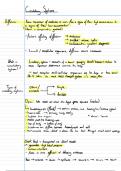
Circulatory Systems
Diffusion : Passive movement
their
of molecules
low concentration
from
or ions a
region of their high concentration to
a
region of
(down
gradient
*
a concentration
S.I units
factors affecting diffusion distance
-
-
>
volume ratio
surface :
-
>
concentration
gradient steepness
-
>
-
Small/unicellular organisms ,
diffusion moves substances
What Circulatory of pumping blood/transport
consists heart medium to
is
system
-
a
circulatory more important substances around the
body
system ? -
>
most complex multicellular organisms are too large or have small
SA: V ratio transport system
.
so need mass Mass
flow
Types of open / > single
circulatory systems closed
-
>
-
↳ double
Open : lacks vessels and instead into
large open spaces (cavities)
↳ /fluid) haemocytes (immune system
haemolymph > contains proteins ions
-
, ,
-
hamocoel -
>
primary body cavity
-bathes the organs * dorsal : back
muscles push
the
-
haemolymph
-top of body
-
bottom of
body
and ells
-
substances can
diffuseblood
between hasmolymph
heart
heart muscles relax is drawn into the
through small valued opening
-
,
Closed : blood is
transported via blood vessels
-
>
generates high blood pressure
-
narrow channels
faster
efficient delivering substances
at
-
so more
-
Heart -
> arteries >
-
aterioles -
>
capillaries -
> venules >
-
Veins -
> heart
, ->
-
Capifliaries : Close contact with most
body cells to supply substances via
diffusion
Ismaller distance
↳ Venules - veins
Values
S.I units -
ensures one
way
blood
flow to maximize
efficiency
Closed circulatory =
larger organisms + more active -
higher metabolic rate
Smaller lose heat
organisms ->
quickly - more active -, increased respiration
Single Single : .
e
g fish
.
w S
Double
through heart
↑
blood travels once
-
> lower
pressure
heart
deoxygenated blood
-
pumps
blood becomes
exchange at the gills
->
>
oxygenated
-
gaseous
>
diffuses
-
CO2 into the water
-
> reduced
pressure due to capillaries
-
blood now flows around the rest of the
body
-
> have lower metabolic rates
single circulatory system organisms as
their transport system is less
efficient
Double : e .
.
g
mammals
-
> blood travels through the heart twice
-
>
generates higher pressure
blood
right ventricle deoxygenated to he longs
-
pumps
to circuit)
be
oxygenated (pulmonary
oxygenated blood returns to the heart and pumped by
he
-
is
(systemic circuit
left ventricle to be
body
> to
satify blic for longer
-
repressurised + maintain pressure
rate
distances
high
Diffusion : Passive movement
their
of molecules
low concentration
from
or ions a
region of their high concentration to
a
region of
(down
gradient
*
a concentration
S.I units
factors affecting diffusion distance
-
-
>
volume ratio
surface :
-
>
concentration
gradient steepness
-
>
-
Small/unicellular organisms ,
diffusion moves substances
What Circulatory of pumping blood/transport
consists heart medium to
is
system
-
a
circulatory more important substances around the
body
system ? -
>
most complex multicellular organisms are too large or have small
SA: V ratio transport system
.
so need mass Mass
flow
Types of open / > single
circulatory systems closed
-
>
-
↳ double
Open : lacks vessels and instead into
large open spaces (cavities)
↳ /fluid) haemocytes (immune system
haemolymph > contains proteins ions
-
, ,
-
hamocoel -
>
primary body cavity
-bathes the organs * dorsal : back
muscles push
the
-
haemolymph
-top of body
-
bottom of
body
and ells
-
substances can
diffuseblood
between hasmolymph
heart
heart muscles relax is drawn into the
through small valued opening
-
,
Closed : blood is
transported via blood vessels
-
>
generates high blood pressure
-
narrow channels
faster
efficient delivering substances
at
-
so more
-
Heart -
> arteries >
-
aterioles -
>
capillaries -
> venules >
-
Veins -
> heart
, ->
-
Capifliaries : Close contact with most
body cells to supply substances via
diffusion
Ismaller distance
↳ Venules - veins
Values
S.I units -
ensures one
way
blood
flow to maximize
efficiency
Closed circulatory =
larger organisms + more active -
higher metabolic rate
Smaller lose heat
organisms ->
quickly - more active -, increased respiration
Single Single : .
e
g fish
.
w S
Double
through heart
↑
blood travels once
-
> lower
pressure
heart
deoxygenated blood
-
pumps
blood becomes
exchange at the gills
->
>
oxygenated
-
gaseous
>
diffuses
-
CO2 into the water
-
> reduced
pressure due to capillaries
-
blood now flows around the rest of the
body
-
> have lower metabolic rates
single circulatory system organisms as
their transport system is less
efficient
Double : e .
.
g
mammals
-
> blood travels through the heart twice
-
>
generates higher pressure
blood
right ventricle deoxygenated to he longs
-
pumps
to circuit)
be
oxygenated (pulmonary
oxygenated blood returns to the heart and pumped by
he
-
is
(systemic circuit
left ventricle to be
body
> to
satify blic for longer
-
repressurised + maintain pressure
rate
distances
high


