Tort Law Notes
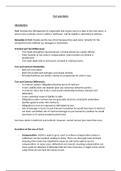
Introduction
Tort: Involves the infringement of a legal right and it gives rise to a claim in the civil courts. A
person who commits a tort is called a ‘tortfeasor’ and his liability is described as tortious.
Remedies in Tort: People use the law of tort because they seek some ‘remedy’ for the
wrong they have suffered e.g. damages or injunctions.
Criminal and Tort Differences:
- Tort claims brought by injured person, criminal actions by a public official;
- Main function of tort claim is compensation, main function of criminal is
punishment;
- Tort cases dealt with in civil courts, criminal in criminal courts.
Tort and Contract Similarities:
- Both are civil claims;
- Both will usually seek damages as principal remedy;
- Principal functions are similar, namely to compensate for victim’s loss.
Tort and Contract Differences:
- In contract, parties’ obligations fixed by terms of contract;
- In tort, liability does not depend upon any consensus between parties;
- In contract, there has to be a contractual relationship between claimant and
defendant;
- In tort, potential scope of liability is wide;
- Obligations under contract law are generally said to be voluntarily undertaken
(parties agree to enter into contract);
- Obligations in tort are imposed on defendant by law;
- Aim of damages in tort is to put claimant in position he would have been in had tort
not been committed, aim of contract damages to put claimant in position he would
have been in if contract properly performed.
Can have claims in both tort and contract, however, cannot recover loss more than once.
Functions of the Law of Tort:
- Compensation: Victim’s need to go to court to achieve compensation (unless a
settlement can be reached), leading to delay. There are also legal costs involved,
meaning if the victim has insufficient means he will not be able to sue for
compensation. In some cases, defendants are insured, meaning compensation can
more easily be obtained. If defendant did not have insurance, it might not be worth
suing if they do not have the means to pay.
, - Deterrence: Most relevant where a defendant is not insured against the claim.
Potential liability in tort may have a deterrent effect if a finding of negligence against
a defendant could adversely affect commercial or professional reputation. Rising
insurance premiums can also act as a deterrent.
- Justice: Justice has two aspects: Retribution against the wrongdoer, and
compensation for the victim. As compensation often comes from insurers, the claim
that tort satisfied the aim of justice is suspect.
- Vindication of Rights: Claimants may wish to make a ‘point of principle’ or initiate an
investigation, or provoke authorities into acting. This may be more important to
individuals than compensation.
Range and Scope of Tort Law:
Types of Harm:
- Battery
- Assault
- Negligence
- Defamation
- Private Nuisance
- Trespass to land
- Etc.
To bring a claim, the claimant would need to satisfy the requirements of the particular
tort(s) on order to be successful in any claim.
A claimant may not have a remedy in tort if he has suffered from a kind of harm which is not
protected by tort law (Bradford Corporation v Pickles).
Policy Limitations on the Protections of Tort Law:
Osman: Public policy arguments may preclude a claim in negligence against the police.
Tort and Human Rights:
Section 6 HRA: Unlawful for public authority to act in a way incompatible with the treaty.
Section 7 HRA: Allows a victim of such breach to bring proceedings against the public
authority.
Where defendant is a public body, the HRA 1998 may sometimes provide a direct
alternative to a claim in tort.
, Section 6 allows human rights to have an indirect influence on the development of tort law,
although it does not mean the courts are obliged to make changes to the principles of the
law of tort.
Defamation, Privacy and Human Rights:
Protecting the claimant against defamation may restrict the defendant’s right to freedom of
expression – A balance needs to be struck.
In some instances, the action for misuse of private information may provide a remedy.
Development of this action has been influenced by human rights, and it can help to provide
protection for Article 8.
Functioning of Tort Law:
Claimant must prove a number of elements for each tort. If claimant succeeds in this, he has
established a case in principle (prima facie) and will succeed unless defendant can produce a
defence.
Burden of proof lies with the claimant, and the burden of establishing a defence with the
defendant. Claimant must prove on the balance of probabilities.
Cannot have a claim for pure economic loss.
Parties:
Individuals can sue or be sued by anyone (in general). However, children under 18 can be
sued but litigation will be conducted through a ‘litigation friend’ (often a parent/guardian).
Parent are not legally liable legally or financially for their children’s torts.
A limited company has its own legal personality and can sue or be sued in its corporate
name. Partnerships can sue or be sued in their partnership name.
When a person dies, any claim he had in tort or any claim against him survives and is taken
over by his personal representatives.
Limitation Period:
Any tort claim must be commenced within certain time limits. Limits are found in the
Limitation Act 1980. The period is generally six years from when the cause of action arises,
but there are special cases. When a child is the claimant, the relevant period of time does
not start to run until the child reaches 18.
Introduction
Tort: Involves the infringement of a legal right and it gives rise to a claim in the civil courts. A
person who commits a tort is called a ‘tortfeasor’ and his liability is described as tortious.
Remedies in Tort: People use the law of tort because they seek some ‘remedy’ for the
wrong they have suffered e.g. damages or injunctions.
Criminal and Tort Differences:
- Tort claims brought by injured person, criminal actions by a public official;
- Main function of tort claim is compensation, main function of criminal is
punishment;
- Tort cases dealt with in civil courts, criminal in criminal courts.
Tort and Contract Similarities:
- Both are civil claims;
- Both will usually seek damages as principal remedy;
- Principal functions are similar, namely to compensate for victim’s loss.
Tort and Contract Differences:
- In contract, parties’ obligations fixed by terms of contract;
- In tort, liability does not depend upon any consensus between parties;
- In contract, there has to be a contractual relationship between claimant and
defendant;
- In tort, potential scope of liability is wide;
- Obligations under contract law are generally said to be voluntarily undertaken
(parties agree to enter into contract);
- Obligations in tort are imposed on defendant by law;
- Aim of damages in tort is to put claimant in position he would have been in had tort
not been committed, aim of contract damages to put claimant in position he would
have been in if contract properly performed.
Can have claims in both tort and contract, however, cannot recover loss more than once.
Functions of the Law of Tort:
- Compensation: Victim’s need to go to court to achieve compensation (unless a
settlement can be reached), leading to delay. There are also legal costs involved,
meaning if the victim has insufficient means he will not be able to sue for
compensation. In some cases, defendants are insured, meaning compensation can
more easily be obtained. If defendant did not have insurance, it might not be worth
suing if they do not have the means to pay.
, - Deterrence: Most relevant where a defendant is not insured against the claim.
Potential liability in tort may have a deterrent effect if a finding of negligence against
a defendant could adversely affect commercial or professional reputation. Rising
insurance premiums can also act as a deterrent.
- Justice: Justice has two aspects: Retribution against the wrongdoer, and
compensation for the victim. As compensation often comes from insurers, the claim
that tort satisfied the aim of justice is suspect.
- Vindication of Rights: Claimants may wish to make a ‘point of principle’ or initiate an
investigation, or provoke authorities into acting. This may be more important to
individuals than compensation.
Range and Scope of Tort Law:
Types of Harm:
- Battery
- Assault
- Negligence
- Defamation
- Private Nuisance
- Trespass to land
- Etc.
To bring a claim, the claimant would need to satisfy the requirements of the particular
tort(s) on order to be successful in any claim.
A claimant may not have a remedy in tort if he has suffered from a kind of harm which is not
protected by tort law (Bradford Corporation v Pickles).
Policy Limitations on the Protections of Tort Law:
Osman: Public policy arguments may preclude a claim in negligence against the police.
Tort and Human Rights:
Section 6 HRA: Unlawful for public authority to act in a way incompatible with the treaty.
Section 7 HRA: Allows a victim of such breach to bring proceedings against the public
authority.
Where defendant is a public body, the HRA 1998 may sometimes provide a direct
alternative to a claim in tort.
, Section 6 allows human rights to have an indirect influence on the development of tort law,
although it does not mean the courts are obliged to make changes to the principles of the
law of tort.
Defamation, Privacy and Human Rights:
Protecting the claimant against defamation may restrict the defendant’s right to freedom of
expression – A balance needs to be struck.
In some instances, the action for misuse of private information may provide a remedy.
Development of this action has been influenced by human rights, and it can help to provide
protection for Article 8.
Functioning of Tort Law:
Claimant must prove a number of elements for each tort. If claimant succeeds in this, he has
established a case in principle (prima facie) and will succeed unless defendant can produce a
defence.
Burden of proof lies with the claimant, and the burden of establishing a defence with the
defendant. Claimant must prove on the balance of probabilities.
Cannot have a claim for pure economic loss.
Parties:
Individuals can sue or be sued by anyone (in general). However, children under 18 can be
sued but litigation will be conducted through a ‘litigation friend’ (often a parent/guardian).
Parent are not legally liable legally or financially for their children’s torts.
A limited company has its own legal personality and can sue or be sued in its corporate
name. Partnerships can sue or be sued in their partnership name.
When a person dies, any claim he had in tort or any claim against him survives and is taken
over by his personal representatives.
Limitation Period:
Any tort claim must be commenced within certain time limits. Limits are found in the
Limitation Act 1980. The period is generally six years from when the cause of action arises,
but there are special cases. When a child is the claimant, the relevant period of time does
not start to run until the child reaches 18.