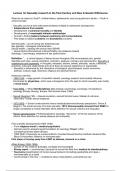
Lecture 1A: Sexuality research in the Past Century and Now & Gender Di erences
What do we mean by Youth?: children/teens, adolescents, and young (almost-) adults -> Youth is
a uid concept.
* Sexuality can be al lever (stimulans/drukkend middel) in adolescent development:
- Independence from parents
- Development of personal morality and identity
- Development of meaningful intimate relationships
- Crucial in nding balance between autonomy and connectedness
- First steps in exploring desires and boundaries (consent)
Sex/sexuality = act of having sex (heterosexual)
Sex (gender) = biological characteristics
Sexual health = dealing with sexual risks (SRHR)
- sexual dysfunctions/sexual violence/healthy sex (pleasure-based)
Sexology = sex therapy, treatment of sex dysfunctions
De nition: “… a central aspect of being human throughout life encompasses sex, gender
identities and roles, sexual orientation, eroticism, pleasure, intimacy and reproduction. Sexuality is
experiences and expressed, in thoughts, fantasies, desires, beliefs, attitudes, values, behaviors,
practices, roles and relationships (not all of them are always experience or expressed).
- Sexuality is in uenced by the interaction of biological, psychological, social, economic,
political, cultural, legal, historical, religious and spiritual factors.
Historical overview:
• 1900-1940 -> large growth of scienti c interest, sexology research and societal in uence.
Dominated by physicians, which was a divergence from the past (in which sexuality was mostly
a moral issue)
• Post-WW2 -> More interdisciplinary (also biology, psychology, sociology). US leading in
sexology (Kinsey, Money), Europe: rst feminist wave (1949)
• Sexual liberation (’60) -> Sexual revolution, second feminist wave. Masters & Johnson,
“discovery” human sexual response.
• 1973-2000 -> Social-constructionist versus medicalization/evolutionary perspective. Simon &
Gagnon: The social sources of human sexuality. 1974: Homosexuality removed from DSM (no
longer considered a mental disorder). More attention for sexual violence and inequality.
• Recent developments: Professionalization sexology, “discovery” of the full anatomy of the
clitoris. More attention for sexual pleasure and inequality.
First scienti c developments (1900-1940):
- From religious-moral to medical-psychiatric
- German psycho-analysts layed foundation for sexology: Freud→often
considering female desire deviant.
- 1906: Birth of sexology as a science Bloch: Founded Sexual Science Institute Havelock Ellis,
Bloch & Hirschfeld: research on homosexuality
First steps of moving away from LGBT as disease, immoral or a crime
Alfred Kinsey (1894-1956):
- pioneer of sex research (biologist, zoologist and sexologist)
- Kinsey report -> revolutionary, because he moved the eld from medical to interdisciplinary
- Taxonomy (classi cation) of human sexual behavior (including paedophilia and rape) +
homosexuality as a scale
- Controversial in his time -> revelations about masturbation, premarital sex etc.
flfi fi fi fl fi fi fi fi fl ff
, John Money (1921-2006):
- Psychologist, sexologist
Key Contributions:
- Conducted groundbreaking clinical empirical studies on gender identity development among
intersex children.
- Introduced the term "gender" in 1955, all those things that a person says or does to disclose
himself or herself as having the status of man or woman
Controversies:
- Criticized for unethical experiments, notably the David Reimer sex reassignment case, where a
boy was raised as a girl but later chose to identify as male at age 14.
- His work highlighted the distinction between gender and biological sex, challenging Freuds
views and emphasizing social aspects of gender.
William Masters & Virginia Johnson (1966):
• ‘Discovery’ the human sexual response cycle, four stages:
1. Excitement
2. Plateau
3. Orgasm
4. Resolution
Sexual response is a natural physiological process that can be in uenced by psychological
factors. Their controversial method of observing people during sexual activity laid the foundation
for behavioral therapy addressing sexual dysfunctions.
The 70s: Henry Foucault, John Gagnon, William Simon, Shere Hite, Susan Brownmiller:
* Social-Constructivist Perspectives (more social concept):
Rejected Freudian ‘sexual instinct’, more attention for sexual violence, sexual equality. Sexuality:
product of societal regulation, norms, meaning, and the freedom/ right to express
themselves.
- Sexual behavior = social behavior
1974: Removal of homosexuality from the DSM!
- After heated debate -> 58% voted that homosexuality is no longer a ‘mental disorder’
- Increased awareness: what is normal or abnormal? + what is sexual ‘deviance’ or variation?
1998/2005: ‘discovery’ of the full anatomy of the clitoris
Ellen Laan (1962-2021): psychologist/sexologist/professor founder of sexual wellbeing Nederland.
Ground-breaking research into female sexual arousal.
Myths maintain sexual inequalities:
- Men are from Mars, woman from Venus -> of 30 sexual behaviors only 4 di erences, 80,26%
overlap, Men and Woman are very similar.
- Penis and vagina are important for reproduction and therefore sexual pleasure -> penis-in-
vagina sex does not always facilitate women’s orgasms.
Sexual inequality observations:
- Orgasme gap, woman’s have fewer orgasms in heterosexual sex, woman in lesbian
relationships have more orgasms.
- Sexual pain, 10% of woman always have pain during intercourse (prevalent in young woman
-> 50%), in men this is rare.
- Sexual coercion & sexual violence, sexual violence is more common among woman.
Sexual similarity observations:
- Men and woman are similar in the capacity to experience sexual pleasure (responsivity to
sexual stimuli, sexual desire, sex drive/hormones)
- But, di erent opportunities for sexual pleasure (gendered scripts, the way our bodies are
build, sexual inequalities).
ff fl ff
What do we mean by Youth?: children/teens, adolescents, and young (almost-) adults -> Youth is
a uid concept.
* Sexuality can be al lever (stimulans/drukkend middel) in adolescent development:
- Independence from parents
- Development of personal morality and identity
- Development of meaningful intimate relationships
- Crucial in nding balance between autonomy and connectedness
- First steps in exploring desires and boundaries (consent)
Sex/sexuality = act of having sex (heterosexual)
Sex (gender) = biological characteristics
Sexual health = dealing with sexual risks (SRHR)
- sexual dysfunctions/sexual violence/healthy sex (pleasure-based)
Sexology = sex therapy, treatment of sex dysfunctions
De nition: “… a central aspect of being human throughout life encompasses sex, gender
identities and roles, sexual orientation, eroticism, pleasure, intimacy and reproduction. Sexuality is
experiences and expressed, in thoughts, fantasies, desires, beliefs, attitudes, values, behaviors,
practices, roles and relationships (not all of them are always experience or expressed).
- Sexuality is in uenced by the interaction of biological, psychological, social, economic,
political, cultural, legal, historical, religious and spiritual factors.
Historical overview:
• 1900-1940 -> large growth of scienti c interest, sexology research and societal in uence.
Dominated by physicians, which was a divergence from the past (in which sexuality was mostly
a moral issue)
• Post-WW2 -> More interdisciplinary (also biology, psychology, sociology). US leading in
sexology (Kinsey, Money), Europe: rst feminist wave (1949)
• Sexual liberation (’60) -> Sexual revolution, second feminist wave. Masters & Johnson,
“discovery” human sexual response.
• 1973-2000 -> Social-constructionist versus medicalization/evolutionary perspective. Simon &
Gagnon: The social sources of human sexuality. 1974: Homosexuality removed from DSM (no
longer considered a mental disorder). More attention for sexual violence and inequality.
• Recent developments: Professionalization sexology, “discovery” of the full anatomy of the
clitoris. More attention for sexual pleasure and inequality.
First scienti c developments (1900-1940):
- From religious-moral to medical-psychiatric
- German psycho-analysts layed foundation for sexology: Freud→often
considering female desire deviant.
- 1906: Birth of sexology as a science Bloch: Founded Sexual Science Institute Havelock Ellis,
Bloch & Hirschfeld: research on homosexuality
First steps of moving away from LGBT as disease, immoral or a crime
Alfred Kinsey (1894-1956):
- pioneer of sex research (biologist, zoologist and sexologist)
- Kinsey report -> revolutionary, because he moved the eld from medical to interdisciplinary
- Taxonomy (classi cation) of human sexual behavior (including paedophilia and rape) +
homosexuality as a scale
- Controversial in his time -> revelations about masturbation, premarital sex etc.
flfi fi fi fl fi fi fi fi fl ff
, John Money (1921-2006):
- Psychologist, sexologist
Key Contributions:
- Conducted groundbreaking clinical empirical studies on gender identity development among
intersex children.
- Introduced the term "gender" in 1955, all those things that a person says or does to disclose
himself or herself as having the status of man or woman
Controversies:
- Criticized for unethical experiments, notably the David Reimer sex reassignment case, where a
boy was raised as a girl but later chose to identify as male at age 14.
- His work highlighted the distinction between gender and biological sex, challenging Freuds
views and emphasizing social aspects of gender.
William Masters & Virginia Johnson (1966):
• ‘Discovery’ the human sexual response cycle, four stages:
1. Excitement
2. Plateau
3. Orgasm
4. Resolution
Sexual response is a natural physiological process that can be in uenced by psychological
factors. Their controversial method of observing people during sexual activity laid the foundation
for behavioral therapy addressing sexual dysfunctions.
The 70s: Henry Foucault, John Gagnon, William Simon, Shere Hite, Susan Brownmiller:
* Social-Constructivist Perspectives (more social concept):
Rejected Freudian ‘sexual instinct’, more attention for sexual violence, sexual equality. Sexuality:
product of societal regulation, norms, meaning, and the freedom/ right to express
themselves.
- Sexual behavior = social behavior
1974: Removal of homosexuality from the DSM!
- After heated debate -> 58% voted that homosexuality is no longer a ‘mental disorder’
- Increased awareness: what is normal or abnormal? + what is sexual ‘deviance’ or variation?
1998/2005: ‘discovery’ of the full anatomy of the clitoris
Ellen Laan (1962-2021): psychologist/sexologist/professor founder of sexual wellbeing Nederland.
Ground-breaking research into female sexual arousal.
Myths maintain sexual inequalities:
- Men are from Mars, woman from Venus -> of 30 sexual behaviors only 4 di erences, 80,26%
overlap, Men and Woman are very similar.
- Penis and vagina are important for reproduction and therefore sexual pleasure -> penis-in-
vagina sex does not always facilitate women’s orgasms.
Sexual inequality observations:
- Orgasme gap, woman’s have fewer orgasms in heterosexual sex, woman in lesbian
relationships have more orgasms.
- Sexual pain, 10% of woman always have pain during intercourse (prevalent in young woman
-> 50%), in men this is rare.
- Sexual coercion & sexual violence, sexual violence is more common among woman.
Sexual similarity observations:
- Men and woman are similar in the capacity to experience sexual pleasure (responsivity to
sexual stimuli, sexual desire, sex drive/hormones)
- But, di erent opportunities for sexual pleasure (gendered scripts, the way our bodies are
build, sexual inequalities).
ff fl ff