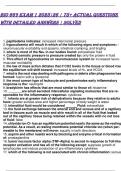
1. papilledema indicates: increased intercranial pressure
2. hypocalcemia will result in which of the following signs and symptoms: -
neuromuscular excitability and spasms, intestinal cramping, and tingling
3. where is most of the Na+ in our bodies found: extracellular fluid
4. Colloid osmotic pressure is pressure created by: only the protein in fluid
5. Thre effect of hypocalcemia on neuromuscular system is: increased neuro-
muscular excitability
6. the law of mass action dictates that if CO2 levels in the tissue or blood rise
the equilibrium will shift toward: increased levels of H+ and HCO3-
7. what is the next step dealing with pathogens or debris after phagosome has
formed: fusion with a lysosome
8. the most comon type of leukocyte and predominates early inflammatory
response is the: neutrophil
9. bradykinin has effects that are most similar to those of: histamine
10. are small secreted intercellular signaling moleucles that are re-
sponsible for the inflammatory response: cytokines
11. infants are at greater risk of dehydrations because they relative to adults
have: greater surface area and higher percentage of body weight is water
12. interstitial fluid would be considered Fluid: extracellular
13. the fluid exchange between the arterial end and venous end of a capillary
bed in tissues such as muscle and skin result in all of the fluid that leaked
out of the capillary tissue being retained within the vessels with no net loss
of fluid: false
14. chloride ion Cl- has an equilibrium potential nearly the same as the resting
potential. As a result, at resting membrane potential chloride ion (when per-
meable to the membrane) will move: equally in both directions
15. aspirin and other nsaids work by blocking and enzyme critical in formation
of: prostaglandins
16. tumor necrosis factor alpha (TNF-Alpha) is secred in response to Toll-like
receptor activation and has all of the following except: suppress growth of
lymphocytes and reduce production of pro-inflammatory cytokines
17. which of the following is not associated with chronic inflammation: serous
1 bn/
8
, exudate
18. what type of exudate is found in early inflammation and is watery: serous
19. hyperkalemia will result in: peaked t waves and early neuromuscular excitabil-
ity
20. of the amount of water found extracellular, how much is found in the
intravascular space: 1/4
2 bn/
8
2. hypocalcemia will result in which of the following signs and symptoms: -
neuromuscular excitability and spasms, intestinal cramping, and tingling
3. where is most of the Na+ in our bodies found: extracellular fluid
4. Colloid osmotic pressure is pressure created by: only the protein in fluid
5. Thre effect of hypocalcemia on neuromuscular system is: increased neuro-
muscular excitability
6. the law of mass action dictates that if CO2 levels in the tissue or blood rise
the equilibrium will shift toward: increased levels of H+ and HCO3-
7. what is the next step dealing with pathogens or debris after phagosome has
formed: fusion with a lysosome
8. the most comon type of leukocyte and predominates early inflammatory
response is the: neutrophil
9. bradykinin has effects that are most similar to those of: histamine
10. are small secreted intercellular signaling moleucles that are re-
sponsible for the inflammatory response: cytokines
11. infants are at greater risk of dehydrations because they relative to adults
have: greater surface area and higher percentage of body weight is water
12. interstitial fluid would be considered Fluid: extracellular
13. the fluid exchange between the arterial end and venous end of a capillary
bed in tissues such as muscle and skin result in all of the fluid that leaked
out of the capillary tissue being retained within the vessels with no net loss
of fluid: false
14. chloride ion Cl- has an equilibrium potential nearly the same as the resting
potential. As a result, at resting membrane potential chloride ion (when per-
meable to the membrane) will move: equally in both directions
15. aspirin and other nsaids work by blocking and enzyme critical in formation
of: prostaglandins
16. tumor necrosis factor alpha (TNF-Alpha) is secred in response to Toll-like
receptor activation and has all of the following except: suppress growth of
lymphocytes and reduce production of pro-inflammatory cytokines
17. which of the following is not associated with chronic inflammation: serous
1 bn/
8
, exudate
18. what type of exudate is found in early inflammation and is watery: serous
19. hyperkalemia will result in: peaked t waves and early neuromuscular excitabil-
ity
20. of the amount of water found extracellular, how much is found in the
intravascular space: 1/4
2 bn/
8