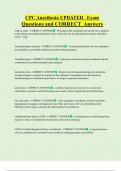
CPC Anesthesia UPDATED Exam
Questions and CORRECT Answers
Add-on codes - CORRECT ANSWER - Procedures that commonly are carried out in addition
to the primary procedure performed. These codes may not be reported alone and are identified
with a + sign.
Anesthesiologist assistant - CORRECT ANSWER - A health professional who has completed
successfully an accredited anesthesia assistant training program.
Anesthesiologist - CORRECT ANSWER - A physician licensed to practice medicine and has
completed an accredited anesthesiology program
Anesthesia time - CORRECT ANSWER - Begins when the anesthesiologist (or anesthesia
provider) begins to prepare the patient for the induction of anesthesia and ends when the
anesthesiologist (or anesthesia provider) is no longer in personal attendance.
arterial line - CORRECT ANSWER - a catheter inserted into an artery. It is used most
commonly to measure real-time blood pressure and to obtain samples for arterial blood gas.
base unit value - CORRECT ANSWER - value assigned to anesthesia codes for anesthetic
management of surgery and diagnostic tests. Base unit values will vary depending on the
difficulty of the surgery, and thus the administration of anesthesia.
cardiopulmonary bypass (CPB) - CORRECT ANSWER - a technique that is used during heart
surgery to take over temporarily the function of the heart and lungs.
CRNA (Certified Registered Nurse Anesthetist) - CORRECT ANSWER - A registered nurse
who has completed an accredited nurse anesthesia training program successfully.
, controlled hypotension - CORRECT ANSWER - a technique used in general anesthesia to
reduce blood pressure to control bleeding during surgery.
conversion factor - CORRECT ANSWER - a unit multiplier to convert anesthesia units into a
dollar amount for anesthesia services. These are reviewed annually by CMS and vary
geographically. May also be negotiated with insurance companies.
central venous catheter - CORRECT ANSWER - a catheter placed in a large vein such as the
internal jugular, subclavian, or femoral vein with the tip of the catheter close to the atrium, or in
the right atrium of the heart.
CVP (Central Venous Pressure) - CORRECT ANSWER - a direct measurement of the blood
pressure in the right atrium and vena cava. CVP reflects the amount of blood returning to the
heart and the ability of the heart to pump the blood from the right heart into the pulmonary
system.
emergency - CORRECT ANSWER - A delay in treatment would lead to significant increase in
the threat to life or body part.
flat fee - CORRECT ANSWER - is based on the physician fee schedule. Payments are made
under the Relative Value Unit, rather than by Conversion Factor. Time is not a consideration for
payment. Examples are arterial lines, CV lines, emergency intubation and Swan Ganz catheter
insertion.
General Anesthesia - CORRECT ANSWER - Drug induced loss of consciousness during
which patients cannot be aroused.
hypothermic circulatory arrest - CORRECT ANSWER - implies a temperature of 20 degrees
centigrade or less.
medical direction - CORRECT ANSWER - occurs when an anesthesiologist is involved in 2,
3, or 4 concurrent anesthesia procedures, or a single anesthesia procedure with a qualified
anesthetist. CMS and other carriers publish criteria that must be met to report medical direction.
Questions and CORRECT Answers
Add-on codes - CORRECT ANSWER - Procedures that commonly are carried out in addition
to the primary procedure performed. These codes may not be reported alone and are identified
with a + sign.
Anesthesiologist assistant - CORRECT ANSWER - A health professional who has completed
successfully an accredited anesthesia assistant training program.
Anesthesiologist - CORRECT ANSWER - A physician licensed to practice medicine and has
completed an accredited anesthesiology program
Anesthesia time - CORRECT ANSWER - Begins when the anesthesiologist (or anesthesia
provider) begins to prepare the patient for the induction of anesthesia and ends when the
anesthesiologist (or anesthesia provider) is no longer in personal attendance.
arterial line - CORRECT ANSWER - a catheter inserted into an artery. It is used most
commonly to measure real-time blood pressure and to obtain samples for arterial blood gas.
base unit value - CORRECT ANSWER - value assigned to anesthesia codes for anesthetic
management of surgery and diagnostic tests. Base unit values will vary depending on the
difficulty of the surgery, and thus the administration of anesthesia.
cardiopulmonary bypass (CPB) - CORRECT ANSWER - a technique that is used during heart
surgery to take over temporarily the function of the heart and lungs.
CRNA (Certified Registered Nurse Anesthetist) - CORRECT ANSWER - A registered nurse
who has completed an accredited nurse anesthesia training program successfully.
, controlled hypotension - CORRECT ANSWER - a technique used in general anesthesia to
reduce blood pressure to control bleeding during surgery.
conversion factor - CORRECT ANSWER - a unit multiplier to convert anesthesia units into a
dollar amount for anesthesia services. These are reviewed annually by CMS and vary
geographically. May also be negotiated with insurance companies.
central venous catheter - CORRECT ANSWER - a catheter placed in a large vein such as the
internal jugular, subclavian, or femoral vein with the tip of the catheter close to the atrium, or in
the right atrium of the heart.
CVP (Central Venous Pressure) - CORRECT ANSWER - a direct measurement of the blood
pressure in the right atrium and vena cava. CVP reflects the amount of blood returning to the
heart and the ability of the heart to pump the blood from the right heart into the pulmonary
system.
emergency - CORRECT ANSWER - A delay in treatment would lead to significant increase in
the threat to life or body part.
flat fee - CORRECT ANSWER - is based on the physician fee schedule. Payments are made
under the Relative Value Unit, rather than by Conversion Factor. Time is not a consideration for
payment. Examples are arterial lines, CV lines, emergency intubation and Swan Ganz catheter
insertion.
General Anesthesia - CORRECT ANSWER - Drug induced loss of consciousness during
which patients cannot be aroused.
hypothermic circulatory arrest - CORRECT ANSWER - implies a temperature of 20 degrees
centigrade or less.
medical direction - CORRECT ANSWER - occurs when an anesthesiologist is involved in 2,
3, or 4 concurrent anesthesia procedures, or a single anesthesia procedure with a qualified
anesthetist. CMS and other carriers publish criteria that must be met to report medical direction.