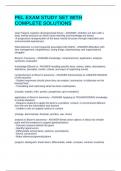
PEL EXAM STUDY SET WITH
COMPLETE SOLUTIONS
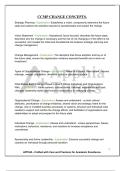
Jean Piaget's cognitive developmental theory - ANSWER--Children are born with a
basic mental structure on which future learning and knowledge are based.
-A progressive reorganization of the basic mental structure through maturation and
environmental experiences.
What behavior is most frequently associated with ADHD - ANSWER-difficulties with
time management, forgetfulness, losing things, daydreaming, and organizational
struggles
Bloom's Taxonomy - ANSWER-knowledge, comprehension, application, analysis,
synthesis, evaluation
Knowledge (Bloom's) - ANSWER-recalling specific facts, names, dates, descriptions,
definitions, principles, trends, criteria, and ways of organizing events
comprehension in Bloom's taxonomy - ANSWER-Demonstrate an UNDERSTANDING
of the facts/text
- Student responses should show they can explain, summarize, or elaborate on the
learned facts
- Translating and rephrasing what has been read/spoken
(classify, explain, infer, predict, paraphrase, give examples)
application in Bloom's taxonomy - ANSWER-Applying or TRANSFERRING knowledge
to actual situations
- Requires students to apply the facts to a problem, context, or environment different
from the one the information was learned
- Unable to rely on original context or content
(change, demonstrate, illustrate, practice, use, show)
analysis in Bloom's taxonomy - ANSWER-Break down objects or ideas into simpler
parts and find evidence to support generalizations
- Discover reasons behind info given
- Identify logical errors
- Differentiate among facts, opinions, assumptions
- Derive conclusions
- Make inferences/generalizations
(support, distinguish, break down, differentiate, relate, compare, contrast, examine)
, synthesis in Bloom's taxonomy - ANSWER-using old concepts to create new ideas,
design and invention, composing, imagining and inferring, modifying, predicting and
combining
evaluation in Bloom's taxonomy - ANSWER-assessing theories, comparison of ideas,
evaluating outcomes, solving, judging, recommending and rating.
kinesthetic learning - ANSWER-a learning style in which the individual learns through
completing physical activity or movement
Most common mental health issue among adolescents? - ANSWER-depression
What can you do to support students with depression? - ANSWER-give specific
supports to function effectively in the school enviornmet. develop classroom support
plans.
Stages of Erikson's Theory of Psychosocial Development - ANSWER--Describes the
impact of social experience across a lifespan.
trust v. mistrust
autonomy v. shame & doubt
initiative v. guilt
industry v. inferiority
identity v. role confusion
intimacy v. isolation
generativity v. stagnation
integrity v. despair
Trust v. Mistrust Stage - ANSWER-0-18 mo.
according to Erikson, the period during which infants develop a sense of trust or
mistrust, largely depending on how well their needs are met by their caregivers
Autonomy v. Shame and Doubt - ANSWER-toddler (18 mo- 2/3yrs) They assert their
sense independence and do things on their own. If restrained or punished too harshly,
they are likely to develop a sense of shame & doubt
Initiative vs. Guilt - ANSWER-3-5 yrs. Erikson's third stage in which the child finds
independence in planning, playing and other activities
Industry vs. Inferiority - ANSWER-6-11yrs. social world expands. begin socially
interacting more. form a strong self-concept
identity vs. role confusion - ANSWER-12-18yrs. teens begin to identify themselves and
may experiment with things.
COMPLETE SOLUTIONS
Jean Piaget's cognitive developmental theory - ANSWER--Children are born with a
basic mental structure on which future learning and knowledge are based.
-A progressive reorganization of the basic mental structure through maturation and
environmental experiences.
What behavior is most frequently associated with ADHD - ANSWER-difficulties with
time management, forgetfulness, losing things, daydreaming, and organizational
struggles
Bloom's Taxonomy - ANSWER-knowledge, comprehension, application, analysis,
synthesis, evaluation
Knowledge (Bloom's) - ANSWER-recalling specific facts, names, dates, descriptions,
definitions, principles, trends, criteria, and ways of organizing events
comprehension in Bloom's taxonomy - ANSWER-Demonstrate an UNDERSTANDING
of the facts/text
- Student responses should show they can explain, summarize, or elaborate on the
learned facts
- Translating and rephrasing what has been read/spoken
(classify, explain, infer, predict, paraphrase, give examples)
application in Bloom's taxonomy - ANSWER-Applying or TRANSFERRING knowledge
to actual situations
- Requires students to apply the facts to a problem, context, or environment different
from the one the information was learned
- Unable to rely on original context or content
(change, demonstrate, illustrate, practice, use, show)
analysis in Bloom's taxonomy - ANSWER-Break down objects or ideas into simpler
parts and find evidence to support generalizations
- Discover reasons behind info given
- Identify logical errors
- Differentiate among facts, opinions, assumptions
- Derive conclusions
- Make inferences/generalizations
(support, distinguish, break down, differentiate, relate, compare, contrast, examine)
, synthesis in Bloom's taxonomy - ANSWER-using old concepts to create new ideas,
design and invention, composing, imagining and inferring, modifying, predicting and
combining
evaluation in Bloom's taxonomy - ANSWER-assessing theories, comparison of ideas,
evaluating outcomes, solving, judging, recommending and rating.
kinesthetic learning - ANSWER-a learning style in which the individual learns through
completing physical activity or movement
Most common mental health issue among adolescents? - ANSWER-depression
What can you do to support students with depression? - ANSWER-give specific
supports to function effectively in the school enviornmet. develop classroom support
plans.
Stages of Erikson's Theory of Psychosocial Development - ANSWER--Describes the
impact of social experience across a lifespan.
trust v. mistrust
autonomy v. shame & doubt
initiative v. guilt
industry v. inferiority
identity v. role confusion
intimacy v. isolation
generativity v. stagnation
integrity v. despair
Trust v. Mistrust Stage - ANSWER-0-18 mo.
according to Erikson, the period during which infants develop a sense of trust or
mistrust, largely depending on how well their needs are met by their caregivers
Autonomy v. Shame and Doubt - ANSWER-toddler (18 mo- 2/3yrs) They assert their
sense independence and do things on their own. If restrained or punished too harshly,
they are likely to develop a sense of shame & doubt
Initiative vs. Guilt - ANSWER-3-5 yrs. Erikson's third stage in which the child finds
independence in planning, playing and other activities
Industry vs. Inferiority - ANSWER-6-11yrs. social world expands. begin socially
interacting more. form a strong self-concept
identity vs. role confusion - ANSWER-12-18yrs. teens begin to identify themselves and
may experiment with things.