TCU Organization Communication Midterm Garner
questions well answered to pass
Chapter One - correct answer ✔✔Chapter One
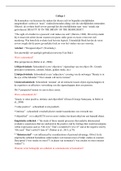
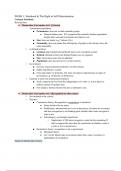
What are the transmission and constitutive perspectives and what are the differences between them? -
correct answer ✔✔Transmission Perspective (Container/Information Perspective): communication
occurs within the organization (OVERLY SIMPLISTIC)
Constitutive Perspective: communication produces the organization or vice versa, communication and
organizations are inseparable (MORE DETAILED)
Know the defining characteristics of organizations. (4) - correct answer ✔✔1) Interdependence:
organizational units are connected to each other
2) Specialization: differentiation of task or division of labor
3) Goal Orientation: toward same general purpose
4) Control Mechanisms:
Understand the 5 types of control and the 5 world-views that Mumby presents. - correct answer ✔✔1)
Simple: ex - Supervisor: "I want you to do this"
2) Technological: ex - using technology to control, such as cameras
3) Beureaucratic: ex - policies / employee manuals
4) Idiological: ex - ideology of good customer service
5) Disciplinary: ex - the employee wants to do best work
Chapter Two - correct answer ✔✔Chapter Two
Why is Marx frustrated with capitalism? - correct answer ✔✔•Argued that workers were alienated from
means of production
•Owners received "surplus labor" from workers - exploitation
, What is the Frankfurt School's critique? For example, why might the Frankfurt School critique modern
media? - correct answer ✔✔• Pushed critique beyond just economics
• Included culture and social life
What is ideology? Know the main points of critical approaches. Understand the process of critique—in
other words, if you are given an ideology or organizational situation, you should be able to apply a
critical lens. - correct answer ✔✔• Ideology: the system of attitudes, beliefs, ideas, perceptions, and
values that shape the reality of people in society
• Main Points of Critical Theory:
1) Organizations are socially constructed through communication
2) Organizations are political sites of power and control
3) Organizations are key sties of identity formation
4) Organizations are sites of collective decision making and democracy
5) Organizations are sites of ethical issues and dilemmas
Chapter Three - correct answer ✔✔Chapter Three
What are rate-busting and systematic soldiering? What was Taylor's solution to these problems? - correct
answer ✔✔Rate-busting: when one worker works more efficiently than others and therefore increase
the standards of output per hour
Systematic soldiering: the deliberate restriction of output by workers
Taylor's solution was his time-motion studies and finding the most efficient ways to complete tasks.
What are time/motion studies? Read Mumby's critique and legacy of scientific management—how has
efficiency become a moral virtue? Why might that be a bad thing? - correct answer ✔✔Time-motion
studies: Taylor's studies that were done to find the best way to do each part of a task, labor was divided
up to deskill the task and workers were timed to maximize their output, later on the Gilbreth's focused
more on motion
questions well answered to pass
Chapter One - correct answer ✔✔Chapter One
What are the transmission and constitutive perspectives and what are the differences between them? -
correct answer ✔✔Transmission Perspective (Container/Information Perspective): communication
occurs within the organization (OVERLY SIMPLISTIC)
Constitutive Perspective: communication produces the organization or vice versa, communication and
organizations are inseparable (MORE DETAILED)
Know the defining characteristics of organizations. (4) - correct answer ✔✔1) Interdependence:
organizational units are connected to each other
2) Specialization: differentiation of task or division of labor
3) Goal Orientation: toward same general purpose
4) Control Mechanisms:
Understand the 5 types of control and the 5 world-views that Mumby presents. - correct answer ✔✔1)
Simple: ex - Supervisor: "I want you to do this"
2) Technological: ex - using technology to control, such as cameras
3) Beureaucratic: ex - policies / employee manuals
4) Idiological: ex - ideology of good customer service
5) Disciplinary: ex - the employee wants to do best work
Chapter Two - correct answer ✔✔Chapter Two
Why is Marx frustrated with capitalism? - correct answer ✔✔•Argued that workers were alienated from
means of production
•Owners received "surplus labor" from workers - exploitation
, What is the Frankfurt School's critique? For example, why might the Frankfurt School critique modern
media? - correct answer ✔✔• Pushed critique beyond just economics
• Included culture and social life
What is ideology? Know the main points of critical approaches. Understand the process of critique—in
other words, if you are given an ideology or organizational situation, you should be able to apply a
critical lens. - correct answer ✔✔• Ideology: the system of attitudes, beliefs, ideas, perceptions, and
values that shape the reality of people in society
• Main Points of Critical Theory:
1) Organizations are socially constructed through communication
2) Organizations are political sites of power and control
3) Organizations are key sties of identity formation
4) Organizations are sites of collective decision making and democracy
5) Organizations are sites of ethical issues and dilemmas
Chapter Three - correct answer ✔✔Chapter Three
What are rate-busting and systematic soldiering? What was Taylor's solution to these problems? - correct
answer ✔✔Rate-busting: when one worker works more efficiently than others and therefore increase
the standards of output per hour
Systematic soldiering: the deliberate restriction of output by workers
Taylor's solution was his time-motion studies and finding the most efficient ways to complete tasks.
What are time/motion studies? Read Mumby's critique and legacy of scientific management—how has
efficiency become a moral virtue? Why might that be a bad thing? - correct answer ✔✔Time-motion
studies: Taylor's studies that were done to find the best way to do each part of a task, labor was divided
up to deskill the task and workers were timed to maximize their output, later on the Gilbreth's focused
more on motion