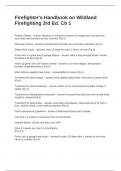
Firefighter's Handbook on Wildland
Firefighting 3rd Ed. Ch 1
Aerobic Fitness - answer Measure of maximum amount of oxygen you can take into
your body and transport to your muscles (Pg 2)
Muscular Fitness - answer Includes both strength and muscular endurance (Pg 2)
Sleep-Work Cycle - answer1 hour of sleep for every 2 hours of work (Pg 3)
Pulse rate is a good way to gauge fatigue - answer After a long enough break, should
be below 110 bpm (Pg 3)
Wake up pulse rate 10% above normal - answer Can mean fatigue, dehydration,
possible impending illness (Pg 3)
Main defense against heat stress - answerability to sweat (Pg 4)
Treatment for heat cramps - answer Drink lightly salted water, fruit juice or sports drink
(Pg 4)
Treatment for heat exhaustion - answer Same as for heat cramps but adds resting in
shade (Pg 4)
Treatment for dehydration exhaustion - answer Increase fluid and rest until normal body
weight is restored (Pg 4)
Treatment for heat stroke - answer Cool body immediately, keep body temp @ 102 or
less, treat for shock, seek medical attention (Pg 4)
Fluid replacement guidelines - answer Caffeinated drinks don't hydrate
Can lose 1-2 quarts of sweat per hour on the fireline
Hydrate before, during, and after your shift
Drink 12 quarts per day if on the fireline
(Pg 3-4)
Pulse rate to gauge heat stress - answerIf under 100 bpm after 1 minute of rest heat
stress is unlikely (Pg 4)
Firefighting 3rd Ed. Ch 1
Aerobic Fitness - answer Measure of maximum amount of oxygen you can take into
your body and transport to your muscles (Pg 2)
Muscular Fitness - answer Includes both strength and muscular endurance (Pg 2)
Sleep-Work Cycle - answer1 hour of sleep for every 2 hours of work (Pg 3)
Pulse rate is a good way to gauge fatigue - answer After a long enough break, should
be below 110 bpm (Pg 3)
Wake up pulse rate 10% above normal - answer Can mean fatigue, dehydration,
possible impending illness (Pg 3)
Main defense against heat stress - answerability to sweat (Pg 4)
Treatment for heat cramps - answer Drink lightly salted water, fruit juice or sports drink
(Pg 4)
Treatment for heat exhaustion - answer Same as for heat cramps but adds resting in
shade (Pg 4)
Treatment for dehydration exhaustion - answer Increase fluid and rest until normal body
weight is restored (Pg 4)
Treatment for heat stroke - answer Cool body immediately, keep body temp @ 102 or
less, treat for shock, seek medical attention (Pg 4)
Fluid replacement guidelines - answer Caffeinated drinks don't hydrate
Can lose 1-2 quarts of sweat per hour on the fireline
Hydrate before, during, and after your shift
Drink 12 quarts per day if on the fireline
(Pg 3-4)
Pulse rate to gauge heat stress - answerIf under 100 bpm after 1 minute of rest heat
stress is unlikely (Pg 4)