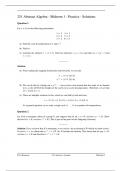
251 Abstract Algebra - Midterm 1 - Practice - Solutions
Question 1
Let σ ∈ S 6 be the following permutation:
1 7→ 3 4 7→ 1
2 7→ 4 5 7→ 6
3 7→ 2 6 7→ 5.
(a) Find the cycle decomposition of σ and σ−1 .
(b) Find |σ|.
(c) Consider the element τ = (1 2 3). Find two elements τ1 , τ2 ∈ S 6 such that |τ1 | = |τ2 | = 2 and
τ = τ1 τ2 .
.........
Solution.
(a) From reading the mapping (backwards and forwards), we see that
σ = (1 3 2 4)(5 6)
σ −1
= (1 4 3 2)(5 6).
(b) We can do this by writing out σ, σ2 , . . . , but we have also learned that the order of an element
in S n is the LCM of the lengths of the cycles in its cycle decomposition. Therefore, we see that
|σ| = lcm(4, 2) = 4.
(c) There are multiple solutions to this, which we can find by trial and error:
τ = (1 2 3) = (1 3)(1 2) = (2 3)(1 3) = (1 2)(2 3).
As a general question: try to write a single cycle (1 . . . k) as a product of transpositions.
Question 2
Let H be a nonempty subset of a group G, and suppose that for all x, y ∈ H, we have xy−1 ∈ H. Show
that for all x ∈ H, we have x−1 ∈ H. (This is part of the proof of the Subgroup Criterion.)
.........
Solution. First, we know that H is nonempty, so we can let x be an element of H (which we know exists).
If we let x = y, we obtain that xx−1 = 1 ∈ H. So, H contains the identity. This means that for any x ∈ H,
we have 1, x ∈ H and therefore 1x−1 = x−1 ∈ H.
Puck Rombach 251 Abstract Algebra Midterm 1
Question 1
Let σ ∈ S 6 be the following permutation:
1 7→ 3 4 7→ 1
2 7→ 4 5 7→ 6
3 7→ 2 6 7→ 5.
(a) Find the cycle decomposition of σ and σ−1 .
(b) Find |σ|.
(c) Consider the element τ = (1 2 3). Find two elements τ1 , τ2 ∈ S 6 such that |τ1 | = |τ2 | = 2 and
τ = τ1 τ2 .
.........
Solution.
(a) From reading the mapping (backwards and forwards), we see that
σ = (1 3 2 4)(5 6)
σ −1
= (1 4 3 2)(5 6).
(b) We can do this by writing out σ, σ2 , . . . , but we have also learned that the order of an element
in S n is the LCM of the lengths of the cycles in its cycle decomposition. Therefore, we see that
|σ| = lcm(4, 2) = 4.
(c) There are multiple solutions to this, which we can find by trial and error:
τ = (1 2 3) = (1 3)(1 2) = (2 3)(1 3) = (1 2)(2 3).
As a general question: try to write a single cycle (1 . . . k) as a product of transpositions.
Question 2
Let H be a nonempty subset of a group G, and suppose that for all x, y ∈ H, we have xy−1 ∈ H. Show
that for all x ∈ H, we have x−1 ∈ H. (This is part of the proof of the Subgroup Criterion.)
.........
Solution. First, we know that H is nonempty, so we can let x be an element of H (which we know exists).
If we let x = y, we obtain that xx−1 = 1 ∈ H. So, H contains the identity. This means that for any x ∈ H,
we have 1, x ∈ H and therefore 1x−1 = x−1 ∈ H.
Puck Rombach 251 Abstract Algebra Midterm 1