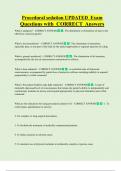
Procedural sedation UPDATED Exam
Questions with CORRECT Answers
What is analgesia? - CORRECT ANSWER - The diminution or elimination of pain in the
otherwise conscious patient
What is local anesthesia? - CORRECT ANSWER - The elimination of sensations,
especially pain, in one part of the body by the topical application or regional injection of a drug
What is general anesthesia? - CORRECT ANSWER - The elimination of all sensation,
accompanied by the loss of consciousness and protective reflexes
What is deep sedation? - CORRECT ANSWER - A controlled state of depressed
consciousness, accompanied by partial loss of protective reflexes including inability to respond
purposefully to verbal command
What is Procedural Sedation (aka light sedation)? - CORRECT ANSWER - A state of
minimally depressed level of consciousness that retains the patient's ability to independently and
continuously maintain an airway and respond appropriately to physical stimulation and verbal
command
What are the indications for using procedural sedation? (5) - CORRECT ANSWER - 1. To
control pain, apprehension or anxiety;
2. For complex or long surgical procedures;
3. To facilitate the treatment of medically compromised patients;
4. To induce amnesia in selected cases;
5. To minimize use of physical restraints in technically complex or precise cases
, What is the biggest risk to using procedural sedation? - CORRECT ANSWER - Loss of
the gag reflex, which can ultimately lead to a blockage of the airway leading to respiratory arrest
What is the best way to avoid the risks associated with procedural sedation? - CORRECT
ANSWER - Carefully titrate drugs to minimally depress a patient's level of consciousness
to control, minimize or eliminate pain
What classifies a Class I pt. for estimating risk for receiving anesthesia & surgery? - CORRECT
ANSWER - Normal healthy patient
What classifies a Class II pt. for estimating risk for receiving anesthesia & surgery? - CORRECT
ANSWER - Patient w/ mild systemic disease includes: Smokers, HTN, Asthmatics
What classifies a Class III pt. for estimating risk for receiving anesthesia & surgery? -
CORRECT ANSWER - Patient w/ severe systemic disease, includes Diabetics
What classifies a Class IV pt. for estimating risk for receiving anesthesia & surgery? -
CORRECT ANSWER - Patient w/ incapacitating disease that is a constant threat to life
What classifies a Class V pt. for estimating risk for receiving anesthesia & surgery? - CORRECT
ANSWER - Morbid patient who is not expected to last 24 hours with or without surgery
What classifies a Class E pt. for estimating risk for receiving anesthesia & surgery? - CORRECT
ANSWER - Emergency Surgery
What is the main difference between a Class I-V risk, and a Class E risk? - CORRECT
ANSWER - The surgeries are planned in Classes I-V, therefore the pt. will most likely
have an empty stomach prior to surgery. Class E pts. are due to Emergencies so the benefit, of
anesthesia and surgery, out-weighs the risk in treating them even if they do not have an empty
stomach prior.
Questions with CORRECT Answers
What is analgesia? - CORRECT ANSWER - The diminution or elimination of pain in the
otherwise conscious patient
What is local anesthesia? - CORRECT ANSWER - The elimination of sensations,
especially pain, in one part of the body by the topical application or regional injection of a drug
What is general anesthesia? - CORRECT ANSWER - The elimination of all sensation,
accompanied by the loss of consciousness and protective reflexes
What is deep sedation? - CORRECT ANSWER - A controlled state of depressed
consciousness, accompanied by partial loss of protective reflexes including inability to respond
purposefully to verbal command
What is Procedural Sedation (aka light sedation)? - CORRECT ANSWER - A state of
minimally depressed level of consciousness that retains the patient's ability to independently and
continuously maintain an airway and respond appropriately to physical stimulation and verbal
command
What are the indications for using procedural sedation? (5) - CORRECT ANSWER - 1. To
control pain, apprehension or anxiety;
2. For complex or long surgical procedures;
3. To facilitate the treatment of medically compromised patients;
4. To induce amnesia in selected cases;
5. To minimize use of physical restraints in technically complex or precise cases
, What is the biggest risk to using procedural sedation? - CORRECT ANSWER - Loss of
the gag reflex, which can ultimately lead to a blockage of the airway leading to respiratory arrest
What is the best way to avoid the risks associated with procedural sedation? - CORRECT
ANSWER - Carefully titrate drugs to minimally depress a patient's level of consciousness
to control, minimize or eliminate pain
What classifies a Class I pt. for estimating risk for receiving anesthesia & surgery? - CORRECT
ANSWER - Normal healthy patient
What classifies a Class II pt. for estimating risk for receiving anesthesia & surgery? - CORRECT
ANSWER - Patient w/ mild systemic disease includes: Smokers, HTN, Asthmatics
What classifies a Class III pt. for estimating risk for receiving anesthesia & surgery? -
CORRECT ANSWER - Patient w/ severe systemic disease, includes Diabetics
What classifies a Class IV pt. for estimating risk for receiving anesthesia & surgery? -
CORRECT ANSWER - Patient w/ incapacitating disease that is a constant threat to life
What classifies a Class V pt. for estimating risk for receiving anesthesia & surgery? - CORRECT
ANSWER - Morbid patient who is not expected to last 24 hours with or without surgery
What classifies a Class E pt. for estimating risk for receiving anesthesia & surgery? - CORRECT
ANSWER - Emergency Surgery
What is the main difference between a Class I-V risk, and a Class E risk? - CORRECT
ANSWER - The surgeries are planned in Classes I-V, therefore the pt. will most likely
have an empty stomach prior to surgery. Class E pts. are due to Emergencies so the benefit, of
anesthesia and surgery, out-weighs the risk in treating them even if they do not have an empty
stomach prior.