Chapter 8 & 9:
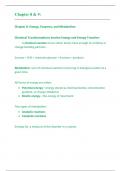
Chapter 8: Energy, Enzymes, and Metabolism
Chemical Transformations Involve Energy and Energy Transfers
A chemical reaction occurs when atoms have enough to combine or
change bonding partners.
Sucrose + H20 = reactants glucose + fructose = products
Metabolism: sum of chemical reactions occurring in biological system at a
given time.
All forms of energy are either:
• Potential energy—energy stored as chemical bonds, concentration
gradient, or charge imbalance
• Kinetic energy—the energy of movement
Two types of metabolism:
• Anabolic reactions
• Catabolic reactions
Entropy (s): a measure of the disorder in a system.
, It takes energy to impose order on a system. Unless energy is applied to a
system, it will be randomly arranged or disordered.
In biological systems:
• Total energy is called enthalpy (H).
• Free energy (G) is the usable energy that can do work.
• Unusable energy is represented by entropy (S) multiplied by the
absolute temperature (T).
H = G + TS
Change in energy can be measured in calories or joules.
Change in free energy of a chemical reaction:
Exergonic reactions release free energy
Endergonic reactions consume free energy.
In principle, chemical reactions are reversible.
Concentrations of A and B determine which direction is favored.
Chemical equilibrium: balance between forward and reverse reactions, a
state of no net change
Section: Enzymes Speed Up Biochemical Transformations
Catalysts increase rates of chemical reactions.
The catalyst is not altered by the reactions.
Most biological catalysts are enzymes (proteins).
2
Chapter 8: Energy, Enzymes, and Metabolism
Chemical Transformations Involve Energy and Energy Transfers
A chemical reaction occurs when atoms have enough to combine or
change bonding partners.
Sucrose + H20 = reactants glucose + fructose = products
Metabolism: sum of chemical reactions occurring in biological system at a
given time.
All forms of energy are either:
• Potential energy—energy stored as chemical bonds, concentration
gradient, or charge imbalance
• Kinetic energy—the energy of movement
Two types of metabolism:
• Anabolic reactions
• Catabolic reactions
Entropy (s): a measure of the disorder in a system.
, It takes energy to impose order on a system. Unless energy is applied to a
system, it will be randomly arranged or disordered.
In biological systems:
• Total energy is called enthalpy (H).
• Free energy (G) is the usable energy that can do work.
• Unusable energy is represented by entropy (S) multiplied by the
absolute temperature (T).
H = G + TS
Change in energy can be measured in calories or joules.
Change in free energy of a chemical reaction:
Exergonic reactions release free energy
Endergonic reactions consume free energy.
In principle, chemical reactions are reversible.
Concentrations of A and B determine which direction is favored.
Chemical equilibrium: balance between forward and reverse reactions, a
state of no net change
Section: Enzymes Speed Up Biochemical Transformations
Catalysts increase rates of chemical reactions.
The catalyst is not altered by the reactions.
Most biological catalysts are enzymes (proteins).
2