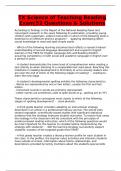
TX Science of Teaching Reading
Exam|52 Questions & Solutions
According to findings in the Report of the National Reading Panel and
convergent research in the years following its publication, providing young
children with systematic, explicit instruction in which of the following skills is
essential to an effective phonics program? - -applying developing letter-
sound knowledge to read and spell simple words
- Which of the following learning outcomes best reflects a research-based
understanding of second-language development and a goal for English
learners in the TEKS for English Language Arts and Reading (ELAR)? - -
acquiring competency in both social and academic language in English over
a period of years
- A student demonstrates the same level of comprehension when reading a
text silently as when listening to a comparable text read aloud. Reaching this
milestone in reading development is first likely to occur among readers who
are near the end of which of the following stages of reading? - -reading-to-
learn-the-new stage
- A student's developmental spelling exhibits the following characteristics.
- Words are represented by one or two letters, usually the first and last
letters.
- Consonant sounds in words are primarily represented.
- Letter names are sometimes used to spell words (e.g., spelling are as "R")
These characteristics correspond most closely to which of the following
stages of spelling development? - -semi-phonetic
- A third grade teacher considers adopting an instructional strategy
described in an article in a professional literacy journal. The article sites
several reputable, scientifically based studies with significant statistical
evidence that the strategy improves student outcomes. To ensure that using
the strategy in the classroom will be consistent with the principles of
evidence-based reading instruction, which of the following questions would
be most important for the teacher to consider before implementing the
strategy with students? - -Will the learning strategy successfully support
students' mastery of the targeted grade-level TEKS?
- A first grade teacher creates a literacy-learner profile for each student in
the class. In the profiles, the teacher notes activities and interests students
have outside of school, information about family relationships, and
descriptions provided by family members about the students special skills
, and personal strengths. The profiles can support an effective literate
environment primarily by: - -identifying assets that the teacher and students
can call upon to meet literacy learning goals.
- According to convergent research as described in the 2018 update to The
Dyslexia Handbook (Texas Education Agency), which of the following
kindergarten students exhibits an early indicator of dyslexia? - -a student
who struggles to learn the most common sounds associated with letters.
- In which line in the table below is the example word accurately matched to
the phonics term that is used to describe phonics element?
Line //// Phonics Term //// Example word
1 /// blend ///cheers
2 /// diagraph /// part
3 /// diphthong /// soap
4 /// trigraph /// match - -Line 4
- A 3rd-grade teacher uses a variety of assessment strategies to monitor
independent reading. EX: administering an oral reading fluency assessment
with a comprehension check to individual students to help determine
independent reading level. The teacher also meets with each student to talk
about their prior reading experiences and interests.
Which of the following questions would be most important for the teacher to
investigate during the reading conferences to better inform selection of
appropriate independent reading materials for each student? - -What are the
student's strengths and gaps in the background knowledge?
- A 3rd-grade teacher uses a variety of assessment strategies to monitor
independent reading. EX: administering an oral reading fluency assessment
with a comprehension check to individual students to help determine
independent reading level. The teacher also meets with each student to talk
about their prior reading experiences and interests.
One student in the class has selected a literacy text for the 3rd-grade range.
During the student's conference with the teacher, the student reads a
representative except from the text with 94% accuracy and 80%
comprehension. In considering these data, the teacher could best conclude
that: - -this text is written at the student's instructional reading level and
should be read with some adult support.
- The most fundamental role of assessment in a standard-based reading
program is to: - -provide a measure of the effectiveness of instruction in
promoting students' progress toward learning goals
Exam|52 Questions & Solutions
According to findings in the Report of the National Reading Panel and
convergent research in the years following its publication, providing young
children with systematic, explicit instruction in which of the following skills is
essential to an effective phonics program? - -applying developing letter-
sound knowledge to read and spell simple words
- Which of the following learning outcomes best reflects a research-based
understanding of second-language development and a goal for English
learners in the TEKS for English Language Arts and Reading (ELAR)? - -
acquiring competency in both social and academic language in English over
a period of years
- A student demonstrates the same level of comprehension when reading a
text silently as when listening to a comparable text read aloud. Reaching this
milestone in reading development is first likely to occur among readers who
are near the end of which of the following stages of reading? - -reading-to-
learn-the-new stage
- A student's developmental spelling exhibits the following characteristics.
- Words are represented by one or two letters, usually the first and last
letters.
- Consonant sounds in words are primarily represented.
- Letter names are sometimes used to spell words (e.g., spelling are as "R")
These characteristics correspond most closely to which of the following
stages of spelling development? - -semi-phonetic
- A third grade teacher considers adopting an instructional strategy
described in an article in a professional literacy journal. The article sites
several reputable, scientifically based studies with significant statistical
evidence that the strategy improves student outcomes. To ensure that using
the strategy in the classroom will be consistent with the principles of
evidence-based reading instruction, which of the following questions would
be most important for the teacher to consider before implementing the
strategy with students? - -Will the learning strategy successfully support
students' mastery of the targeted grade-level TEKS?
- A first grade teacher creates a literacy-learner profile for each student in
the class. In the profiles, the teacher notes activities and interests students
have outside of school, information about family relationships, and
descriptions provided by family members about the students special skills
, and personal strengths. The profiles can support an effective literate
environment primarily by: - -identifying assets that the teacher and students
can call upon to meet literacy learning goals.
- According to convergent research as described in the 2018 update to The
Dyslexia Handbook (Texas Education Agency), which of the following
kindergarten students exhibits an early indicator of dyslexia? - -a student
who struggles to learn the most common sounds associated with letters.
- In which line in the table below is the example word accurately matched to
the phonics term that is used to describe phonics element?
Line //// Phonics Term //// Example word
1 /// blend ///cheers
2 /// diagraph /// part
3 /// diphthong /// soap
4 /// trigraph /// match - -Line 4
- A 3rd-grade teacher uses a variety of assessment strategies to monitor
independent reading. EX: administering an oral reading fluency assessment
with a comprehension check to individual students to help determine
independent reading level. The teacher also meets with each student to talk
about their prior reading experiences and interests.
Which of the following questions would be most important for the teacher to
investigate during the reading conferences to better inform selection of
appropriate independent reading materials for each student? - -What are the
student's strengths and gaps in the background knowledge?
- A 3rd-grade teacher uses a variety of assessment strategies to monitor
independent reading. EX: administering an oral reading fluency assessment
with a comprehension check to individual students to help determine
independent reading level. The teacher also meets with each student to talk
about their prior reading experiences and interests.
One student in the class has selected a literacy text for the 3rd-grade range.
During the student's conference with the teacher, the student reads a
representative except from the text with 94% accuracy and 80%
comprehension. In considering these data, the teacher could best conclude
that: - -this text is written at the student's instructional reading level and
should be read with some adult support.
- The most fundamental role of assessment in a standard-based reading
program is to: - -provide a measure of the effectiveness of instruction in
promoting students' progress toward learning goals