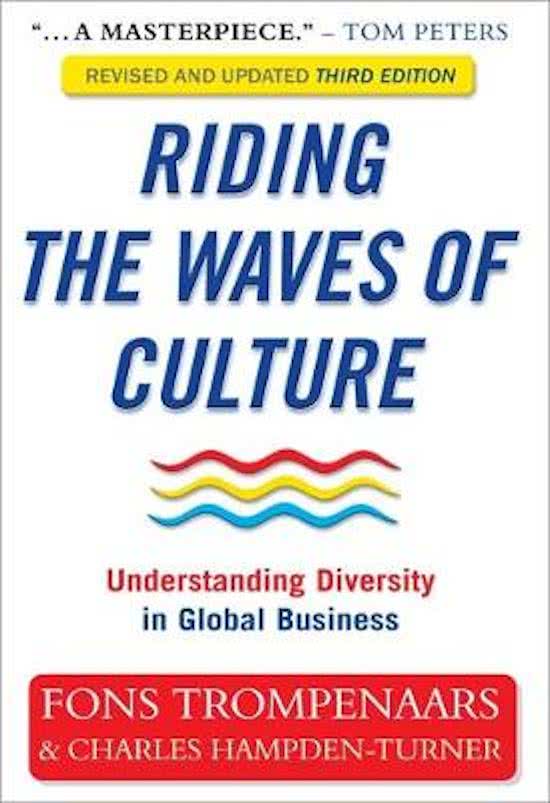
Samenvatting Riding the waves of culture
Chapter 1 An Introduction to Culture
One management technique might not work for a different culture this is all due to culture
differences.
This book focuses on three things;
1. Dispel the notion there is “one best way” of managing and organizing’;
2. Give readers a better understanding of their own culture and cultural differences in
general, by learning how to recognize and cope with these differences in business
context;
3. Provide some cultural insights in to the “global” versus “local” dilemma facing
international organizations.
The main focus lays on understanding your own culture, with our own assumptions and
expectations of it and how people “should” think and act.
The impact of culture on business
Many of the management techniques have to be adjusted in to the culture. The common
management terms (authority, bureaucracy, creativity, accountability, verification etc.) are
terms we all know all over the world, but they do not fit everywhere like you would fit them
in your own culture.
According to their research and theory, internationalization will create a common culture
worldwide. This will make the future for the international business man much easier.
Example McDonald’s; people point to McDonald’s as examples of tastes, markets and
similar cultures everywhere this is correct a lot of the products/services are
worldwide the same.
However: it is not important what they are and where they are located but what
McDonald’s means to people in their own culture. For example; in Moscow dining at
McDonald’s is seen as a status symbol whereas eating in McDonald’s in New York it is
a quick bite for not a lot of money. Here we see a clear culture difference
A growing dilemma under the international mangers is Glocalization; this is a mixture of two
words Global and Local. Managers need to find the balance between consistency (Global)
and adaptation (Local). You constantly face people from different nationalities that you need
to work with.
Paralysis through Analysis; The elixir of the management profession
Peters and Waterman criticized the rational model. Western analytical thinking (analysing all
options) and rationality (reckoning the consequences before you act) have led to many
international successes in the field of technology. Has led to many success stories within the
international field of technology.
However this can become a form of an handicap when applied to human relations. Switching
between these two states is difficult.
Ex; Japan are an example with this field, they are able to use a logic appropriate to machines
ánd a logical more appropriate to social relations. When in Rome, understand the behaviour
of Rome to become more Japanese.
1
,Samenvatting Riding the waves of culture
The internationalization of business requires more insight into the different cultural patterns.
Pay-for-performance, for example, is not useful in all cultures.
Pay- for- performance; being paid higher if you work better.
How proven formulas can give the wrong result
It is more important to know what hierarchy means to the Dutch people than asking how
many hierarchical levels the company they work for has.
Culture is the way which people solve problems
Culture: the way in which a group of people solves problems and reconciles dilemmas.
Culture can be seen as an onion with a variety of layers. To find the core of once culture you
need to peel it layer by layer (onion model). The outer layer consists of culture products,
these are things that directly caught your attention. Then comes the layer of norms and
values, they are deeper layers and therefore harder to identify.
National, Corporate, and Professional culture
There are three types of culture;
1. National culture
2. Corporate culture
3. Profession culture
The basis of cultural differences
There are three types of cultural dilemmas;
1. Dilemma’s that arise from our relationship with other people;
2. Dilemma’s that arise from the passage of time;
3. Dilemma’s that relate to the environment.
From the solutions that different cultures within these three categories have choses we can
identify seven fundamental dimensions of culture.
Human relations;
1. Universalism versus particularism; universalists judge people as admirable if they
keep to standards and rules agreed on in their culture. This is a rule-based society.
Rules are for everyone and under all circumstances, no exceptions. Particularist
judge people according to the relationships they have. Are they your friends or is she
your sister? Is he important to you? Then you have an obligation to keep and protect
the person even if rules and regulations say you should not.
2. Individualism versus communitarianism; Trompenaars states that this is the conflict
between what each one of us wants as an individual and the interests of the group
we belong to. With individualism being a prime orientation to the self and
communitarianism as a prime orientation to common goals and objectives.
3. Neutral versus affective; in neutral cultures you do not communicate your emotions,
but control them. In fact, if you do show your emotions by accident, you would feel
compelled to apologize or dash out of the room. In affective cultures it is normal to
communicate your emotions and to receive an emotionally sensitive response in
return.
2
, Samenvatting Riding the waves of culture
4. Specific and diffuse; in specific oriented cultures you deal with other people in
specific areas of your life and single levels of personality. You separate the task-
relation you have with someone, and isolate it from other dealings with him or her.
In diffuse cultures you deal with other people diffusely; in multiple areas of your life
and at several levels at the same time.
5. Achieved versus ascribed; achieved status is the high status you gain from what you
have accomplished. Ascribed status is the high status you gain because of whom or
what you are associated with (age, gender, social class).
Chapter 2 The one best way of organizing
Culture is a shared system of meanings. It dictates what we pay attention to, how we act,
and what we value.
Geert Hofstede mental programs; the behaviour of people within organizations. Each of
us carries within us the ways we have learned about organizing our experience to mean
something.
Culture cannot be seen as a side dish or a luxury item. Culture can be found throughout the
whole organisation. With his own patterns and meanings on different aspects.
Chapter 3 The meaning of culture
What one culture may regard as essential a certain level of material wealth, for example—
may not be so vital to other cultures.
What is the meaning of the world culture; shared believes within the group and have the
same meanings. (shared system of meanings to avoid conflict)
A basic assumption are obvious things, respect, honesty things that are taken for granted,
privacy, freedom. From these assumption raise values.
The Concept of Culture
Social interaction, or meaningful communication, presupposes common ways of processing
information among the people interacting. These presuppositions have consequences for
doing business as well as managing across cultural boundaries.
Even “at home,” managers are faced with an increasingly diverse and multicultural
workforce. The mutual dependence of the actors is due to the fact that together they
constitute a connected system of meanings: a shared definition of a situation by a group.
An absolute condition for meaningful interaction in business and management is the
existence of mutual expectations.
Example page 28 the guy in the Burberry coat that is in fact an homeless person. Appearance
may not always be right. Expectations occur on many different levels, from concrete, explicit
levels to implicit and subconscious ones.
3
Chapter 1 An Introduction to Culture
One management technique might not work for a different culture this is all due to culture
differences.
This book focuses on three things;
1. Dispel the notion there is “one best way” of managing and organizing’;
2. Give readers a better understanding of their own culture and cultural differences in
general, by learning how to recognize and cope with these differences in business
context;
3. Provide some cultural insights in to the “global” versus “local” dilemma facing
international organizations.
The main focus lays on understanding your own culture, with our own assumptions and
expectations of it and how people “should” think and act.
The impact of culture on business
Many of the management techniques have to be adjusted in to the culture. The common
management terms (authority, bureaucracy, creativity, accountability, verification etc.) are
terms we all know all over the world, but they do not fit everywhere like you would fit them
in your own culture.
According to their research and theory, internationalization will create a common culture
worldwide. This will make the future for the international business man much easier.
Example McDonald’s; people point to McDonald’s as examples of tastes, markets and
similar cultures everywhere this is correct a lot of the products/services are
worldwide the same.
However: it is not important what they are and where they are located but what
McDonald’s means to people in their own culture. For example; in Moscow dining at
McDonald’s is seen as a status symbol whereas eating in McDonald’s in New York it is
a quick bite for not a lot of money. Here we see a clear culture difference
A growing dilemma under the international mangers is Glocalization; this is a mixture of two
words Global and Local. Managers need to find the balance between consistency (Global)
and adaptation (Local). You constantly face people from different nationalities that you need
to work with.
Paralysis through Analysis; The elixir of the management profession
Peters and Waterman criticized the rational model. Western analytical thinking (analysing all
options) and rationality (reckoning the consequences before you act) have led to many
international successes in the field of technology. Has led to many success stories within the
international field of technology.
However this can become a form of an handicap when applied to human relations. Switching
between these two states is difficult.
Ex; Japan are an example with this field, they are able to use a logic appropriate to machines
ánd a logical more appropriate to social relations. When in Rome, understand the behaviour
of Rome to become more Japanese.
1
,Samenvatting Riding the waves of culture
The internationalization of business requires more insight into the different cultural patterns.
Pay-for-performance, for example, is not useful in all cultures.
Pay- for- performance; being paid higher if you work better.
How proven formulas can give the wrong result
It is more important to know what hierarchy means to the Dutch people than asking how
many hierarchical levels the company they work for has.
Culture is the way which people solve problems
Culture: the way in which a group of people solves problems and reconciles dilemmas.
Culture can be seen as an onion with a variety of layers. To find the core of once culture you
need to peel it layer by layer (onion model). The outer layer consists of culture products,
these are things that directly caught your attention. Then comes the layer of norms and
values, they are deeper layers and therefore harder to identify.
National, Corporate, and Professional culture
There are three types of culture;
1. National culture
2. Corporate culture
3. Profession culture
The basis of cultural differences
There are three types of cultural dilemmas;
1. Dilemma’s that arise from our relationship with other people;
2. Dilemma’s that arise from the passage of time;
3. Dilemma’s that relate to the environment.
From the solutions that different cultures within these three categories have choses we can
identify seven fundamental dimensions of culture.
Human relations;
1. Universalism versus particularism; universalists judge people as admirable if they
keep to standards and rules agreed on in their culture. This is a rule-based society.
Rules are for everyone and under all circumstances, no exceptions. Particularist
judge people according to the relationships they have. Are they your friends or is she
your sister? Is he important to you? Then you have an obligation to keep and protect
the person even if rules and regulations say you should not.
2. Individualism versus communitarianism; Trompenaars states that this is the conflict
between what each one of us wants as an individual and the interests of the group
we belong to. With individualism being a prime orientation to the self and
communitarianism as a prime orientation to common goals and objectives.
3. Neutral versus affective; in neutral cultures you do not communicate your emotions,
but control them. In fact, if you do show your emotions by accident, you would feel
compelled to apologize or dash out of the room. In affective cultures it is normal to
communicate your emotions and to receive an emotionally sensitive response in
return.
2
, Samenvatting Riding the waves of culture
4. Specific and diffuse; in specific oriented cultures you deal with other people in
specific areas of your life and single levels of personality. You separate the task-
relation you have with someone, and isolate it from other dealings with him or her.
In diffuse cultures you deal with other people diffusely; in multiple areas of your life
and at several levels at the same time.
5. Achieved versus ascribed; achieved status is the high status you gain from what you
have accomplished. Ascribed status is the high status you gain because of whom or
what you are associated with (age, gender, social class).
Chapter 2 The one best way of organizing
Culture is a shared system of meanings. It dictates what we pay attention to, how we act,
and what we value.
Geert Hofstede mental programs; the behaviour of people within organizations. Each of
us carries within us the ways we have learned about organizing our experience to mean
something.
Culture cannot be seen as a side dish or a luxury item. Culture can be found throughout the
whole organisation. With his own patterns and meanings on different aspects.
Chapter 3 The meaning of culture
What one culture may regard as essential a certain level of material wealth, for example—
may not be so vital to other cultures.
What is the meaning of the world culture; shared believes within the group and have the
same meanings. (shared system of meanings to avoid conflict)
A basic assumption are obvious things, respect, honesty things that are taken for granted,
privacy, freedom. From these assumption raise values.
The Concept of Culture
Social interaction, or meaningful communication, presupposes common ways of processing
information among the people interacting. These presuppositions have consequences for
doing business as well as managing across cultural boundaries.
Even “at home,” managers are faced with an increasingly diverse and multicultural
workforce. The mutual dependence of the actors is due to the fact that together they
constitute a connected system of meanings: a shared definition of a situation by a group.
An absolute condition for meaningful interaction in business and management is the
existence of mutual expectations.
Example page 28 the guy in the Burberry coat that is in fact an homeless person. Appearance
may not always be right. Expectations occur on many different levels, from concrete, explicit
levels to implicit and subconscious ones.
3