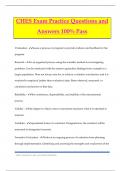
CHES Exam Practice Questions and
Answers 100% Pass
Evaluation - ✔✔assess a process or program to provide evidence and feedback for the
program.
Research - ✔✔is an organized process using the scientific method for investigating
problems. Can be conducted with the intent to generalize findings from a sample to a
larger population. Does not always aim for, or achieve, evaluative conclusions, and it is
restricted to empirical (rather than evaluative) data. Bases observed, measured, or
calculated conclusions on that data.
Reliability - ✔✔the consistency, dependability, and stability of the measurement
process.
Validity - ✔✔the degree to which a test or assessment measures what it is intended to
measure.
Variables - ✔✔operational forms of a construct. Designate how the construct will be
measured in designated scenarios.
Formative Evaluation - ✔✔looks at an ongoing process of evaluation from planning
through implementation. Identifying and assessing the strengths and weaknesses of the
EMILY CHARLENE © 2025, ALL RIGHTS RESERVED 1
,way a health educator implements a program. Allows for continual assessment; allows
for monitoring progress, troubleshooting, and corrective actions.
Process Evaluation - ✔✔any combination of measures that occur as a program is
implemented to assure or improve the quality of performance or delivery
Summative Evaluation - ✔✔often associated with measures of judgments that enable
the investigator to draw conclusions. It is also commonly associated with impact and
outcome evaluations. Focuses on the outcomes or products
Impact Evaluations - ✔✔focuses on immediate and observable effects of a program
leading to the desired outcomes.
Outcome Evaluation - ✔✔focused on the ultimate goal, product or policy. Often
measured in terms of morbidity and mortality.
Purpose Statement - ✔✔identifies in detail what the health education specialist wants to
learn over the course of an evaluation or research project. Usually a sentence or two
written with specificity and detail. Helps to focus and guide efforts involved with data
collection and analysis.
Evaluation Questions - ✔✔specifically developed questions. Help to establish
boundaries for the evaluation by stating what aspects of the program will be addressed.
Creating encourages stakeholders to reveal what they believe the evaluation should
answer. Use to monitor and measure processes, activities, outputs and expected
outcomes.
EMILY CHARLENE © 2025, ALL RIGHTS RESERVED 2
,Search Strategies - ✔✔typically require health education specialists to:
identify key search terms
identify a period of time to conduct the search
characteristics of the target population
health conditions of interest.
Systematic Reviews - ✔✔a published qualitative review of a comprehensive synthesis of
publications on particular topics.
Meta-analyses - ✔✔a systematic method of evaluating statistical data based on results
of several independent studies of the same problem.
Pooled analyses - ✔✔a method for collecting all the individual data from a group of
studies, combining them into one large set of data, and then analyzing the data as it
came from one big study.
Quantitative Methodology - ✔✔focuses on quantifying, or measuring, things related to
health education programs through the use of numerical data to help describe, explain,
or predict phenomena.
Qualitative Methodology - ✔✔descriptive in nature and attempts to discover meaning
or interpret why phenomena are occurring.
EMILY CHARLENE © 2025, ALL RIGHTS RESERVED 3
, Mixed Methods Approach - ✔✔data collection to "tell the story" and describe
classifications, as well as to indicate why a phenomenon is occurring within a
population
Health and Psychosocial Instruments (HaPI) database - ✔✔help health education
specialists identify useful existing data collection instruments. Database collects rating
scales, questionnaires, checklists, tests, interview schedules, and coding
schemes/manuals for health and social sciences. Health and psychosocial instruments
in this database are used and/or published in literature and often recognize reliability
and validity concerns. Used for assessment and/or evaluation purposes.
Logic Model - ✔✔used in evaluation to assist in describing key aspects of programs in
terms of a simple flow chart.
Inputs - ✔✔resources, contributions, and other investments that go into a program.
Human, fiscal, physical, and intellectual resources needed to address the objectives of a
program.
Outputs - ✔✔the activities, services, and products that will reach the participants of a
program. Activities, products and services that will influence short-term outcomes.
Outcomes - ✔✔are often depicted as short-term, intermediate, or long-term.
Short-term Outcomes - ✔✔often described as quantifiable changes in knowledge, skills
or access to resources that happen if planned activities are successfully carried out.
Changes in knowledge or skills among participants of the program.
EMILY CHARLENE © 2025, ALL RIGHTS RESERVED 4
Answers 100% Pass
Evaluation - ✔✔assess a process or program to provide evidence and feedback for the
program.
Research - ✔✔is an organized process using the scientific method for investigating
problems. Can be conducted with the intent to generalize findings from a sample to a
larger population. Does not always aim for, or achieve, evaluative conclusions, and it is
restricted to empirical (rather than evaluative) data. Bases observed, measured, or
calculated conclusions on that data.
Reliability - ✔✔the consistency, dependability, and stability of the measurement
process.
Validity - ✔✔the degree to which a test or assessment measures what it is intended to
measure.
Variables - ✔✔operational forms of a construct. Designate how the construct will be
measured in designated scenarios.
Formative Evaluation - ✔✔looks at an ongoing process of evaluation from planning
through implementation. Identifying and assessing the strengths and weaknesses of the
EMILY CHARLENE © 2025, ALL RIGHTS RESERVED 1
,way a health educator implements a program. Allows for continual assessment; allows
for monitoring progress, troubleshooting, and corrective actions.
Process Evaluation - ✔✔any combination of measures that occur as a program is
implemented to assure or improve the quality of performance or delivery
Summative Evaluation - ✔✔often associated with measures of judgments that enable
the investigator to draw conclusions. It is also commonly associated with impact and
outcome evaluations. Focuses on the outcomes or products
Impact Evaluations - ✔✔focuses on immediate and observable effects of a program
leading to the desired outcomes.
Outcome Evaluation - ✔✔focused on the ultimate goal, product or policy. Often
measured in terms of morbidity and mortality.
Purpose Statement - ✔✔identifies in detail what the health education specialist wants to
learn over the course of an evaluation or research project. Usually a sentence or two
written with specificity and detail. Helps to focus and guide efforts involved with data
collection and analysis.
Evaluation Questions - ✔✔specifically developed questions. Help to establish
boundaries for the evaluation by stating what aspects of the program will be addressed.
Creating encourages stakeholders to reveal what they believe the evaluation should
answer. Use to monitor and measure processes, activities, outputs and expected
outcomes.
EMILY CHARLENE © 2025, ALL RIGHTS RESERVED 2
,Search Strategies - ✔✔typically require health education specialists to:
identify key search terms
identify a period of time to conduct the search
characteristics of the target population
health conditions of interest.
Systematic Reviews - ✔✔a published qualitative review of a comprehensive synthesis of
publications on particular topics.
Meta-analyses - ✔✔a systematic method of evaluating statistical data based on results
of several independent studies of the same problem.
Pooled analyses - ✔✔a method for collecting all the individual data from a group of
studies, combining them into one large set of data, and then analyzing the data as it
came from one big study.
Quantitative Methodology - ✔✔focuses on quantifying, or measuring, things related to
health education programs through the use of numerical data to help describe, explain,
or predict phenomena.
Qualitative Methodology - ✔✔descriptive in nature and attempts to discover meaning
or interpret why phenomena are occurring.
EMILY CHARLENE © 2025, ALL RIGHTS RESERVED 3
, Mixed Methods Approach - ✔✔data collection to "tell the story" and describe
classifications, as well as to indicate why a phenomenon is occurring within a
population
Health and Psychosocial Instruments (HaPI) database - ✔✔help health education
specialists identify useful existing data collection instruments. Database collects rating
scales, questionnaires, checklists, tests, interview schedules, and coding
schemes/manuals for health and social sciences. Health and psychosocial instruments
in this database are used and/or published in literature and often recognize reliability
and validity concerns. Used for assessment and/or evaluation purposes.
Logic Model - ✔✔used in evaluation to assist in describing key aspects of programs in
terms of a simple flow chart.
Inputs - ✔✔resources, contributions, and other investments that go into a program.
Human, fiscal, physical, and intellectual resources needed to address the objectives of a
program.
Outputs - ✔✔the activities, services, and products that will reach the participants of a
program. Activities, products and services that will influence short-term outcomes.
Outcomes - ✔✔are often depicted as short-term, intermediate, or long-term.
Short-term Outcomes - ✔✔often described as quantifiable changes in knowledge, skills
or access to resources that happen if planned activities are successfully carried out.
Changes in knowledge or skills among participants of the program.
EMILY CHARLENE © 2025, ALL RIGHTS RESERVED 4